
Two Retirees. Two Different Choices. One Very Different Experience.
When David retired at 65, his financial advisor gave him a simple recommendation.
“If you can comfortably afford the premiums, buy Medigap.”
David wasn’t thrilled about paying more every month.
But he liked one thing.
Predictability.
He wanted to know that if he became seriously ill, his healthcare costs wouldn’t suddenly explode.
So he chose Original Medicare with a Medigap policy.
His friend Michael retired the same year.
He made a different decision.
A television commercial promised low premiums, extra benefits, dental coverage, vision care, and even a gym membership.
It sounded like an easy choice.
He enrolled in a Medicare Advantage plan.
For the first few years, both men felt they had made the right decision.
David paid more every month.
Michael paid much less.
Then life changed.
David developed heart disease.
Michael needed multiple specialist visits and eventually knee replacement surgery.
Suddenly, the decision they made years earlier mattered far more than the monthly premium they had focused on.
That’s the challenge with choosing Medicare coverage.
You’re not buying insurance for the person you are today.
You’re buying protection for the person you might become ten or twenty years from now.
The Most Common Medicare Mistake
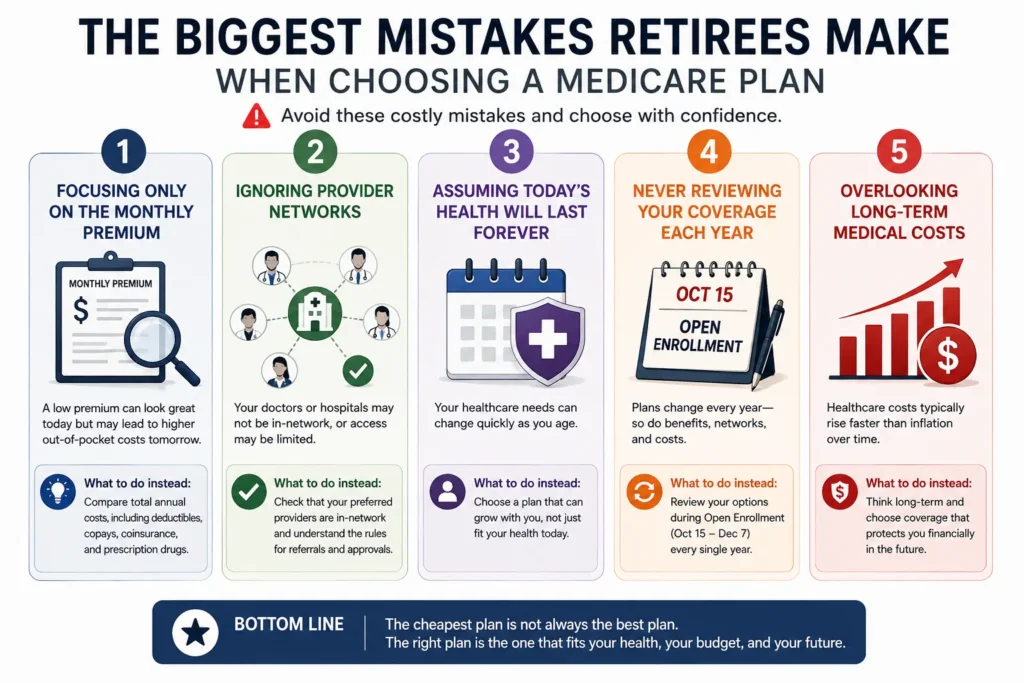
Ask most retirees why they chose a healthcare plan, and you’ll often hear the same answer.
“It had the lowest premium.”
That answer is understandable.
But it may also be incomplete.
Healthcare isn’t like buying a streaming subscription.
The cheapest option isn’t necessarily the least expensive over time.
Instead of asking,
“Which plan costs less today?”
Ask,
“Which plan is likely to protect me better throughout retirement?”
That single question changes the entire decision.
Two Different Ways to Receive Medicare
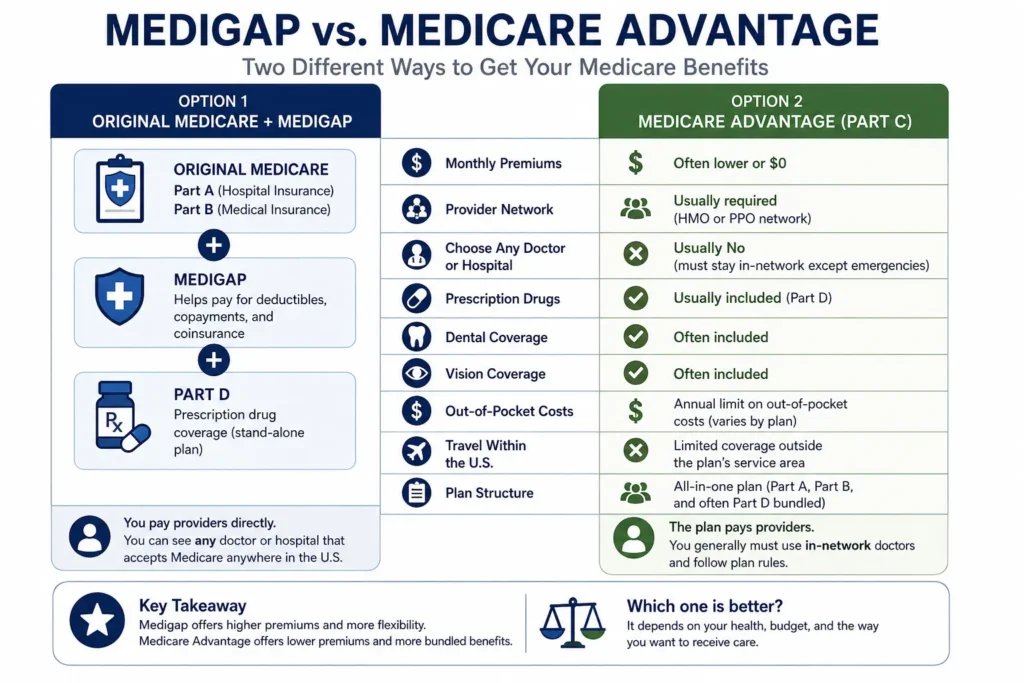
Many retirees think Medigap and Medicare Advantage are competing insurance companies.
They’re not.
They’re two completely different ways of receiving Medicare benefits.
Understanding this distinction is the first step toward making a smarter decision.
Option One: Original Medicare + Medigap
Original Medicare consists primarily of Part A and Part B.
Many retirees then purchase a Medigap policy from a private insurer to help cover deductibles, coinsurance, and other out-of-pocket expenses.
Most also enroll in a separate Part D prescription drug plan.
The result is often:
- Higher monthly premiums
- Lower surprise medical bills
- Greater flexibility when choosing doctors and hospitals
- No need to stay within many provider networks
For retirees who value predictability, this combination can provide considerable peace of mind.
Option Two: Medicare Advantage
Medicare Advantage plans are offered by private insurance companies approved by Medicare.
Instead of combining Original Medicare, Medigap, and Part D separately, many Advantage plans bundle these benefits into a single package.
They often advertise:
- Lower monthly premiums
- Prescription drug coverage
- Dental benefits
- Vision benefits
- Hearing benefits
- Fitness programs
These extra benefits explain why Medicare Advantage has become increasingly popular.
But lower premiums tell only part of the story.
Every Advantage plan has its own provider networks, referral requirements, prior authorization rules, and annual out-of-pocket limits.
Understanding those details matters far more than the marketing brochure.
The Question Isn’t “Which Is Better?”
This is where many retirement articles go wrong.
They try to declare one winner.
Reality is more complicated.
Neither Medigap nor Medicare Advantage is universally better.
Each is designed for a different type of retiree.
The right question isn’t,
“Which plan is best?”
It’s,
“Which plan fits the way I expect to use healthcare during retirement?”
That shift in thinking is the foundation of a smarter retirement decision.
Comparing the Trade-Offs
Think of the choice this way.
Medigap asks you to pay more upfront in exchange for greater predictability later.
Medicare Advantage asks you to pay less upfront while accepting more variability in how you receive care and what you may pay when significant medical needs arise.
Neither approach is inherently right or wrong.
Your health, finances, lifestyle, travel habits, and tolerance for uncertainty all play a role.
The best plan isn’t the one with the lowest premium.
It’s the one you’ll still be comfortable with when life doesn’t go according to plan.
Real-Life Comparison: Three Different Retirees
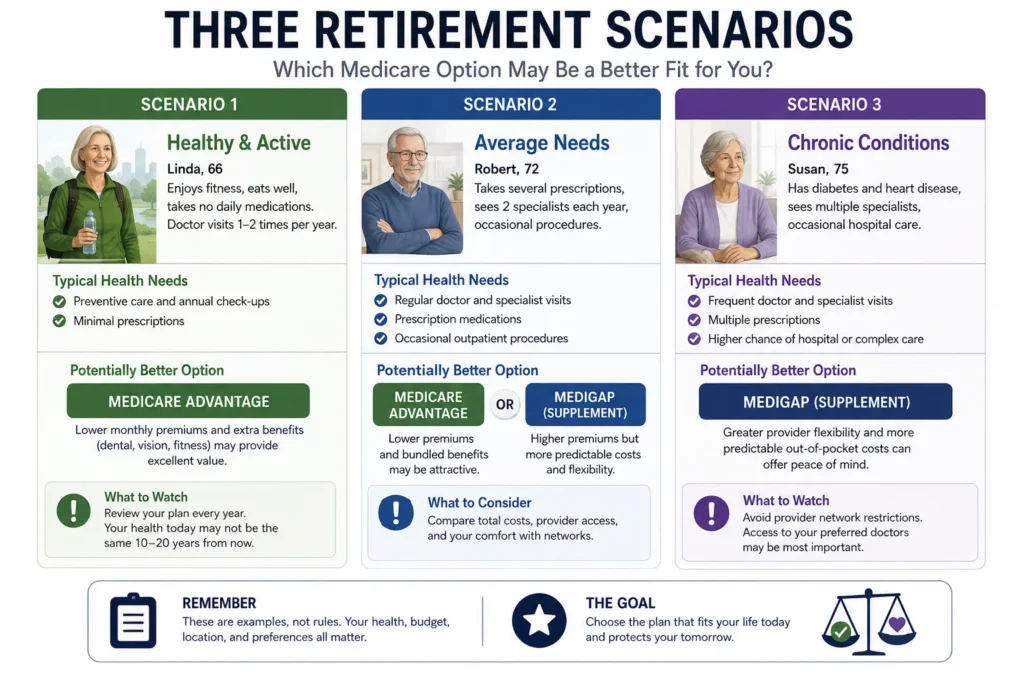
The easiest way to compare these two options is to stop thinking about insurance plans and start thinking about people.
Imagine three retirees.
Each has a different health profile.
Each may reach a different conclusion.
Scenario 1: Healthy and Active
Linda is 66.
She exercises regularly, takes no daily medications, and visits her primary care physician once or twice each year.
She wants to keep her monthly expenses as low as possible.
For someone like Linda, a Medicare Advantage plan may provide excellent value.
Lower premiums and additional benefits such as dental, vision, or fitness programs may outweigh the possibility of higher medical costs later.
But she should still review her plan every year.
Healthy today doesn’t necessarily mean healthy ten years from now.
Scenario 2: Average Healthcare Needs
Robert is 72.
He takes several prescriptions, sees two specialists every year, and occasionally needs outpatient procedures.
His healthcare costs are relatively predictable.
For retirees like Robert, the decision becomes less obvious.
Some will value the lower monthly cost of Medicare Advantage.
Others will gladly pay higher Medigap premiums to reduce unexpected bills and gain broader access to physicians.
At this point, personal preference often matters as much as mathematics.
Scenario 3: Chronic Medical Conditions
Susan is 75.
She has diabetes, heart disease, and frequent specialist appointments.
She occasionally travels to receive treatment at nationally recognized medical centers.
For retirees with significant ongoing healthcare needs, predictability often becomes more valuable than low premiums.
Many people in this situation appreciate the flexibility of Original Medicare combined with Medigap, particularly when they want broader provider access and fewer concerns about networks or prior authorization requirements.
The Decision Framework
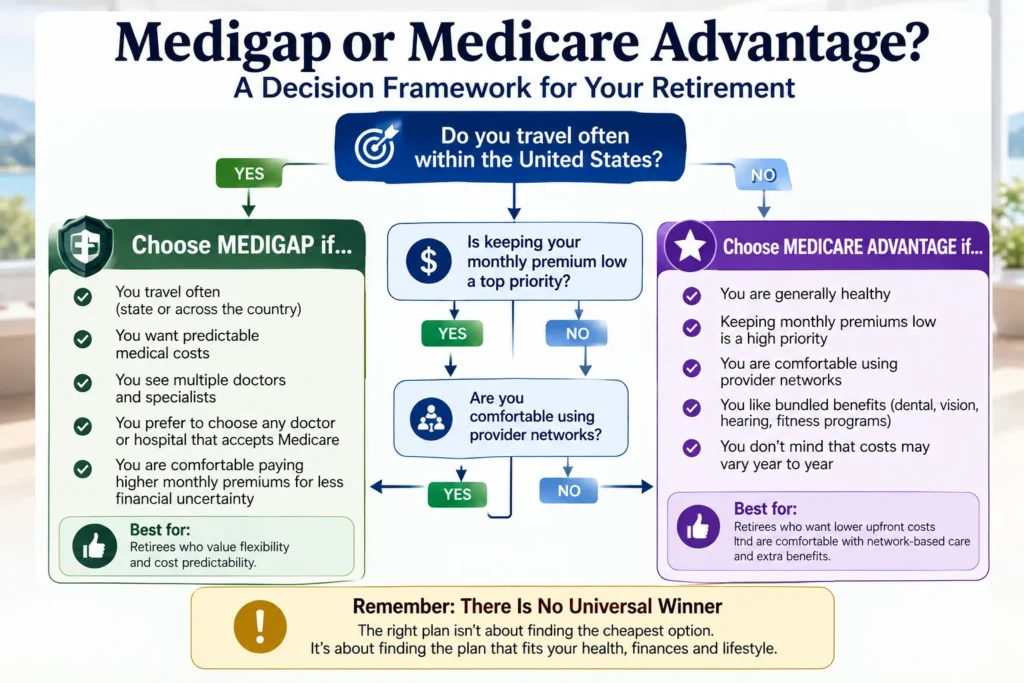
Instead of asking,
“Which plan is cheaper?”
Ask these questions.
Medigap may be a better fit if…
- You want predictable medical expenses.
- You expect frequent doctor visits.
- You travel often within the United States.
- You prefer maximum flexibility when choosing physicians and hospitals.
- You are comfortable paying higher monthly premiums in exchange for lower financial uncertainty.
Medicare Advantage may be a better fit if…
- You are generally healthy.
- Keeping monthly premiums low is a high priority.
- You are comfortable using provider networks.
- You appreciate bundled benefits such as dental, vision, or fitness programs.
- You understand that out-of-pocket costs may vary from year to year.
Questions to Ask Before You Choose
Before enrolling in either plan, answer these questions honestly.
- How important is keeping my monthly budget predictable?
- Am I willing to pay more every month for greater financial certainty?
- Do I regularly travel or spend part of the year in another state?
- Are my preferred doctors and hospitals included in this plan?
- Could my healthcare needs look very different ten years from now?
Your answers matter more than anyone else’s recommendation.
The Biggest Mistakes Retirees Make
Many Medicare decisions become expensive because retirees focus on the wrong numbers.
Common mistakes include:
- Choosing a plan based only on the monthly premium.
- Ignoring provider networks.
- Assuming today’s health will continue forever.
- Never reviewing coverage during Open Enrollment.
- Believing the most popular plan must be the best plan.
Healthcare decisions should be based on your future, not someone else’s present.
Frequently Asked Questions
Can I switch plans later?
In many situations, yes.
However, switching rules and eligibility can depend on timing and personal circumstances, making annual reviews especially important.
Which option has lower monthly premiums?
Medicare Advantage plans often have lower monthly premiums, but total annual healthcare costs can vary depending on the care you receive.
Which plan offers more provider flexibility?
Original Medicare combined with Medigap generally offers broader flexibility because many providers nationwide accept Original Medicare.
Is Medicare Advantage a bad choice?
Not at all.
For many healthy retirees, it can be an excellent option.
The key is making sure the plan matches your healthcare needs and financial priorities.
Should I make this decision once and never revisit it?
No.
Healthcare needs change over time.
Reviewing your coverage each year is one of the simplest ways to avoid costly surprises.
Final Thoughts
The most expensive Medicare decision isn’t choosing the “wrong” plan.
It’s choosing a plan without understanding why it fits—or doesn’t fit—your life.
Healthcare is deeply personal.
So is retirement.
The best choice is rarely the one someone else recommends.
It’s the one that still makes sense when your health, your finances, and your priorities inevitably change.
Retirement isn’t about predicting the future perfectly.
It’s about giving your future self better options.
Retirement Playbook
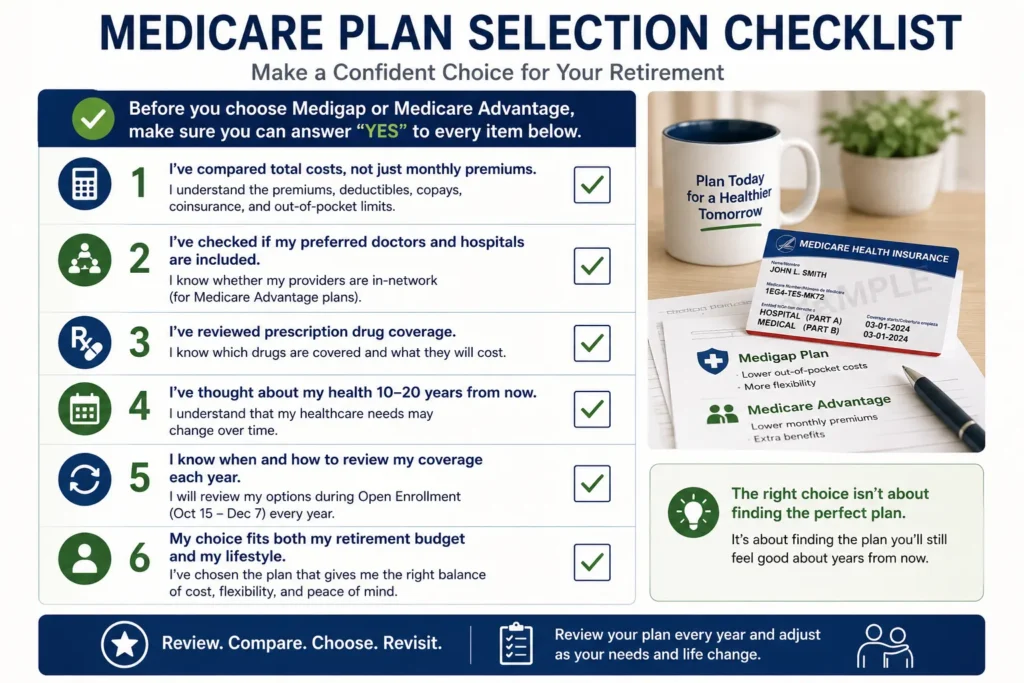
Before choosing your Medicare coverage, make sure you can answer “yes” to these questions.
☐ I understand the difference between Medigap and Medicare Advantage.
☐ I’ve compared total costs—not just monthly premiums.
☐ I’ve checked whether my preferred doctors and hospitals are included.
☐ I’ve considered how my healthcare needs may change over the next 10–20 years.
☐ I know when and how to review my coverage during Open Enrollment.
☐ My choice fits both my retirement budget and my lifestyle.
The right Medicare decision isn’t about finding the perfect plan.
It’s about finding the plan you’ll still feel confident about years from now.
Coming Next
Long-Term Care Insurance: Do You Really Need It in Retirement?