Long-Term Care Insurance: Do You Really Need It in Retirement?
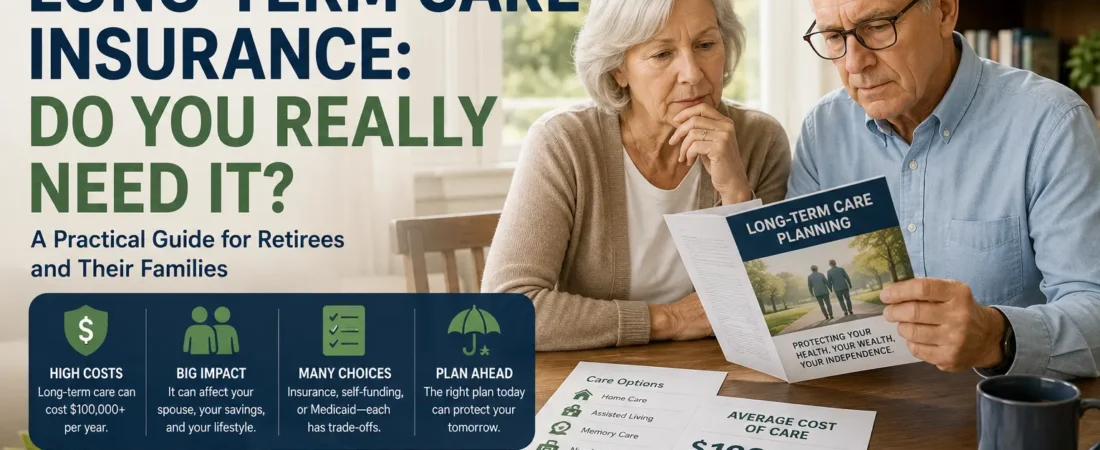
Long-term care insurance can protect your retirement savings from years of expensive care—but that doesn’t mean every retiree should buy it. The right answer depends on your assets, income, spouse, health, and how much financial risk your retirement portfolio can comfortably absorb.
Two Couples. Similar Retirements. One Very Different Ending.
At 67, Tom and Linda thought they had built a comfortable retirement.
They had $1.2 million invested, Social Security income, a paid-off home, and enough money left over for travel.
They had planned for taxes. They had estimated healthcare costs. They had even talked about what would happen if the market crashed shortly after they retired.
But there was one question they had never really answered:
Would long-term care insurance protect their retirement—or were they wealthy enough to take that risk themselves?
Their longtime friends, Robert and Susan, were in a remarkably similar position.
For the next decade, both couples enjoyed the retirement they had planned.
Then, at 79, Tom began showing signs of dementia.
At first, Linda helped him at home.
She managed his medications. She prepared his meals. She made sure he didn’t wander outside alone.
But eventually, she couldn’t do it anymore.
Tom needed professional care.
And suddenly, the question wasn’t whether their portfolio could support another vacation.
It was whether it could support years of care.
Robert and Susan eventually faced a similar health crisis.
But years earlier, they had made a different financial decision.
They had purchased long-term care coverage.
Neither couple had made an obviously foolish choice.
Neither could have known exactly what would happen.
Yet a decision made more than a decade earlier eventually affected not only their finances, but where they could receive care, how much responsibility fell on their spouses, and how much of their retirement savings remained available for the surviving partner.
That’s what makes long-term care planning so difficult.
You’re paying today for something you hope you’ll never need.
But if you do need it, the cost can change almost everything.
The $100,000-a-Year Question
Long-term care isn’t simply another healthcare expense.
It belongs in a different category.
A retiree might absorb a $3,000 dental bill.
A portfolio can probably survive an expensive hearing aid.
Even several thousand dollars of unexpected medical expenses may be manageable with a properly funded retirement reserve.
Long-term care can be different.
Depending on where you live and the level of care required, professional care can potentially cost tens of thousands of dollars every year—and more intensive care can push annual expenses well into six figures.
And those expenses may continue for years.
That’s why the important question isn’t:
“Can I afford one year of long-term care?”
It’s:
“What happens to my retirement plan if one spouse needs expensive care for several years?”
That is a much harder question.
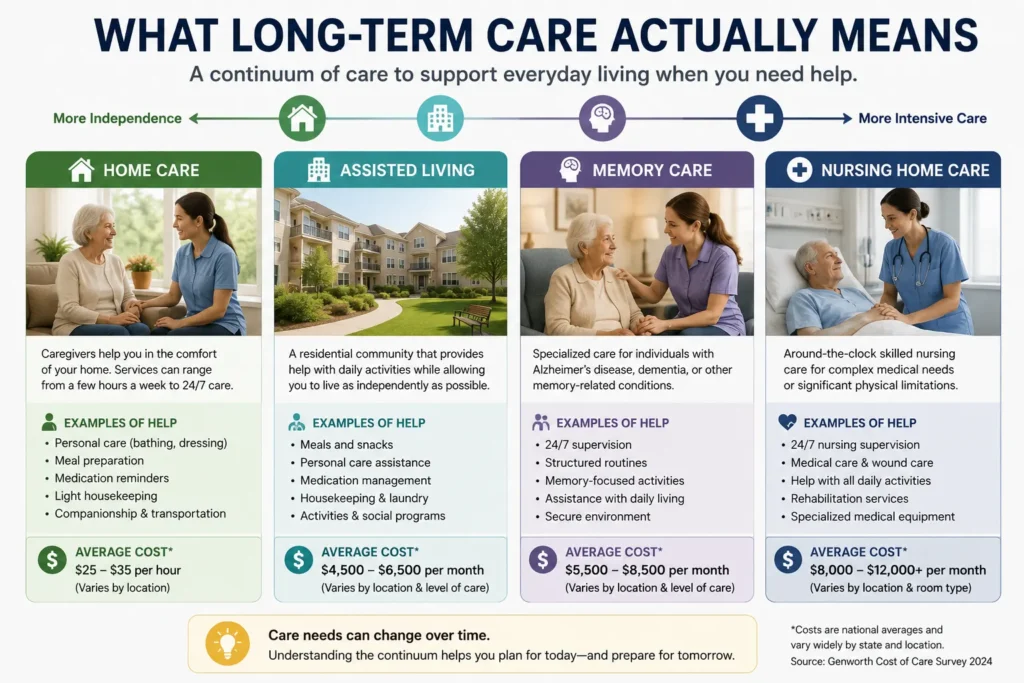
First, Understand What Long-Term Care Actually Means
Long-term care doesn’t necessarily mean living in a nursing home.
It describes assistance with everyday activities when someone can no longer manage them independently.
That may include help with:
Bathing
Dressing
Eating
Toileting
Moving safely
Managing cognitive impairment
Medication routines
Everyday personal care
Care can happen in several places.
At Home
Many retirees would prefer to remain in their own homes.
Professional caregivers may visit for several hours each day—or eventually provide much more extensive assistance.
Assisted Living
A retiree may still live relatively independently while receiving help with meals, medication, transportation, or personal care.
Memory Care
People living with Alzheimer’s disease or other forms of dementia may eventually require specialized supervision and secure residential care.
Nursing Home Care
People with significant physical or medical limitations may require around-the-clock assistance.
The important point is simple:
Long-term care is not one product or one building. It’s a spectrum of care that can become progressively more expensive as your needs increase.
The Medicare Assumption That Can Break a Retirement Plan
One of the most dangerous assumptions in retirement planning is:
“If something serious happens, Medicare will take care of it.”
Medicare can cover certain medically necessary services and limited skilled care under qualifying circumstances.
But Medicare generally does not pay for indefinite custodial care simply because someone can no longer safely bathe, dress, eat, or live independently.
That distinction matters enormously.
A heart attack is primarily a medical event.
Years of assistance because of dementia or age-related frailty can become a long-term care event.
Financially, those are very different risks.
This is why Medicare planning and long-term care planning should never be treated as the same thing.
Long-Term Care Is Also a Spouse Problem
Suppose a retired couple has accumulated $1 million.
At first glance, that sounds comfortable.
But that money isn’t necessarily supporting one retirement.
It’s supporting two.
If one spouse eventually requires expensive long-term care, the portfolio may suddenly have two jobs:
Fund the care of one spouse.
And:
Fund the retirement of the healthy spouse.
The mortgage or property taxes don’t disappear.
The healthy spouse still needs food.
They still need transportation.
They still need healthcare.
They may live another 10, 15, or 20 years.
That’s why long-term care planning isn’t simply about protecting the person who becomes sick.
It’s often about protecting the financial independence of the person who remains healthy.
So, Does Everyone Need Long-Term Care Insurance?
No.
And this is where many discussions about long-term care insurance become misleading.
Long-term care insurance isn’t automatically a good investment simply because long-term care is expensive.
Insurance exists to transfer a financial risk that would otherwise be difficult for you to absorb.
If you have very little retirement wealth, expensive private insurance premiums themselves may strain your budget.
If you are extremely wealthy, you may be able to pay for care directly from your assets.
The group caught between those two extremes faces the hardest decision.
They have enough wealth to protect.
But perhaps not enough wealth to comfortably absorb several years of very expensive care.
For these households, long-term care insurance can become much more interesting.
The Three Long-Term Care Groups
A useful way to think about the decision is to divide retirees into three broad groups.
Group 1: Limited Retirement Assets
For households with relatively limited savings, long-term care insurance premiums may compete with essential retirement spending.
Depending on circumstances, Medicaid may eventually become part of the long-term care financing picture after eligibility requirements are satisfied.
That doesn’t mean planning is unnecessary.
It means expensive private insurance may not always be the most practical solution.
Group 2: Meaningful Assets—but Not Unlimited Assets
This is where the decision becomes especially important.
Imagine a household with:
A solid retirement portfolio
A paid-off or mostly paid-off home
Reliable Social Security income
Enough money for a comfortable retirement
They may feel wealthy.
But several years of expensive care for one spouse could still materially change the surviving spouse’s financial security.
This is the group that should examine long-term care insurance particularly carefully.
Not because insurance is automatically the answer.
But because the financial risk is large enough to matter and small enough that transferring part of it may be practical.
Group 3: High-Net-Worth Retirees
At some point, insurance becomes less necessary as a financial protection tool.
A household with substantial liquid assets and reliable income may be able to self-fund long-term care without materially changing its lifestyle.
For these retirees, the question becomes:
“Why pay an insurance company to absorb a risk my portfolio can comfortably absorb?”
Some may still purchase coverage for estate-planning or psychological reasons.
But financially, self-insuring becomes increasingly viable as wealth rises.
The Real Question: What Are You Trying to Protect?
This is the question I would ask before looking at a single insurance quote.
Are you protecting:
Your spouse’s retirement?
Your investment portfolio?
Your children’s inheritance?
Your ability to choose higher-quality care?
Your ability to remain at home longer?
Your peace of mind?
Those are very different objectives.
And they may lead to very different insurance decisions.
A retiree trying to preserve a large inheritance may evaluate long-term care insurance differently from someone whose primary concern is ensuring that a surviving spouse can remain financially independent.
Before choosing an insurance product, decide what you’re actually insuring.
Because the goal isn’t to buy long-term care insurance.
The goal is to build a retirement plan that can survive a long-term care event.
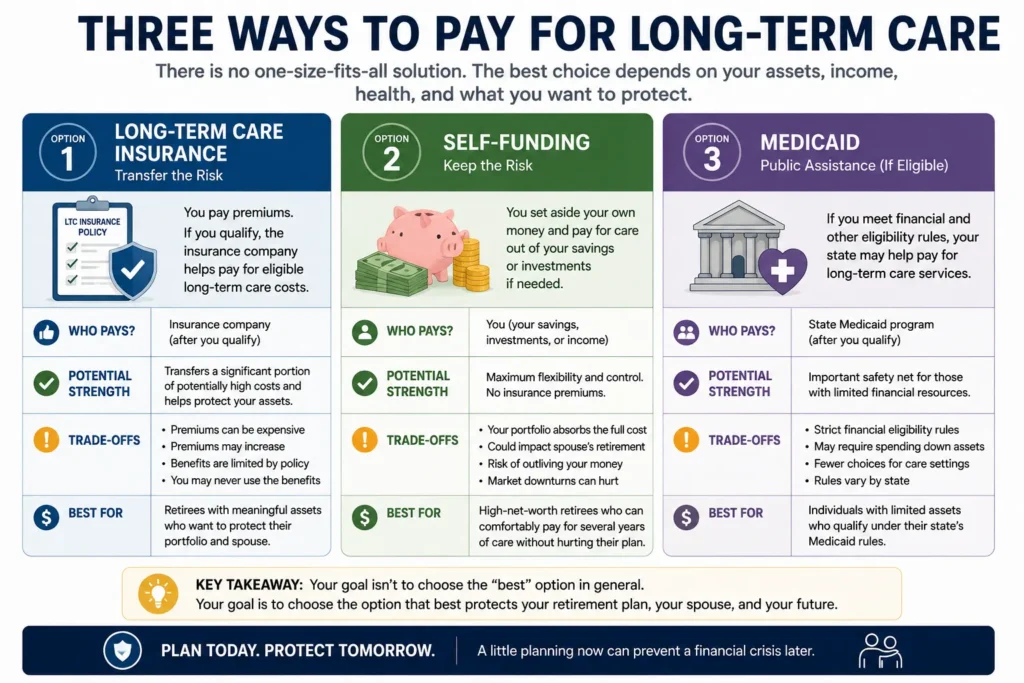
Three Ways to Pay for Long-Term Care
Once you accept that long-term care is a financial risk, the next question becomes much easier to frame.
There are essentially three ways to deal with it.
You can transfer the risk.
You can keep the risk.
Or, if your assets eventually fall low enough and you meet applicable eligibility rules, public assistance may become part of the solution.
Let’s look at each.
Option 1: Buy Long-Term Care Insurance
Traditional long-term care insurance works much like other forms of insurance.
You pay premiums.
If you eventually qualify for benefits under the policy, the insurer helps pay eligible long-term care expenses subject to the policy’s terms, benefit limits, waiting periods, and other conditions.
The obvious advantage is risk transfer.
Instead of asking your retirement portfolio to absorb the entire cost of a multi-year care event, you’re asking an insurance company to absorb part of it.
But there are trade-offs.
Premiums can be substantial.
They may increase.
You may pay premiums for years and never collect benefits.
And coverage isn’t unlimited.
That’s why long-term care insurance should not be viewed as a way to eliminate the risk.
It’s a way to share the risk.
Option 2: Self-Fund the Risk
Self-funding sounds simple.
Don’t buy insurance.
Keep the money invested.
If you eventually need care, pay for it yourself.
For wealthy retirees, this can be perfectly rational.
But self-funding requires more than having a large portfolio.
You need to ask:
“Could my portfolio pay for several years of care without damaging the retirement of my spouse?”
That’s a much higher standard.
A $1.5 million portfolio may look substantial when it supports ordinary retirement spending.
It can look very different when a six-figure annual care expense is added.
The correct self-insurance question isn’t whether you can write the check.
It’s whether writing those checks repeatedly would materially change the rest of your retirement plan.
Option 3: Medicaid
Medicaid is an important payer of long-term care in the United States, but it should not be confused with Medicare.
Eligibility is generally subject to financial and other requirements, and rules can vary by state and individual circumstances.
For households with limited financial resources, Medicaid may ultimately play a major role.
But relying on Medicaid as your primary plan may reduce your financial flexibility and potentially affect your choices regarding where and how care is received.
For retirees with meaningful assets they want to preserve, simply assuming “Medicaid will handle it” is not a complete long-term care strategy.
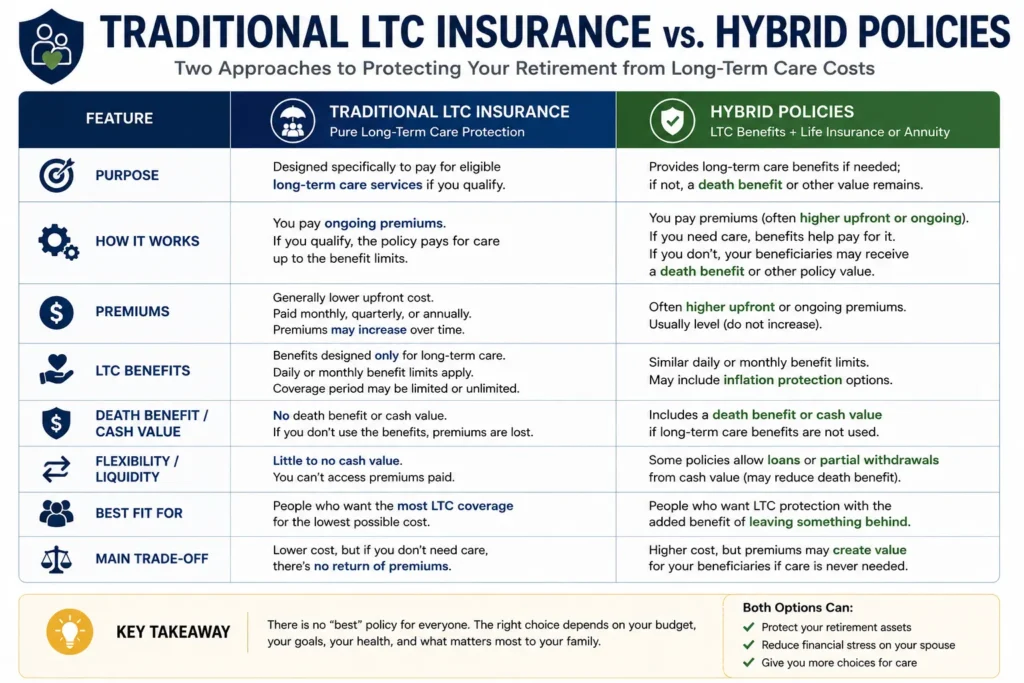
Traditional LTC Insurance vs. Hybrid Policies
Long-term care insurance has changed significantly.
Traditional policies are no longer the only option.
Hybrid policies have become another way to address the uncomfortable question:
“What if I pay all these premiums and never need long-term care?”
Traditional Long-Term Care Insurance
The basic structure is straightforward.
You pay premiums in exchange for long-term care benefits if you qualify under the policy.
Advantages
Designed specifically for long-term care risk
Can transfer a meaningful portion of potential care costs
May protect retirement assets
Can reduce financial pressure on a spouse
Disadvantages
Premiums can be expensive
Premiums may increase
Benefits may never be used
Policies contain limits and eligibility requirements
Traditional LTC insurance can make sense when your primary objective is efficient risk transfer.
Hybrid Long-Term Care Policies
Hybrid products typically combine long-term care benefits with life insurance or another insurance component.
If long-term care is needed, qualifying benefits may help pay for care.
If long-term care isn’t needed, there may still be a death benefit or other value depending on the policy.
That structure can feel psychologically easier.
The money doesn’t necessarily feel “lost” if care is never required.
But there is no free lunch.
Hybrid policies can require significant upfront premiums or substantial ongoing payments, and their economics can differ considerably from traditional LTC insurance.
The question isn’t whether hybrid policies are better.
It’s whether the additional features justify the cost for your financial plan.
When Should You Consider Buying Coverage?
Timing matters.
Wait too long and two things can happen.
Coverage may become considerably more expensive.
Or your health may make obtaining desirable coverage difficult or impossible.
Buy too early, however, and you could spend many additional years paying premiums before you’re likely to need care.
This creates an uncomfortable balancing act.
In Your 50s
You may have better insurability and potentially more options.
But you may also pay premiums for decades.
This can be an appropriate time to begin researching rather than automatically buying.
In Your Early 60s
For many households, this becomes a particularly useful planning window.
Retirement assets are clearer.
Retirement income is easier to estimate.
Family health history may be more informative.
And you may still have reasonable insurance options depending on your health.
This is often when the question changes from:
“Should I think about long-term care someday?”
to:
“What exactly is my plan if one of us needs care?”
In Your 70s
The economics can become more difficult.
Premiums may be considerably higher, and health conditions may limit available coverage.
At this point, self-funding, existing assets, family support, housing decisions, and other strategies may become increasingly important.
Waiting isn’t necessarily wrong.
But waiting without a plan is.
When Long-Term Care Insurance May NOT Be Worth It
This section matters because insurance isn’t automatically the answer.
Long-term care insurance may deserve additional scrutiny if:
The Premium Would Strain Your Retirement Budget
An insurance policy designed to protect your retirement shouldn’t make retirement unaffordable.
If paying premiums forces you to reduce essential spending or withdraw excessively from investments, the solution may be creating another problem.
You Can Comfortably Self-Insure
If several years of expensive care would barely affect your lifestyle, spouse’s financial security, or estate objectives, transferring the risk may be unnecessary.
You Have Very Limited Assets to Protect
If premiums would consume a meaningful portion of your retirement income, private LTC insurance may not be economically practical.
Other planning strategies may deserve priority.
You’re Buying It Only Because You’re Afraid
Fear is rarely a good reason to buy a complicated financial product.
Before purchasing coverage, understand:
What triggers benefits
How long benefits can last
Daily or monthly benefit limits
Inflation protection
Elimination periods
Premium structure
Exclusions
What happens if you stop paying premiums
If you don’t understand what you’re buying, don’t let fear make the decision for you.
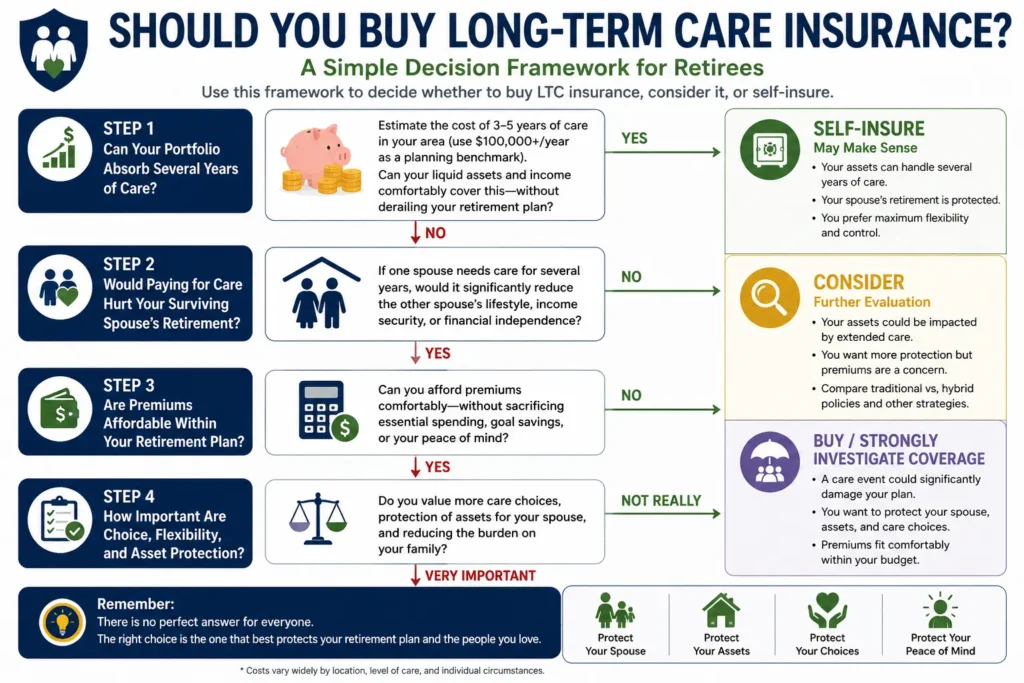
The Long-Term Care Decision Framework
Here’s a more useful way to think about the decision.
Step 1: Stress-Test Your Portfolio
Ask:
What happens if one spouse needs three years of expensive care?
Don’t calculate only the care bill.
Calculate what happens to:
Portfolio withdrawals
Taxes
Investment longevity
The surviving spouse
Housing expenses
Your estate
If the plan still works comfortably, self-insuring may be reasonable.
If the plan begins to break, transferring some of the risk deserves consideration.
Step 2: Determine What You’re Protecting
Rank these priorities:
Surviving spouse
Choice of care
Portfolio
Home
Inheritance
Independence
Your priorities determine how much risk you should transfer.
Step 3: Decide How Much Risk You Can Keep
You don’t necessarily need insurance to cover every dollar.
Imagine your portfolio could comfortably absorb the first portion of long-term care expenses but would struggle with a multi-year event.
In that situation, you may want insurance designed primarily to protect against the catastrophic tail of the risk.
Insurance is often most valuable when it protects you from outcomes you cannot comfortably absorb yourself.
Step 4: Compare the Three Strategies
Strategy
Potential Strength
Main Trade-Off
Traditional LTC Insurance
Direct risk transfer
Premiums and potential increases
Hybrid Policy
LTC protection plus other policy value
Often substantial cost
Self-Funding
Maximum flexibility and control
Portfolio absorbs the full risk
Medicaid
Important safety net for eligible households
Financial eligibility and other rules apply
There is no universal winner.
The correct strategy depends on the size of your assets, retirement income, health, family situation, state rules, and what you want your money to accomplish.
A Simple Buy / Consider / Self-Insure Framework
BUY / Strongly Investigate Coverage
Long-term care insurance deserves serious consideration when:
You have meaningful retirement assets to protect.
A multi-year care event could materially damage your portfolio.
Your spouse depends on those assets.
Premiums fit comfortably within your retirement budget.
Maintaining flexibility in care is important to you.
CONSIDER
The decision is less obvious when:
Your portfolio could absorb some—but not all—of the risk.
You have significant home equity.
Family members may provide some assistance.
You are deciding between traditional and hybrid coverage.
You value insurance but are concerned about premiums.
This is where careful modeling becomes especially valuable.
SELF-INSURE MAY MAKE SENSE
Self-funding becomes more reasonable when:
Your liquid assets are substantial.
Retirement income comfortably exceeds normal spending.
Several years of care would not threaten your spouse’s lifestyle.
You deliberately maintain assets specifically for future healthcare and care expenses.
Self-insuring should be a decision.
Not the absence of one.
Frequently Asked Questions
Does Medicare pay for long-term care?
Medicare may cover certain qualifying skilled nursing or home health services under specific circumstances, but it generally doesn’t cover indefinite custodial long-term care simply because someone needs help with everyday activities.
Does everyone need long-term care insurance?
No.
Some households cannot comfortably afford the premiums, while wealthier households may be able to self-fund the risk.
The decision is particularly important for households with meaningful—but not unlimited—retirement assets.
What is the best age to buy long-term care insurance?
There isn’t one perfect age.
Health, insurability, premium affordability, retirement assets, and family circumstances all matter.
For many people, the years approaching retirement are an important time to evaluate the decision rather than waiting until care appears imminent.
Is a hybrid policy better than traditional LTC insurance?
Not necessarily.
Hybrid policies can provide additional value if long-term care is never needed, while traditional insurance may offer a more direct way to transfer long-term care risk.
Compare benefits, premiums, inflation protection, liquidity, and opportunity costs—not just marketing features.
Can I simply use my retirement savings?
Yes—if your retirement plan can withstand it.
The key question is whether paying for several years of care would compromise your spouse’s retirement or other important financial goals.
What if I never need long-term care?
That’s the fundamental nature of insurance.
You are transferring a risk that may never occur.
The goal isn’t to “win” by collecting benefits.
The goal is to prevent a potentially expensive event from destroying a financial plan you spent decades building.
Final Thoughts
Long-term care insurance is one of those financial products that looks unnecessary right up until the moment it becomes incredibly valuable.
But that doesn’t mean everyone should buy it.
A wealthy retiree may not need it.
A retiree with limited resources may not be able to justify the premiums.
The difficult decision belongs to everyone in between.
That’s why the smartest question isn’t:
“Should I buy long-term care insurance?”
It’s:
“If one of us needs years of care, what happens to the other person’s retirement?”
If you can answer that question confidently, you have a long-term care plan.
Whether an insurance policy is part of that plan is secondary.
Because retirement security isn’t about insuring every possible risk.
It’s about identifying the risks capable of changing your life—and making sure none of them can change it more than you can afford.
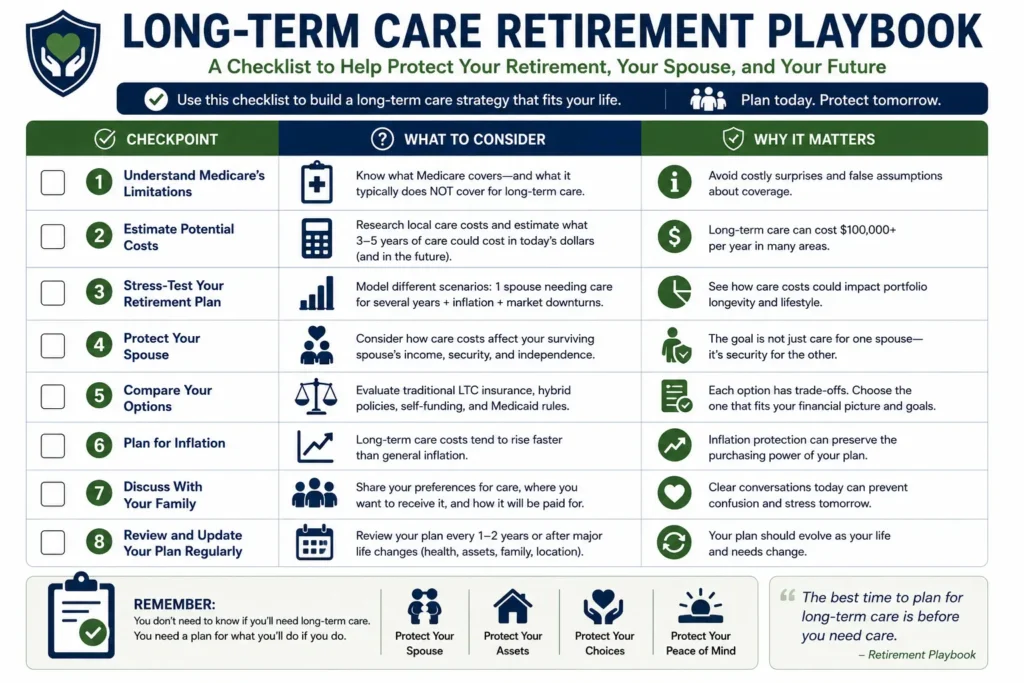
Retirement Playbook
Before deciding how you’ll handle long-term care, make sure you can answer “yes” to these questions.
☐ I understand that Medicare generally won’t cover indefinite custodial long-term care.
☐ I’ve estimated what several years of care could do to our retirement portfolio.
☐ I’ve considered the financial impact on the healthy spouse.
☐ I know whether traditional LTC insurance, hybrid coverage, or self-funding fits our situation.
☐ I understand the major benefits, limits, and costs before buying any policy.
☐ I’ve considered how inflation could affect future care expenses.
☐ My family knows what kind of care I would prefer and how we plan to pay for it.
☐ Our long-term care strategy is part of our overall retirement plan—not an afterthought.
You don’t need to know whether you’ll ever need long-term care.
You need to know what you’ll do if you do.
Coming Next
The Retirement Expense That Can Destroy a $1 Million Portfolio: How Long-Term Care Changes the Math