For decades, John believed he had done everything right.
He contributed consistently to his 401(k), delayed claiming Social Security until age 70, paid off his mortgage, and even built a healthy emergency fund. By every traditional measure, he was financially ready for retirement.
Then he turned 65.
Friends kept telling him,
“Don’t worry. Medicare will cover your healthcare.”
Within the first year, he realized how misleading that sentence could be.
His Medicare Part B premium was automatically deducted from his Social Security check.
He purchased a Medigap policy because he didn’t want unlimited medical bills.
He enrolled in a Part D prescription drug plan.
He still paid deductibles.
Dental care wasn’t covered.
Neither were his hearing aids.
When he needed new glasses, Medicare contributed almost nothing.
By the end of the year, his healthcare spending was several thousand dollars higher than he had expected.
Nothing catastrophic had happened.
This was simply normal retirement healthcare.
And that’s exactly why so many retirees underestimate it.
The Biggest Medicare Myth
Many Americans believe Medicare works like employer health insurance.
It doesn’t.
Medicare dramatically reduces healthcare costs compared to paying entirely out of pocket, but it rarely eliminates them.
Instead, retirement healthcare becomes a combination of several different expenses:
- Monthly premiums
- Deductibles
- Coinsurance
- Prescription drug costs
- Supplemental insurance
- Dental care
- Vision care
- Hearing care
- Long-term care expenses
Each category may seem manageable individually.
Together, they create one of the largest ongoing expenses in retirement.
Medicare Is Not Free
Many retirees are surprised before they even visit a doctor.
The first bill arrives automatically.
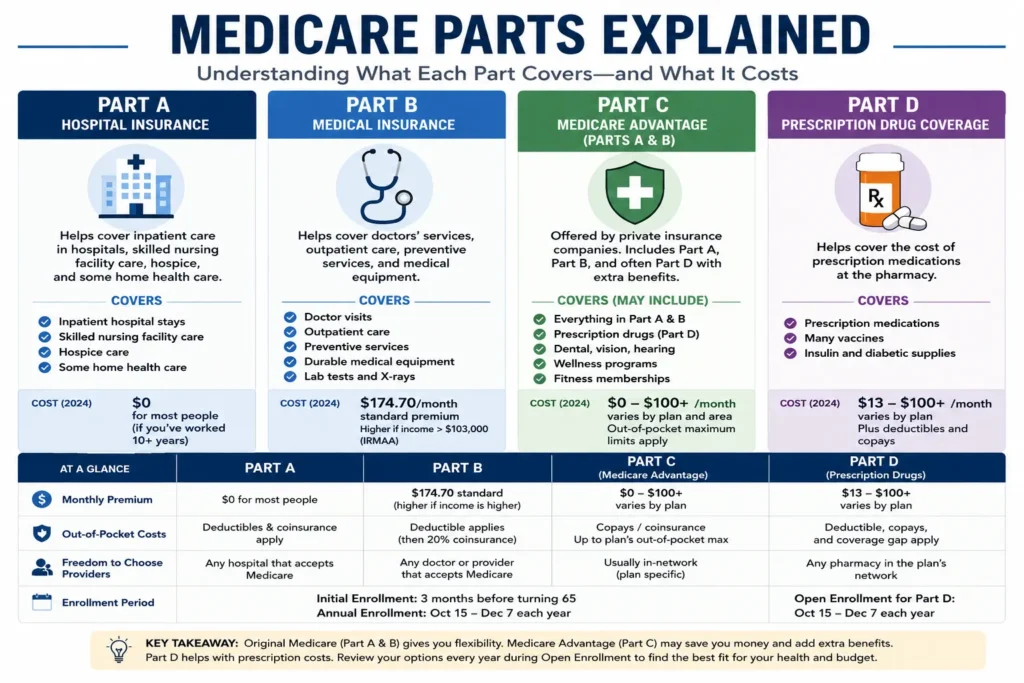
Part A (Hospital Insurance)
For most workers who paid Medicare payroll taxes long enough, Part A premiums are usually free.
That creates the impression that Medicare itself is free.
Unfortunately, that’s only the beginning.
Part B (Medical Insurance)
Part B covers physician visits, outpatient services, preventive care, and many diagnostic procedures.
Unlike Part A, nearly everyone pays a monthly premium.
Higher-income retirees pay considerably more through Income-Related Monthly Adjustment Amounts (IRMAA).
Even before paying a single medical bill, healthcare becomes a recurring monthly expense.
Part D (Prescription Drugs)
Prescription coverage requires another premium.
The cost depends on:
- Your chosen plan
- Your medications
- Your pharmacy
- Income level
Many retirees underestimate prescription expenses because medications often increase with age.
Medicare Advantage or Medigap?
This is one of retirement’s most important decisions.
Neither option is universally better.
Each involves different trade-offs.
Medicare Advantage
Typically offers lower monthly premiums and bundles several services into one plan.
However, provider networks, prior authorization rules, and out-of-pocket limits deserve careful consideration.
Medigap + Original Medicare
Usually involves higher monthly premiums.
In return, many retirees gain greater flexibility when choosing physicians and often face more predictable medical costs.
The cheapest option today is not always the least expensive over a 25-year retirement.
The Costs Medicare Doesn’t Cover
This is where retirement budgets often begin to fail.
Many people assume Medicare covers “healthcare.”
In reality, it covers specific medical services.
Several expensive categories remain largely outside its protection.
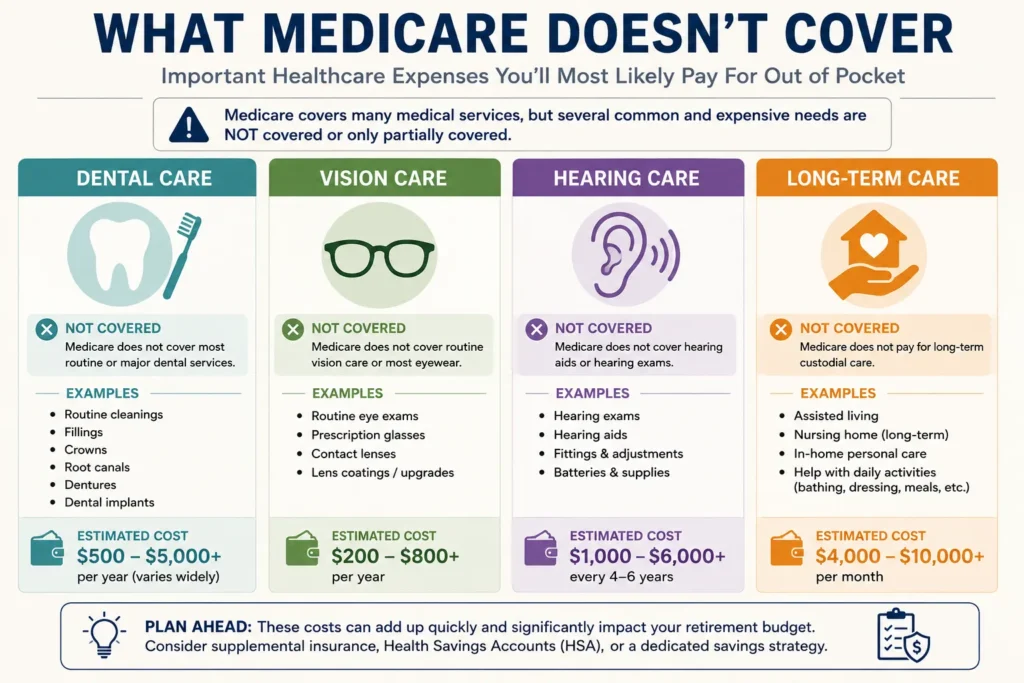
Dental Care
Routine cleanings.
Crowns.
Root canals.
Dentures.
Dental implants.
These expenses frequently come entirely out of pocket.
One major dental procedure can easily cost more than an entire year’s Medicare premiums.
Vision Care
Routine eye exams.
Prescription glasses.
Contact lenses.
Many retirees need updated prescriptions every few years, making vision care another recurring expense rather than a one-time purchase.
Hearing Aids
Modern hearing aids have become remarkably sophisticated.
They’ve also become remarkably expensive.
Since replacement may be needed every several years, hearing expenses should be viewed as part of a long-term retirement budget—not an unexpected emergency.
Long-Term Care: The Expense That Changes Everything
If there is one healthcare cost capable of reshaping an entire retirement plan, it is long-term care.
This is also the expense many retirees assume Medicare will cover.
In most cases, it does not.
Medicare is designed to pay for medically necessary care, such as hospital stays, physician services, rehabilitation after an illness, and certain short-term skilled nursing services.
It is not designed to pay for years of custodial care—help with everyday activities like bathing, dressing, eating, or moving around safely.
That distinction surprises many families.
A retiree may recover from surgery with Medicare covering much of the treatment, but if that same person later requires daily assistance because of dementia, Parkinson’s disease, or simple age-related frailty, the financial responsibility often shifts to the individual and their family.
This is why long-term care is one of the largest financial risks in retirement.
Some people will never need it.
Others may require assistance for several years.
The uncertainty makes planning difficult—but ignoring it makes the consequences far more expensive.
Healthcare Inflation Doesn’t Stop at Retirement
Many retirement plans assume spending becomes stable after age 65.
Healthcare rarely follows that pattern.
Medical costs have historically tended to rise faster than general inflation over long periods.
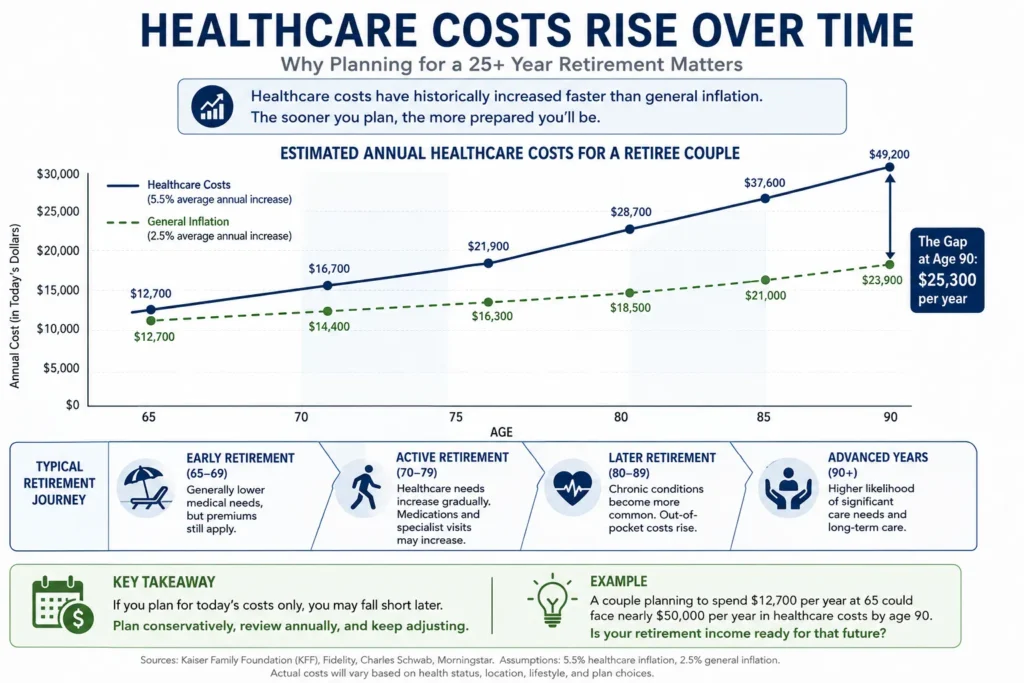
Even if Medicare premiums increase gradually, prescription drugs, specialist visits, medical technology, and supplemental insurance can all become more expensive over time.
Consider two retirees who each spend $8,000 per year on healthcare at age 65.
If healthcare costs continue increasing over a 25-year retirement, the retiree who planned only for today’s expenses may find themselves thousands of dollars short every year in their 80s.
Retirement planning isn’t only about estimating your first year of expenses.
It’s about estimating your last.
The “Hidden Healthcare Budget”
Many financial planners encourage clients to separate healthcare from their normal living expenses.
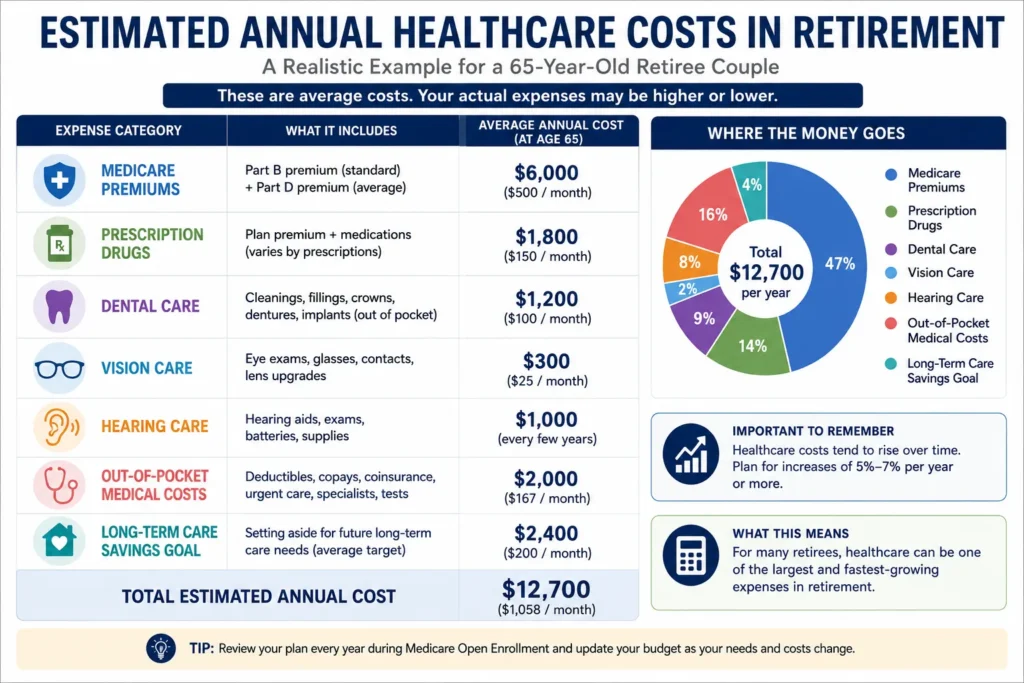
Instead of including medical costs inside a general monthly budget, create a dedicated healthcare budget with categories such as:
- Medicare premiums
- Prescription drug costs
- Supplemental insurance
- Dental care
- Vision care
- Hearing care
- Out-of-pocket medical expenses
- Long-term care savings
Seeing these expenses separately makes it much easier to understand where your money is actually going.
More importantly, it prevents healthcare costs from quietly consuming the money you intended for travel, hobbies, or time with your grandchildren.
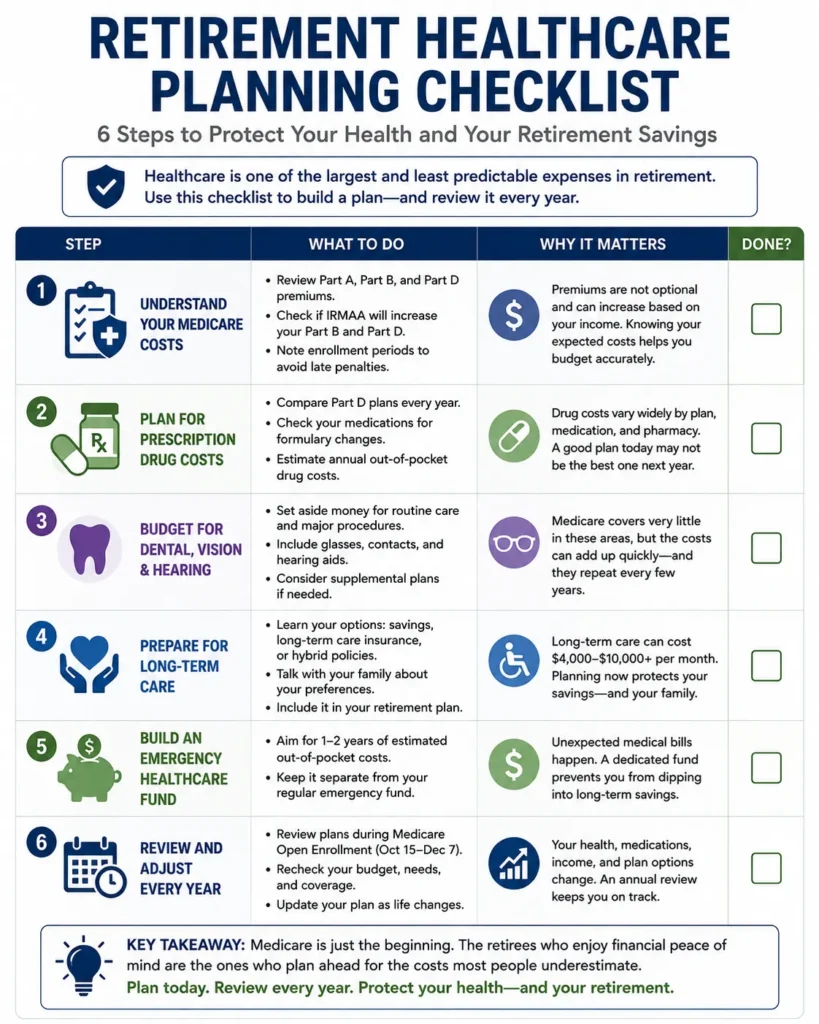
A Better Way to Prepare
No one can predict future medical needs.
But you can build flexibility into your retirement plan.
A practical approach includes:
- Reviewing Medicare choices every year during Open Enrollment.
- Building an emergency healthcare fund in addition to a regular emergency fund.
- Estimating future healthcare costs using conservative assumptions instead of best-case scenarios.
- Discussing long-term care preferences with your family before a crisis occurs.
- Reassessing healthcare spending annually rather than assuming it will stay constant.
Preparation won’t eliminate medical expenses.
It will reduce the chance that they become a financial emergency.
Retirement Playbook
Before you retire, ask yourself these five questions:
☐ Do I know my expected monthly Medicare premiums?
☐ Have I estimated annual out-of-pocket healthcare costs?
☐ Have I planned for dental, vision, and hearing expenses?
☐ Do I have a strategy for potential long-term care needs?
☐ Can my retirement budget absorb healthcare costs that rise faster than inflation?
If you answered “no” to any of these questions, your retirement plan probably needs another review.
Healthcare isn’t just another line item in retirement.
For many households, it’s one of the largest ongoing expenses they’ll ever face.
The good news is that this isn’t a problem of uncertainty—it’s a problem of preparation.
The retirees who enjoy the greatest peace of mind aren’t necessarily the healthiest or the wealthiest.
They’re the ones who planned for the expenses most people never saw coming.
Final Thoughts
Key Takeaway
Medicare provides an essential safety net, but it is not comprehensive health insurance. Premiums, prescription drugs, dental care, vision, hearing, and especially long-term care can add up to tens of thousands of dollars over retirement. The earlier you include these costs in your retirement income plan, the fewer financial surprises you’ll face later.
Coming Next
How to Estimate Your Retirement Healthcare Costs Before You Stop Working