
Most retirement plans have a number for almost everything.
You know roughly how much you want to spend each year.
You have an estimate for Social Security.
You may have calculated your Medicare premiums, housing costs, travel budget, and even how much you can safely withdraw from your portfolio.
Then someone asks:
“How much have you set aside for long-term care?”
And suddenly the spreadsheet gets quiet.
The problem isn’t that retirees don’t know long-term care can be expensive.
Most do.
The problem is that nobody knows how much care they will personally need.
You could spend almost nothing.
You could need a few hours of help at home for several months.
Or you could eventually require years of assisted living, memory care, or nursing-home care costing well into six figures.
That uncertainty leads retirees toward two opposite mistakes.
Some ignore the risk entirely.
Others see frightening estimates approaching $300,000, $500,000, or more and assume they need to keep an enormous pile of cash untouched for the rest of their lives.
Neither approach is particularly useful.
A better question is:
How much of the long-term care risk does your retirement portfolio actually need to cover?
That number can be very different from the theoretical maximum cost of care.
And once you understand it, building a long-term care fund becomes much more manageable.
The First Mistake: Trying to Fund the Worst Possible Scenario
Imagine a 65-year-old couple with a $1.2 million retirement portfolio.
They read that nursing-home care can cost more than $100,000 per year.
Then they imagine:
- $120,000 per year
- for three years
- for both spouses
Suddenly they think they need:
$720,000 reserved for long-term care.
If they mentally remove that money from their retirement portfolio, their $1.2 million retirement suddenly feels like a $480,000 retirement.
That’s enough to frighten almost anyone.
But this is not how retirement risk should normally be modeled.
You don’t build a retirement plan by simultaneously assuming:
- both spouses need expensive institutional care,
- both need it for several years,
- neither has other income,
- neither can use home equity,
- none of their normal living expenses disappear,
- and every dollar must be sitting in cash before retirement begins.
That’s not conservative planning.
That’s stacking multiple adverse assumptions on top of each other.
Long-term care planning works better when you think in terms of layers of funding.
Start With What Care Actually Costs Today
Before deciding how much to save, we need a realistic starting point.
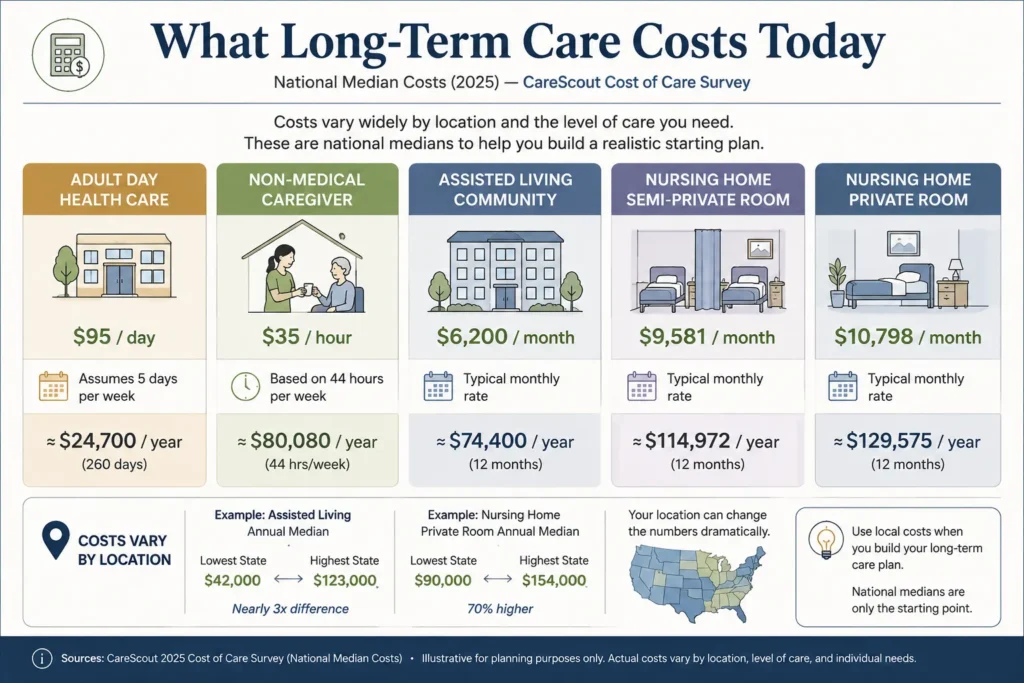
CareScout’s 2025 Cost of Care Survey reports these national median costs:
| Type of Care | 2025 National Median |
|---|---|
| Adult day health care | $95/day |
| Non-medical caregiver | $35/hour |
| Assisted living community | $6,200/month |
| Nursing home — semi-private room | $9,581/month |
| Nursing home — private room | $10,798/month |
At those rates, a private nursing-home room costs roughly $129,575 per year.
Assisted living is about $74,400 per year.
And non-medical in-home caregiving, assuming 44 hours per week, works out to approximately $80,080 per year.
Those are serious numbers.
But there is another number retirement planners sometimes forget.
Your existing retirement spending does not continue unchanged.
Suppose you normally spend $70,000 per year in retirement.
If you move permanently into assisted living, you don’t necessarily spend $70,000 plus $74,400.
Some existing expenses may disappear or shrink:
- groceries,
- utilities,
- home maintenance,
- transportation,
- travel,
- entertainment,
- and possibly housing costs.
The financial problem is therefore not always:
Cost of care
It is often closer to:
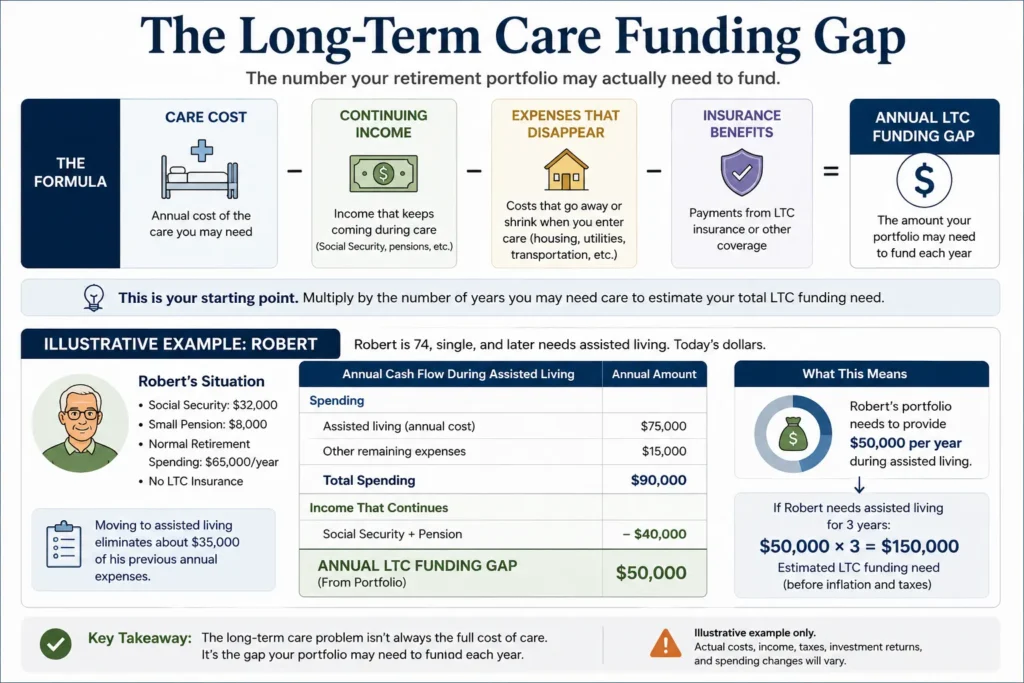
Cost of care − expenses that disappear − reliable income − insurance benefits
That is the number your portfolio may actually have to fund.
And that distinction changes everything.
The Long-Term Care Funding Gap
Let’s build a simple example.
Meet Robert.
He is 74, retired, single, and living on:
- $32,000 from Social Security
- $8,000 from a small pension
- withdrawals from his investment portfolio
His normal retirement spending is approximately:
$65,000 per year.
Several years later, Robert needs assisted living.
We’ll use $75,000 per year as a simplified illustrative care cost, close to the current national median.
At first glance, you might say:
Robert needs another $75,000 every year.
But that isn’t necessarily true.
Suppose moving into assisted living eliminates approximately $35,000 of his previous annual expenses.
Robert still receives:
$40,000 of Social Security and pension income.
His simplified annual cash flow might look like this:
| Annual Amount | |
| Assisted living | $75,000 |
| Other remaining expenses | $15,000 |
| Total spending | $90,000 |
| Social Security + pension | −$40,000 |
| Portfolio funding needed | $50,000/year |
If Robert needs assisted living for three years:
$50,000 × 3 = $150,000
His long-term care funding problem isn’t necessarily $225,000.
It may be closer to $150,000.
That’s still substantial.
But it is a much more useful planning number.
Illustrative example only. Actual care costs, taxes, income, investment returns, and spending changes will vary.
So How Much Should You Set Aside for Long-Term Care?
There is no universal number.
But for planning purposes, I find it more useful to think in funding ranges rather than pretending there is one precise answer.
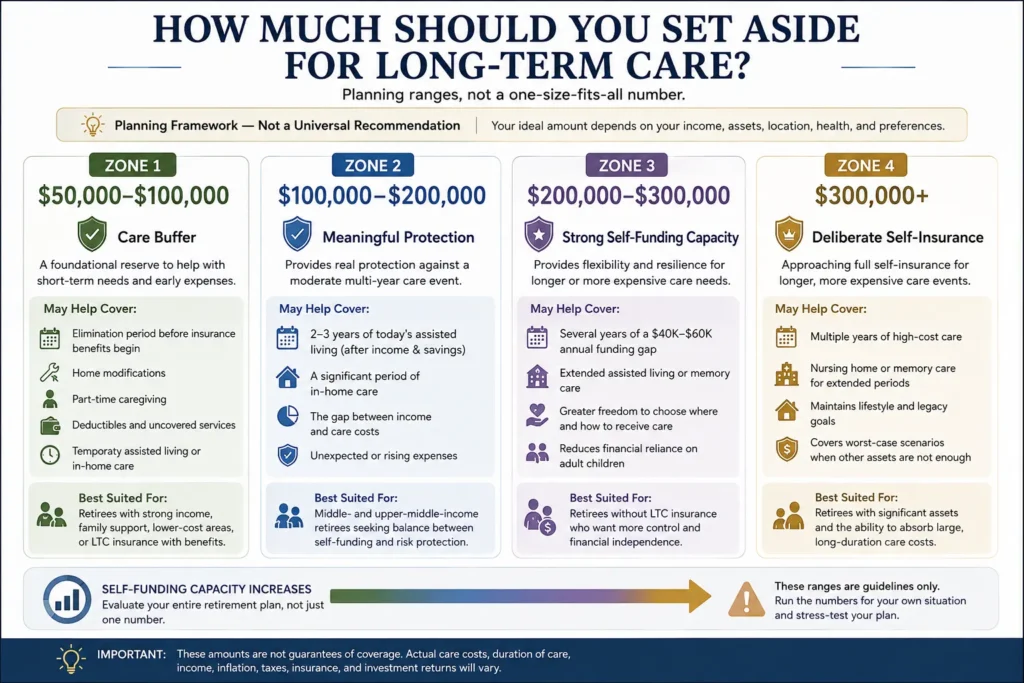
Consider four starting zones.
Zone 1: $50,000–$100,000
This may provide a useful care reserve for someone who:
- has substantial guaranteed retirement income,
- owns a mortgage-free home,
- expects family support,
- lives in a relatively lower-cost area,
- or has long-term care insurance covering part of the risk.
This amount probably won’t finance years of full-time nursing-home care.
That’s not necessarily its job.
It may instead cover:
- an elimination period before insurance benefits begin,
- home modifications,
- part-time caregiving,
- temporary assisted living,
- deductibles and uncovered services,
- or the gap between income and care costs.
Think of this as a care buffer, not complete self-insurance.
Zone 2: $100,000–$200,000
For many middle- and upper-middle-income retirees, this is where a dedicated LTC reserve begins to provide meaningful protection.
A $150,000 reserve, for example, could potentially cover:
- several years of a $40,000–$50,000 annual funding gap,
- roughly two years of today’s median assisted-living cost before accounting for other income,
- or a significant period of in-home care.
Again, the reserve does not necessarily have to pay the entire bill.
Social Security keeps arriving.
Pensions keep arriving.
Some normal expenses disappear.
A spouse may still have income.
And other assets may eventually become available.
The fund is there to prevent the care bill from forcing you to liquidate investments at the worst possible time.
Zone 3: $200,000–$300,000
This begins to look more like serious self-funding capacity.
It may make sense for retirees who:
- don’t own long-term care insurance,
- have substantial investable assets,
- want more flexibility over where they receive care,
- have longevity in their family,
- want to reduce financial dependence on adult children,
- or live in higher-cost care markets.
A $250,000 LTC fund won’t eliminate every possible risk.
But combined with Social Security, pensions, investment income, and possibly home equity, it can absorb a meaningful long-term care event.
For a household with a multimillion-dollar portfolio, this money doesn’t necessarily need to sit in a separate account.
It can simply be a designated portion of the portfolio.
That’s an important distinction we’ll return to.
Zone 4: $300,000+
At this point you are approaching deliberate self-insurance.
This strategy is generally more realistic for households with significant assets.
Someone with a $4 million portfolio does not necessarily need to buy insurance against a $200,000–$300,000 expense.
They may reasonably decide:
“We will retain enough assets to absorb the risk ourselves.”
But even wealthy retirees should not interpret self-insurance as:
“We’ll figure it out later.”
True self-insurance means you have deliberately identified:
- which assets would pay for care,
- how much you are willing to spend,
- how those assets will be invested,
- what happens if both spouses need care,
- and when home equity becomes part of the plan.
If those questions haven’t been answered, you don’t have a self-insurance strategy.
You simply have assets.
Your Portfolio Size Changes the Answer
Here’s where the decision becomes more interesting.
Imagine four retired households.
| Retirement Assets | Possible LTC Approach |
| $400,000 | Preserve liquidity; insurance/Medicaid planning may matter more |
| $800,000 | Partial reserve + insurance may reduce portfolio risk |
| $1.5 million | Hybrid approach becomes increasingly practical |
| $3 million+ | Self-funding becomes much more realistic |
These aren’t rules.
They’re a framework.
A retiree with $400,000 cannot casually carve $200,000 out of the portfolio and declare it untouchable.
That would leave too little money supporting ordinary retirement.
At the opposite extreme, a household with $5 million may not need to pay decades of insurance premiums to protect against a loss the portfolio could comfortably absorb.
The hardest decisions often occur in the middle.
Roughly speaking, households with perhaps:
$750,000–$2 million of investable retirement assets
can face the most uncomfortable trade-off.
They may have too much wealth to simply assume Medicaid will eventually solve the problem.
But a multi-year care event can still materially damage their retirement plan or inheritance goals.
To see how quickly that risk can change an otherwise comfortable retirement, our $1 million portfolio long-term care analysis shows what happens when a major care event collides with withdrawals, market risk, and the needs of a surviving spouse.
This is where a dedicated reserve, insurance, or a combination of both deserves serious attention.
Don’t Forget the House
One of the largest assets in many American retirement plans never appears in the investment portfolio.
The home.
Suppose a couple retires with:
- $1.1 million invested
- a mortgage-free $500,000 home
Looking only at the portfolio can make long-term care risk appear more dangerous than it actually is.
If one spouse eventually moves permanently into institutional care after the other spouse has died, the house may no longer need to serve its original purpose.
Selling it could create hundreds of thousands of dollars of additional care funding.
That does not mean:
“Your house is your long-term care plan.”
There are obvious problems with relying entirely on home equity.
The spouse may still live there.
The home may be difficult to sell quickly.
The care event may occur during a weak housing market.
The family may strongly want to keep the property.
And home equity isn’t particularly useful for paying next month’s caregiver bill unless you have a practical way to access it.
But ignoring the house entirely can be just as misleading.
For many retirees, home equity should be viewed as the final layer of the LTC funding plan rather than the first.
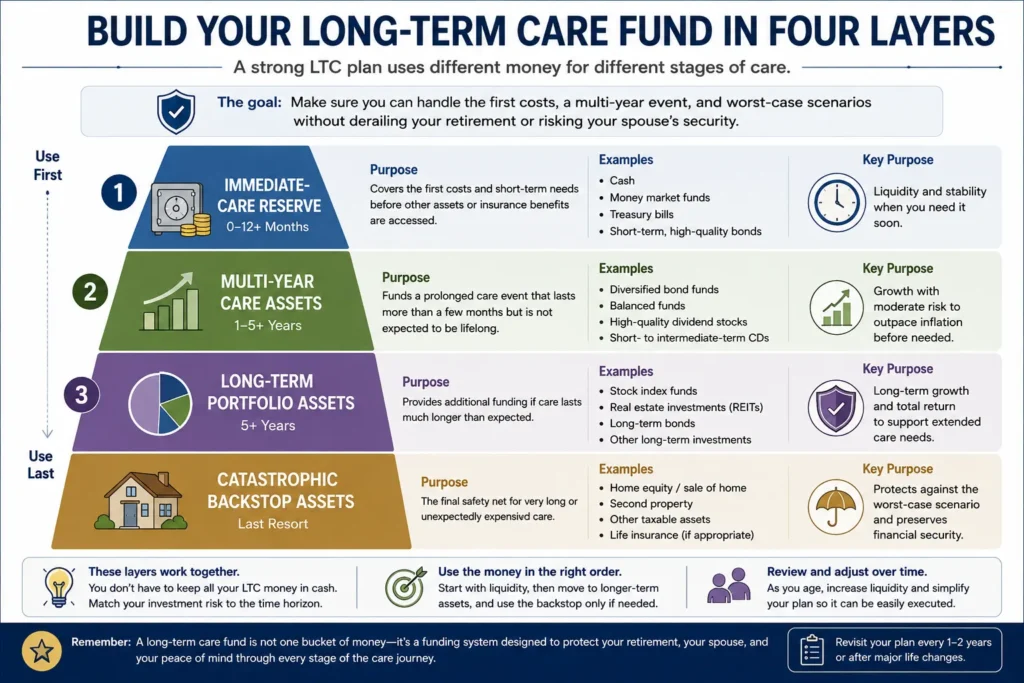
Build Your Long-Term Care Fund in Four Layers
Instead of asking:
“How much money do I need for long-term care?”
build the answer from four layers.
Layer 1 — Guaranteed Income
Start with income that continues regardless of the market.
Examples include:
- Social Security
- pensions
- annuity income
- other reliable recurring income
If your care costs $90,000 per year and guaranteed income covers $45,000, your portfolio isn’t facing a $90,000 problem.
It is facing approximately a:
$45,000 funding gap.
Layer 2 — Dedicated Liquid Assets
Next comes money that can be accessed without selling long-term investments during a market crash.
This might include:
- cash,
- money-market funds,
- Treasury bills,
- short-term Treasuries,
- or a conservative bond allocation.
This layer can cover the first months or years of care.
But don’t make the mistake of putting the entire LTC reserve in cash at age 65.
You may not need the money for 15, 20, or 25 years.
Inflation matters.
Layer 3 — Long-Term Portfolio Assets
The next layer is your investment portfolio.
Stocks are not inherently inappropriate for future LTC spending.
Time horizon matters.
If you’re 60 and planning for a potential expense at age 85, keeping the entire reserve in cash for 25 years introduces another risk:
purchasing-power erosion.
A long-term care reserve can therefore be invested differently depending on when the money might realistically be needed.
We’ll build that structure shortly.
Layer 4 — Home Equity and Other Backstop Assets
Finally, identify assets you would use only if a severe or prolonged care event occurred.
These might include:
- home equity,
- a second property,
- taxable investments,
- permanent life insurance cash value,
- or other nonessential assets.
The purpose of this layer isn’t to fund routine care.
It exists for the tail risk:
the unusually long or unusually expensive care event.
Once these four layers are visible, a frightening $300,000 long-term care problem often becomes a much more manageable series of smaller funding problems.
The Couple Problem: Don’t Simply Double the Number
Couples often make another planning mistake.
They calculate a $200,000 reserve for one person and conclude:
“We need $400,000.”
Maybe.
But not automatically.
Two spouses needing expensive long-term care at exactly the same time for exactly the same duration is possible, but it isn’t the only scenario worth planning around.
More commonly, care needs occur at different times.
That means the household may be able to reuse part of the same financial capacity.
However, couples have a different risk that singles don’t.
The healthy spouse still needs somewhere to live.
If one spouse enters a nursing home while the other remains at home, many household expenses do not disappear.
You may still have:
- property taxes,
- utilities,
- maintenance,
- groceries,
- transportation,
- insurance,
- and ordinary living expenses.
This can make the first spouse’s care event surprisingly expensive.
So instead of simply doubling your single-person LTC number, couples should model three scenarios:
Scenario A — One spouse needs care while the other remains healthy
Scenario B — The surviving spouse later needs care
Scenario C — Both spouses need care simultaneously
You don’t necessarily need enough cash sitting aside to fully finance Scenario C.
But your retirement plan should survive it.
That is a much better test.
The Question Isn’t “Can I Pay for Care?”
It’s:
“What Would I Have to Sacrifice to Pay for Care?”
This is the question that turns long-term care planning from an abstract insurance discussion into an actual retirement decision.
Suppose you have $1.5 million.
Technically, you can pay a $200,000 long-term care bill.
But what happens afterward?
Does it mean:
- your spouse must reduce spending?
- you sell investments during a bear market?
- the house has to be sold?
- your children receive substantially less inheritance?
- charitable plans disappear?
- or your surviving spouse faces a much weaker retirement?
If the answer is:
“Nothing important changes,”
you may have strong self-insurance capacity.
If the answer is:
“That would fundamentally change our retirement,”
you probably need another layer of protection.
And that’s where the size—and structure—of your long-term care fund becomes far more important.
Turn Your Long-Term Care Risk Into a Number
Now we can turn the framework into something you can actually use.
You don’t need to predict exactly how many years of care you will need.
You need a reasonable estimate of the financial gap your retirement plan would have to absorb.
A simple starting formula is:
Annual Care Cost
− Income Available During Care
− Expenses That Disappear
− Insurance Benefits
= Annual LTC Funding Gap
Then:
Annual LTC Funding Gap × Planning Period
= Base LTC Fund
Finally, add a margin for uncertainty.
Let’s see what that looks like.
Example 1: The $900,000 Retiree
Susan is 67 and single.
She has:
- $900,000 invested
- $36,000 per year from Social Security
- a paid-off $350,000 home
- no long-term care insurance
Her normal retirement spending is approximately $60,000 per year.
She decides to model a future assisted-living scenario using today’s dollars.
Illustrative Example
| Item | Annual Amount |
|---|---|
| Assisted living | $75,000 |
| Remaining personal expenses | $12,000 |
| Total spending during care | $87,000 |
| Social Security | −$36,000 |
| Estimated portfolio gap | $51,000 |
If Susan wants the portfolio to cover three years:
$51,000 × 3 = $153,000
She could round that target to approximately:
$175,000
to provide additional flexibility.
That does not mean Susan should move $175,000 into a savings account tomorrow.
It means approximately $175,000 of her retirement resources should eventually be capable of serving this purpose.
Her house provides another backstop if care becomes unusually long or expensive.
That is a long-term care plan.
“Hopefully my $900,000 will be enough” is not.
Illustrative example only. Actual costs, income, taxes, investment returns, and care needs will vary.
Example 2: The $1.6 Million Couple
Now consider David and Karen, both 65.
They have:
- $1.6 million invested
- $58,000 combined annual Social Security income
- a mortgage-free $550,000 home
- no traditional LTC insurance
Their normal retirement spending is $85,000 per year.
Instead of reserving $400,000 because there are two of them, they model the more difficult first-care scenario.
David enters a nursing facility while Karen remains at home.
Assume an illustrative annual care cost of:
$125,000
Karen still needs approximately $50,000 to maintain the household and her lifestyle.
Total household spending becomes:
$175,000
Their Social Security continues providing approximately:
$58,000
That leaves:
$117,000 per year
that may need to come from the portfolio.
That’s the important number.
One year is manageable.
Three or four consecutive years—especially during a bear market—could materially change Karen’s retirement.
For this household, simply saying:
“We have $1.6 million. We’ll self-fund.”
may be too casual.
A better strategy might combine:
- a dedicated liquid care reserve,
- long-term portfolio assets,
- some form of LTC insurance,
- and home equity as the final backstop.
They don’t necessarily need insurance to cover every dollar.
They need enough protection to prevent a severe care event from damaging the surviving spouse’s retirement.
That is a very different objective.
Illustrative example only.
Example 3: The $3.5 Million Household
Now consider another retired couple with:
- $3.5 million invested
- $70,000 of reliable annual retirement income
- an $800,000 paid-off home
- moderate retirement spending
They could still buy LTC insurance.
But the economics look different.
Suppose they experience a $250,000 care event.
That is painful.
But it represents roughly:
7% of their investment portfolio.
If their retirement plan remains financially strong after absorbing that loss, transferring the risk to an insurer may be less important.
They might instead designate:
$250,000–$350,000 of portfolio capacity
as their long-term care reserve.
They don’t necessarily need a separate account labeled “LTC.”
The reserve can remain part of the portfolio.
The important thing is that their retirement projections recognize that those assets may eventually be consumed by care.
This is what genuine self-funding looks like.
A Long-Term Care Fund Does Not Have to Be a Bank Account
This is one of the most important ideas in this article.
When I say:
“Build a $150,000 long-term care fund,”
I do not necessarily mean:
Put $150,000 into cash and never touch it.
For a 65-year-old, that could be a poor strategy.
The money may not be needed until age 80, 85, or 90.
Keeping decades of future spending entirely in cash exposes the reserve to inflation.
Instead, think of your LTC fund as a job assigned to part of your retirement portfolio.
You might mentally divide it into three buckets.
Bucket 1: Money You Could Need Soon
This is your immediate-care reserve.
Possible holdings include:
- cash,
- money-market funds,
- Treasury bills,
- short-term Treasuries,
- short-duration high-quality bonds.
This money is designed for accessibility and stability.
It might cover:
- home modifications,
- an initial caregiver,
- temporary rehabilitation,
- an insurance elimination period,
- or the first several months of care.
Bucket 2: Money for a Multi-Year Care Event
This money can take somewhat more investment risk because it probably won’t all be spent at once.
A diversified allocation of high-quality bonds and other portfolio assets may make sense depending on your overall retirement strategy.
The purpose is not to maximize returns.
It is to avoid keeping every future care dollar in cash for decades.
Bucket 3: Catastrophic-Care Assets
These are assets you would rather not use but could access if care lasted far longer than expected.
Examples might include:
- long-term investments,
- home equity,
- a second property,
- other taxable assets.
Think of these as your financial firewall.
If Bucket 1 and Bucket 2 are exhausted, Bucket 3 prevents the care event from becoming a family financial emergency.
Inflation Is the Part Most LTC Funds Get Wrong
Suppose you’re 65 today and decide:
“$150,000 should be enough.”
Then you leave exactly $150,000 earmarked for care.
But you don’t need care until age 85.
The problem is obvious.
Long-term care costs will probably not remain where they are today.
Let’s use a simple illustrative assumption of 3% annual care-cost inflation.
A $150,000 care need in today’s dollars would become approximately:
| Years From Now | Equivalent Cost at 3% Inflation |
|---|---|
| Today | $150,000 |
| 10 years | ~$202,000 |
| 15 years | ~$234,000 |
| 20 years | ~$271,000 |
| 25 years | ~$314,000 |
At 4% inflation, the difference becomes even larger.
After 20 years:
$150,000 × 1.04²⁰ ≈ $329,000
This doesn’t mean you need $329,000 sitting aside today.
It means the assets assigned to future care need some ability to grow before they are needed.
This is why a 60- or 65-year-old putting the entire LTC reserve into cash can create a different kind of risk.
Safety from market volatility is useful.
Safety from inflation matters too.
Long-term care is only one part of the equation; our guide to estimating your retirement healthcare costs shows how to build Medicare premiums, out-of-pocket expenses, and other medical spending into the broader retirement budget.
The HSA Can Become a Powerful Retirement Healthcare Asset
If you are eligible to contribute to a Health Savings Account before Medicare, the HSA deserves special attention.
It is one of the few accounts with unusually favorable federal tax treatment:
- eligible contributions can be deductible or pre-tax,
- investment growth can be tax-deferred,
- and qualified medical withdrawals can be tax-free.
For retirement planning, the interesting part is that qualified medical expenses can include certain long-term care expenses, subject to tax rules.
Qualified long-term care insurance premiums can also potentially be paid from an HSA tax-free, subject to age-based annual limits established by the IRS.
That makes the HSA potentially useful as part of the healthcare layer of a retirement portfolio.
But there is an important distinction.
Your HSA probably shouldn’t be your entire LTC plan.
Even a well-funded HSA may be too small to finance years of institutional care.
Think of it as another funding layer.
For example:
HSA → medical and qualified care expenses
Cash/bonds → initial care gap
Portfolio → extended care
Home equity → catastrophic backstop
That is much stronger than expecting one account to solve everything.
Should You Build an LTC Fund or Buy Insurance?
This doesn’t have to be an either/or decision.
If you’re still deciding whether transferring some of this risk makes sense, our guide to whether you really need long-term care insurance walks through the costs, trade-offs, and situations where coverage may—or may not—be worth it.
In fact, one of the most practical approaches is often:
Partial Self-Funding + Partial Insurance
Imagine your retirement plan could comfortably absorb:
$100,000 of care costs
but would become vulnerable if costs reached:
$300,000 or $400,000.
You don’t necessarily need insurance designed to pay the first dollar of care.
You may want insurance primarily for the risk your portfolio cannot comfortably absorb.
Conceptually:
You absorb the manageable loss.
Insurance protects against the damaging loss.
That is how people routinely think about other forms of insurance.
Long-term care can be approached similarly.
When Self-Funding May Make More Sense
Self-funding becomes increasingly attractive when:
- your portfolio is large relative to the potential care expense,
- you have substantial guaranteed income,
- you own significant home equity,
- paying premiums would meaningfully reduce current retirement spending,
- you value flexibility over how assets are eventually used,
- or you can absorb a large care event without threatening a spouse’s security.
The key phrase is:
without threatening the rest of the retirement plan.
Having enough money to physically pay a nursing-home bill is not the same as being able to comfortably self-insure.
When Insurance Deserves a Closer Look
Insurance may become more valuable when:
- a $200,000–$400,000 care event could materially damage your portfolio,
- one spouse’s care could jeopardize the other spouse’s retirement,
- protecting an inheritance is important,
- you don’t want adult children becoming the default care plan,
- you have limited home equity,
- or predictable premiums are preferable to accepting a large uncertain liability.
The decision is rarely:
Insurance good. Self-funding bad.
Or the reverse.
The real question is:
Which risks can your balance sheet comfortably retain, and which risks should be transferred?
Don’t Build the Fund by Destroying Your Retirement
There is a strange paradox in long-term care planning.
People sometimes become so worried about future care that they sacrifice the retirement they are trying to protect.
Imagine a healthy 66-year-old couple.
They stop traveling.
They avoid helping their grandchildren.
They keep an enormous amount in cash.
They refuse to spend money on things they value.
Why?
Because someday one of them might need expensive care.
Twenty years later, perhaps neither does.
They protected themselves from one risk by guaranteeing another:
underliving their retirement.
A good LTC fund should create confidence.
It should not become a financial shrine that nobody is allowed to touch.
The goal is resilience—not maximum fear.
The “Retirement Floor” Approach
One useful way to think about self-funding is to establish a portfolio floor.
Suppose you retire with:
$1.8 million
and determine that your retirement remains comfortable as long as investable assets stay above approximately:
$1.2 million
That gives you roughly:
$600,000 of financial capacity
above your retirement floor.
You obviously don’t want to spend all of it on care.
But it tells you something important.
A $150,000–$200,000 care event may be absorbable without fundamentally changing the retirement.
Now imagine someone with:
$700,000
whose plan becomes fragile below:
$550,000.
Their margin is only:
$150,000.
A $250,000 care event is a fundamentally different risk for this household.
Same nursing home.
Same bill.
Completely different financial consequence.
That’s why universal LTC savings targets are not very useful.
How Much Should You Actually Target?
Here’s a practical starting framework.
These are planning ranges, not financial rules.
| Financial Situation | LTC Funding Approach |
|---|---|
| Limited retirement assets | Preserve retirement liquidity; evaluate insurance and potential Medicaid exposure |
| Strong income but moderate assets | $50K–$150K accessible reserve + risk-transfer strategy |
| $750K–$1.5M investable assets | Consider roughly $100K–$200K of LTC capacity plus insurance/home equity |
| $1.5M–$3M | $150K–$300K+ self-funded capacity or hybrid strategy |
| $3M+ | Larger portfolio-designated reserve; full self-funding increasingly viable |
Do not take this table and automatically transfer that amount into cash.
Use it to ask:
How much LTC loss can my retirement plan absorb before something important has to change?
That is your real starting number.
Your Long-Term Care Fund Should Change as You Age
The plan you create at 60 should not remain untouched until 90.
At 60, care may be decades away.
Your LTC assets can generally remain integrated with your long-term investment portfolio.
At 70, the risk horizon is shorter.
You may gradually increase the amount of stable, accessible assets.
At 80, liquidity becomes much more important.
And once early signs of care needs appear, the priority can shift dramatically from long-term growth toward:
accessibility, simplicity, and capital preservation.
You can think of it as a glide path.
Age 55–65
Identify the risk.
Decide whether insurance belongs in the plan.
Build HSA assets where eligible.
Keep long-horizon LTC money invested appropriately.
Age 65–75
Recalculate care costs.
Review insurance.
Identify which portfolio assets would fund care.
Begin strengthening liquidity.
Age 75–85
Increase accessible reserves where appropriate.
Simplify accounts.
Make sure a spouse or trusted family member understands the plan.
Review housing decisions.
Age 85+
Liquidity and execution may matter more than portfolio optimization.
At this stage, the best LTC plan is one someone can actually use.
The Administrative Risk Nobody Models
There is another long-term care risk that has nothing to do with money.
You may not be the person managing your finances when the money is needed.
Cognitive decline, stroke, dementia, or serious illness can make a beautifully optimized retirement portfolio useless if nobody knows how to access it.
Your LTC plan should therefore answer:
- Who can legally manage the finances?
- Where are the accounts?
- Which account pays for care first?
- Is there a durable financial power of attorney?
- Where are insurance policies stored?
- Who knows how to file a claim?
- What happens to the house?
- Which assets should not be sold unless absolutely necessary?
This may be more important than squeezing another 0.5% of return from the LTC reserve.
A complicated plan that only you understand is not a complete plan.
Five Mistakes to Avoid
1. Assuming Medicare Will Pay for Years of Custodial Care
Medicare can cover certain skilled nursing and home health services under specific conditions.
It is not a general insurance program for years of custodial long-term care.
Building your plan around Medicare paying the entire bill can leave a major funding gap.
For a broader look at what Medicare does—and doesn’t—pay for after you retire, see our guide to how much Medicare really costs in retirement.
2. Keeping the Entire Reserve in Cash for Decades
Liquidity is valuable.
Twenty-five years of inflation is expensive.
Match the investment strategy to the likely time horizon.
3. Ignoring the Healthy Spouse
The care recipient isn’t the only person whose financial security matters.
Model what happens to the spouse who remains at home.
4. Treating the House as Either Untouchable or Worthless
Both extremes can distort the plan.
Home equity can be a powerful late-stage funding resource without necessarily becoming the first source of care money.
5. Choosing a Target Without Testing the Portfolio
A $200,000 LTC fund means very different things inside a:
$600,000 portfolio
and a:
$3 million portfolio.
Always test the care event against the entire retirement plan.
FAQ
Is $100,000 enough for long-term care?
It can be a meaningful reserve, but it is not enough to guarantee coverage of every long-term care scenario.
At today’s national costs, $100,000 could cover a substantial period of assisted living or in-home care, but prolonged nursing-home care can exceed that amount quickly.
The more useful question is how much of the care expense will already be covered by income, insurance, reduced living expenses, and other assets.
Your Medicare coverage choice also affects the healthcare expenses surrounding your LTC plan, so it helps to understand the trade-offs between Medigap and Medicare Advantage before estimating your total retirement healthcare reserve.
Is $200,000 enough?
For many retirees, $200,000 represents significant self-funding capacity.
Combined with Social Security, pensions, home equity, and other portfolio assets, it can absorb many—not all—care scenarios.
But a prolonged nursing-home or memory-care event can still exceed it.
Should I keep my LTC fund in cash?
Usually not all of it, especially if you are decades away from potentially needing care.
Near-term reserves should generally emphasize liquidity and stability.
Money that may not be needed for 15–25 years can potentially remain invested as part of a diversified retirement portfolio.
Your asset allocation should reflect your individual risk tolerance and overall financial plan.
Can I use my 401(k) or IRA for long-term care?
Yes.
Retirement accounts can provide money for care, but withdrawals from traditional tax-deferred accounts generally create taxable income.
Large withdrawals can also affect other parts of your tax and retirement picture.
The account balance therefore isn’t necessarily equal to the amount available to spend after taxes.
Should I use my home to pay for long-term care?
Home equity can be an important backstop, particularly when the home is no longer needed by you or a spouse.
But relying exclusively on the home creates liquidity and timing risks.
It is usually better treated as one layer of the funding strategy rather than the entire strategy.
What if I never need long-term care?
Then assets that remained in your portfolio are still yours.
They can support retirement spending, a surviving spouse, heirs, or charitable goals.
This flexibility is one of the major advantages of self-funding compared with strategies that require transferring money or premiums elsewhere.
What if I can’t afford to build a large LTC fund?
Do not destroy your current retirement trying to create an unrealistic reserve.
Start by understanding your actual resources:
- guaranteed income,
- savings,
- insurance,
- home equity,
- family support,
- and potential Medicaid eligibility.
For households with limited assets, the goal may not be to accumulate a $200,000 dedicated care reserve.
It may be to preserve enough liquidity for the early stages of care while understanding what Medicaid may eventually cover, what assets may be protected under applicable rules, and what support may realistically be available.
The worst strategy is pretending the risk doesn’t exist simply because fully self-funding it isn’t possible.
How many years of long-term care should I plan for?
There is no single duration that works for everyone.
Rather than trying to predict exactly how long you will need care, stress-test several scenarios.
For example:
Scenario 1: One year of moderate home or assisted-living care.
Scenario 2: Three years of substantial care.
Scenario 3: A prolonged five-year or longer event.
Then ask whether each scenario merely reduces your assets or actually threatens the financial security of you or your spouse.
You do not necessarily need to fully pre-fund the worst imaginable scenario.
But you should know what would happen if it occurred.
When should I start building a long-term care fund?
Ideally, long before you expect to need it.
Your 50s and early 60s are particularly useful planning years because you may still have:
- employment income,
- retirement-plan contributions,
- HSA eligibility,
- a long investment horizon,
- and more insurance options than you may have later.
But starting later is still better than having no plan.
At 70 or 75, the strategy may simply emphasize liquidity, portfolio positioning, housing, insurance already in force, and clear instructions for family members.
Should my long-term care fund be separate from my retirement portfolio?
Not necessarily.
For many retirees, creating a separate account is psychologically useful because it makes the money’s purpose clear.
But financially, the LTC reserve can remain part of the broader retirement portfolio.
The important thing is that you know:
how much capacity is available, where the money will come from, and what gets sold first.
A label on an account does not create a plan.
A funding strategy does.
Final Thoughts
Long-term care is one of the strangest expenses in retirement.
You may never have a major bill.
Or it may become one of the largest expenses of your life.
That uncertainty tempts us to search for a perfect number:
$100,000?
$200,000?
$300,000?
But the number by itself isn’t the plan.
Consider two retirees who each have $200,000 available for long-term care.
One has $30,000 of annual Social Security income, rents an apartment, and owns a $600,000 investment portfolio.
The other has $70,000 of guaranteed annual income, a $2.5 million portfolio, and an $800,000 mortgage-free home.
They may have identical “LTC funds.”
They do not have identical long-term care risk.
That’s why the better question isn’t:
How much does long-term care cost?
It is:
How much of that cost would my retirement plan actually have to absorb?
Start there.
Subtract the income that continues.
Account for expenses that disappear.
Include insurance benefits if you have them.
Identify the assets that could reasonably pay the remaining gap.
Then stress-test what happens if care lasts longer than expected.
You may discover that you need insurance.
You may discover that $100,000–$200,000 of designated portfolio capacity is enough to make your plan resilient.
You may discover that your assets are large enough to self-fund the risk.
Or you may discover that home equity and eventual Medicaid eligibility need to be part of the conversation.
None of those answers is automatically right or wrong.
The objective isn’t to eliminate every possible financial risk from retirement.
You can’t.
The objective is to make sure one expensive chapter of life doesn’t unexpectedly rewrite everything that came before it.
Retirement Playbook: Build Your Long-Term Care Fund
You don’t need to predict your future health.
You need to decide how your retirement would pay the bill if care becomes necessary.
Work through these steps.
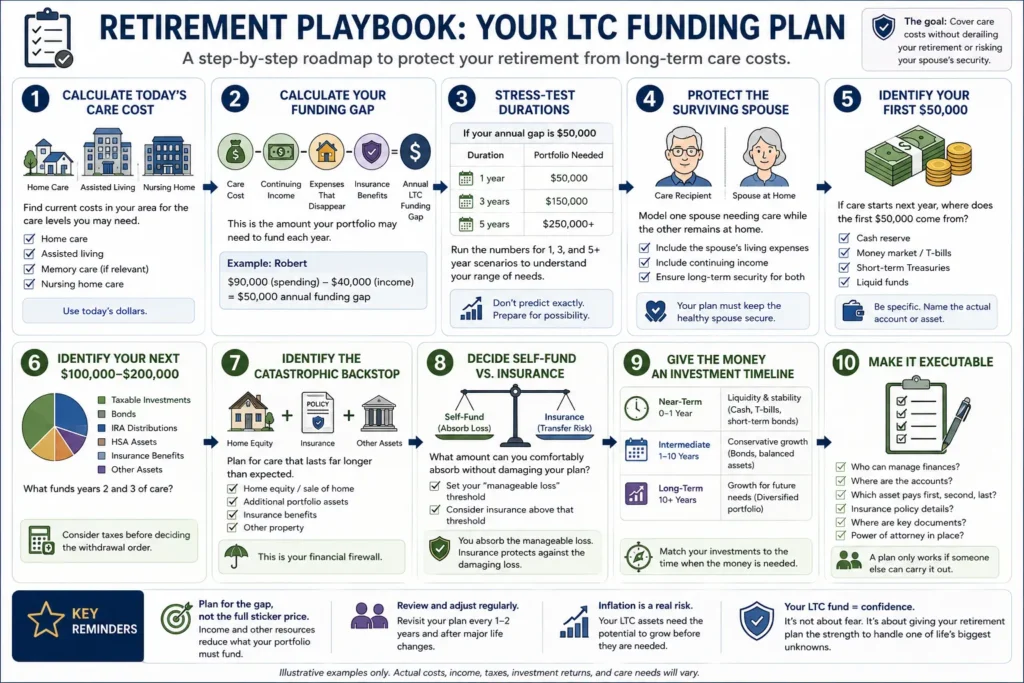
Step 1 — Estimate the Cost Where You Expect to Retire
Do not rely only on the national median.
Find current costs for:
- home care,
- assisted living,
- memory care if relevant,
- and nursing-home care
in the area where you realistically expect to live.
Use today’s dollars first.
Do not mix today’s portfolio value with care costs inflated 20 years into the future.
Step 2 — Calculate Your Annual Funding Gap
Use:
**Expected annual care cost
- remaining living expenses
− Social Security
− pension/other reliable income
− insurance benefits
= annual LTC funding gap**
This is usually much more useful than simply multiplying the advertised price of a nursing-home room by three.
Step 3 — Test Three Durations
Run the funding gap for:
1 year
3 years
5+ years
For example, if your annual funding gap is $50,000:
| Care Duration | Portfolio Funding Required |
|---|---|
| 1 year | $50,000 |
| 3 years | $150,000 |
| 5 years | $250,000 |
Illustrative example only; excludes future inflation, taxes, investment returns, and changing care needs.
You now have a range instead of a false-precision target.
Step 4 — Run the Surviving-Spouse Test
For couples, assume one spouse needs expensive care while the other remains at home.
Ask:
Can we pay for the care without financially damaging the healthy spouse?
Do not assume ordinary household spending disappears.
This is often the scenario that reveals whether your LTC strategy is actually strong enough.
Step 5 — Identify Your First $50,000
If care began next year, where would the first $50,000 come from?
Write down the actual account.
Not:
“Our investments.”
Instead:
“Cash reserve first, then short-term Treasuries in the taxable brokerage account.”
The more specific the answer, the more useful the plan.
Step 6 — Identify Your Next $100,000–$200,000
Now assume care continues.
Which assets fund year two and year three?
Possible sources include:
- taxable investments,
- bonds,
- IRA distributions,
- HSA assets for eligible expenses,
- LTC insurance benefits,
- or other designated retirement assets.
Consider the tax consequences before deciding the withdrawal order.
Step 7 — Identify the Catastrophic Backstop
Now model the scenario you hope never happens.
Care lasts five years or longer.
What gets used then?
Possibilities include:
- additional portfolio assets,
- home equity,
- insurance benefits,
- sale of other property,
- or eventual Medicaid planning where applicable.
You don’t necessarily need this money sitting in cash.
You need to know that the financial capacity exists.
Step 8 — Decide How Much Risk You Want to Transfer
Now ask:
At what dollar amount would long-term care stop being an inconvenience and start threatening our retirement?
Perhaps you can comfortably absorb:
$75,000.
Maybe:
$150,000.
Maybe:
$300,000.
Above that threshold, insurance may become more valuable.
Below it, self-funding may be reasonable.
This is a much better way to evaluate LTC insurance than asking whether insurance is simply “worth it.”
Step 9 — Give the Money an Investment Timeline
Don’t invest money needed next year the same way as money potentially needed 20 years from now.
Think in layers:
Near-term care money → liquidity and stability
Intermediate care money → conservative portfolio assets
Long-term care capacity → diversified retirement portfolio
Catastrophic risk → portfolio/home equity/insurance backstop
Your LTC fund is not one bucket.
It is a funding system.
Step 10 — Make Sure Someone Else Can Execute the Plan
Write down:
- where the money is,
- which assets should be used first,
- insurance policy information,
- key contacts,
- where legal documents are stored,
- and who has authority to act if you cannot.
Then make sure the appropriate spouse, family member, attorney, or trusted person knows the plan exists.
A long-term care strategy that disappears when you lose the ability to manage it isn’t much of a strategy.
The 15-Minute Long-Term Care Test
If you want the shortest version of this entire article, answer these seven questions:
- What does one year of care cost where I live?
- How much reliable income would continue during care?
- What would my annual funding gap be?
- Can my portfolio cover three years of that gap?
- If I’m married, is my spouse still financially secure afterward?
- What asset pays first, second, and last?
- Who can execute this plan if I cannot?
If you can answer all seven, you are far ahead of someone who merely says:
“I have enough retirement savings. We’ll deal with it.”
One Number to Remember
If there is one number worth calculating after reading this article, it isn’t:
the price of a nursing home.
It is your:
Annual LTC Funding Gap
Once you know that number, almost every other decision becomes easier.
You can estimate how much portfolio capacity you need.
You can determine whether insurance would materially improve the plan.
You can decide how much liquidity to maintain.
You can understand whether home equity matters.
And you can see whether an expensive care event threatens your spouse—or merely reduces your estate.
Long-term care planning becomes much less frightening when an unknown future bill becomes a defined financial problem.
You may not know whether you’ll need care.
You may not know when.
You may not know for how long.
But you can know how you would pay for it.
And that is what a long-term care fund is really for.
Coming Next
Long-term care isn’t the only retirement expense that can quietly grow faster than your original plan.
Another major risk sits inside almost every retirement budget:
healthcare inflation.
In the next Retirement Playbook, we’ll look at:
How Healthcare Inflation Can Destroy Your Retirement Budget—and How to Plan for It
We’ll examine why simply increasing today’s Medicare and healthcare budget by ordinary inflation can underestimate future costs, how a higher healthcare inflation rate changes a 20- or 30-year retirement projection, and how to build that uncertainty into your retirement income plan without unnecessarily overfunding healthcare.