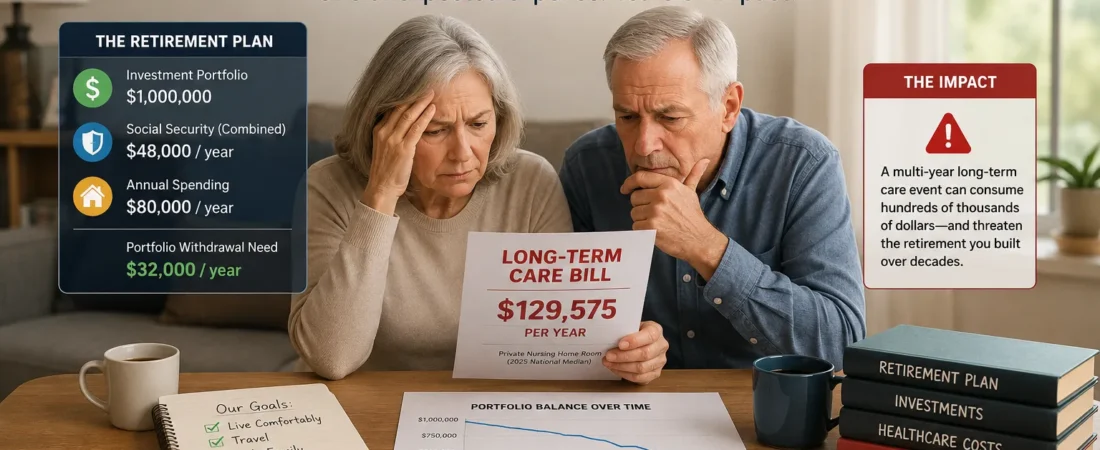
Long-term care costs can turn a seemingly comfortable $1 million retirement portfolio into a much more fragile financial plan. The real risk isn’t one large bill—it’s what happens when years of care, normal retirement spending, and a market downturn arrive at the same time.
$1 Million Felt Like Enough—Until the Math Changed
At 65, Richard and Ellen had what many Americans would consider a successful retirement portfolio.
$1 million invested.
Their mortgage was paid off.
Social Security covered a meaningful portion of their basic expenses.
They weren’t planning extravagant vacations or a second home.
Their goal was simpler.
Live comfortably.
Travel occasionally.
Help the grandchildren when they could.
And never become financially dependent on their children.
Their retirement plan looked solid.
Then Richard turned 78.
What began as occasional forgetfulness became something more serious.
First, Ellen started managing his medications.
Then she stopped leaving him home alone.
Eventually, Richard needed professional help.
And the retirement calculation that had worked for 13 years suddenly stopped working.
Not because the stock market crashed.
Not because they had spent recklessly.
Not because they retired too early.
Their plan changed because they had added an expense that could rival—or exceed—their entire normal retirement budget:
long-term care.
That is the uncomfortable truth behind a $1 million retirement portfolio.
A million dollars can provide a very comfortable retirement under one set of assumptions.
Under another, it can disappear much faster than most retirees expect.
Why $1 Million Can Be Misleading
Retirement planning loves round numbers.
$500,000.
$1 million.
$2 million.
They feel like milestones.
But a portfolio balance tells you surprisingly little by itself.
Two couples can retire with exactly $1 million and experience completely different outcomes.
One might comfortably leave money to their children.
Another might struggle in their 80s.
The difference comes from everything surrounding that number:
- Social Security income
- Pension income
- Annual spending
- Taxes
- Investment returns
- Inflation
- Housing costs
- Retirement length
- Healthcare expenses
- Long-term care
If you’re still building the healthcare side of your retirement budget, start with our step-by-step guide to estimating your retirement healthcare costs before you stop working.
That’s why asking:
“Is $1 million enough to retire?”
isn’t really the right question.
A better question is:
“What does my $1 million portfolio have to pay for?”
Long-term care can dramatically change the answer.
Start With a Normal $1 Million Retirement
Let’s build a simplified example.
Assume a married couple retires at 65 with:
Investment portfolio: $1,000,000
Combined Social Security: $48,000 per year
Annual household spending: $80,000
For simplicity, assume these figures are expressed in today’s dollars and ignore taxes for the moment.
Social Security covers $48,000 of their spending.
That leaves:
$32,000 per year
that needs to come from the portfolio.
That’s a starting withdrawal rate of roughly:
3.2%
On paper, that doesn’t look particularly aggressive.
The portfolio isn’t being asked to finance their entire lifestyle.
Social Security is doing a substantial amount of the work.
This is why Richard and Ellen could reasonably feel comfortable.
But now let’s change one variable.
How Long-Term Care Costs Change the Math
Long-term care isn’t a single price.
The cost depends heavily on where you live, how much help you need, and where that care is delivered.
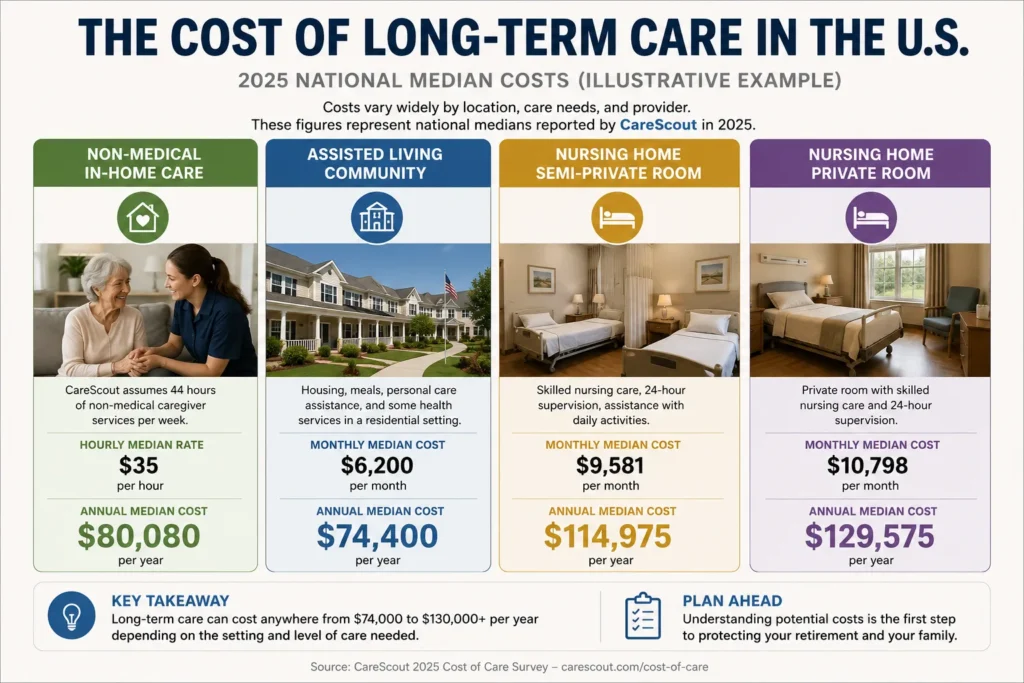
CareScout’s 2025 national median figures illustrate the scale of the expense:
| Type of Care | 2025 National Median |
|---|---|
| Non-medical in-home caregiver* | $80,080/year |
| Assisted living community | $74,400/year |
| Nursing home — semi-private room | $114,975/year |
| Nursing home — private room | $129,575/year |
*CareScout’s in-home figure assumes 44 hours of non-medical caregiver services per week.
These are national medians, not forecasts or quotes. Actual costs can vary dramatically by location and level of care.
But they reveal something important.
A retiree who previously needed $32,000 from a portfolio each year could suddenly need tens of thousands—or potentially more than $100,000—of additional annual cash flow.
That’s not a minor budget adjustment.
It’s a completely different retirement.
Scenario 1: One Year of Long-Term Care
Let’s assume Richard requires a private nursing home room for one year.
Using the 2025 national median as an illustration:
Normal portfolio withdrawal: $32,000
Long-term care: $129,575
Potential total portfolio demand:
$161,575
That’s more than 16% of the original $1 million portfolio in a single year before considering taxes, market movements, or other changes in household spending.
Of course, real life isn’t quite that simple.
Some normal household expenses may decline when one spouse enters residential care.
Some retirees have long-term care insurance.
Some have pensions or other income.
Others may use home equity.
But the basic point remains:
One expensive care year can consume several years’ worth of normal retirement withdrawals.
Scenario 2: Three Years of Long-Term Care
Now the math becomes more uncomfortable.
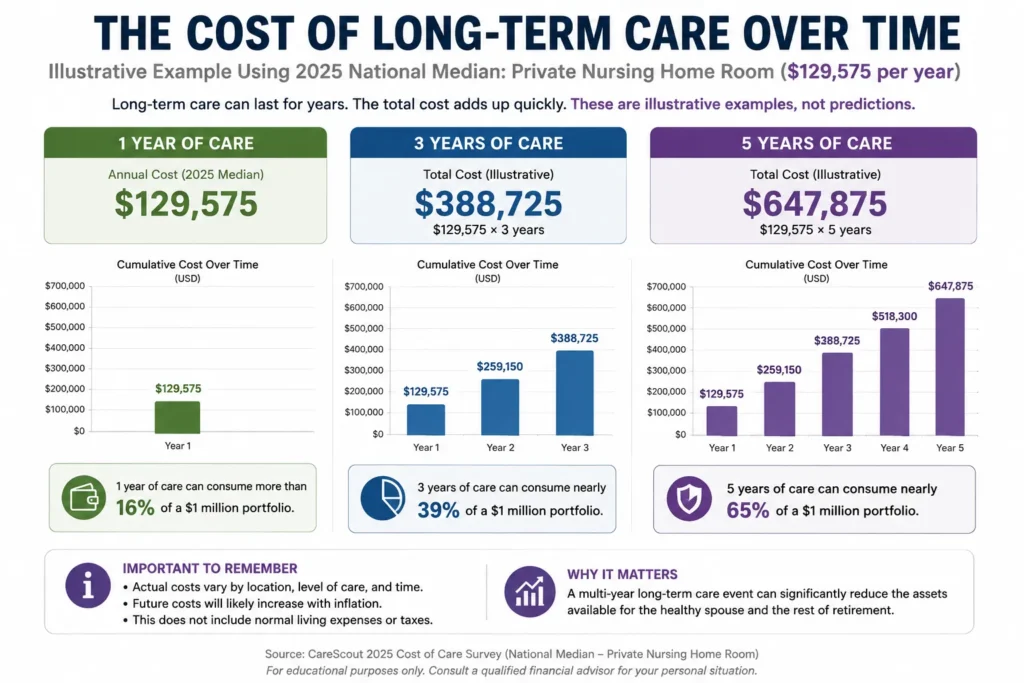
Suppose Richard requires three years of private-room nursing care.
If we simply held today’s national median cost constant for illustration:
$129,575 × 3 = $388,725
Nearly $389,000.
And that’s just the care.
It doesn’t include the continuing living expenses of the healthy spouse.
It doesn’t account for future increases in care costs.
It doesn’t include taxes that might be triggered by larger retirement-account withdrawals.
And it doesn’t consider what the investment market happens to be doing while those withdrawals occur.
This is where a $1 million portfolio can begin to feel much smaller.
Scenario 3: Five Years Changes the Entire Retirement
Extend the same simplified calculation to five years.
$129,575 × 5 = $647,875
Again, that’s not a forecast.
It doesn’t mean every person needing long-term care will spend $647,875.
Many people receive less intensive care.
Some receive unpaid family care.
Some spend fewer years receiving care.
Some use assisted living or part-time home care rather than a private nursing home room.
But the scenario demonstrates the financial risk.
A multi-year high-cost care event doesn’t simply increase retirement spending.
It can fundamentally change who the remaining retirement assets are able to support.
And that leads to the part of the calculation that often gets overlooked.
The Healthy Spouse Problem
Imagine Richard dies after several years of care.
The long-term care bills stop.
The financial problem doesn’t necessarily stop with them.
Ellen is now 83.
She may live another 10 years.
Or 15.
Or longer.
She still needs:
- Housing
- Food
- Transportation
- Medicare
- Supplemental insurance
- Prescription drugs
- Property taxes
- Home maintenance
- Her own future long-term care
And household income may change after Richard’s death.
This is why long-term care planning should never ask only:
“Can we afford his care?”
The better question is:
“After paying for his care, can she still afford her retirement?”
That distinction changes everything.
A couple might technically have enough assets to pay several hundred thousand dollars for care.
But spending the money could leave the surviving spouse with a dramatically weaker retirement plan.
Being able to pay a bill is not the same as being able to afford it.
Medicare Doesn’t Solve This Problem
Another common assumption is that a six-figure long-term care bill would largely become Medicare’s problem.
For custodial long-term care, that generally isn’t how Medicare works.
Medicare may cover certain qualifying skilled nursing and home health services, but it does not generally pay for ongoing custodial long-term care simply because someone needs help with activities such as bathing, dressing, or using the bathroom.
That means many long-term care expenses ultimately need another funding source:
- Personal savings
- Retirement accounts
- Long-term care insurance
- Hybrid insurance
- Home equity
- Family resources
- Medicaid for people who meet applicable eligibility requirements
This is why long-term care deserves its own line in a retirement plan.
It isn’t simply a larger version of your normal Medicare budget.
It’s a separate financial risk.
For a broader look at what Medicare does—and doesn’t—pay for after you retire, see our guide to how much Medicare really costs in retirement.
Home Care vs. Assisted Living vs. Nursing Home
The good news is that long-term care doesn’t automatically mean a $130,000 nursing home bill.
Care exists on a spectrum.
A retiree needing several hours of help each week may spend far less than someone requiring around-the-clock supervision.
Using 2025 national medians, assisted living was about $74,400 per year, while a non-medical caregiver providing 44 hours of weekly in-home care worked out to about $80,080 per year.
A semi-private nursing home room was approximately $114,975 per year, while a private room reached approximately $129,575.
The important variable isn’t simply:
Will I need long-term care?
It’s also:
What level of care will I need, for how long, and where will I receive it?
Those three questions can change the financial outcome by hundreds of thousands of dollars.
And we still haven’t introduced one of the most dangerous variables of all.
What happens if the care bills arrive at exactly the same time the stock market falls?
What If Long-Term Care Arrives During a Bear Market?
This is where the mathematics becomes much more dangerous.
Imagine Richard enters long-term care at 78.
His portfolio is already funding part of the couple’s retirement.
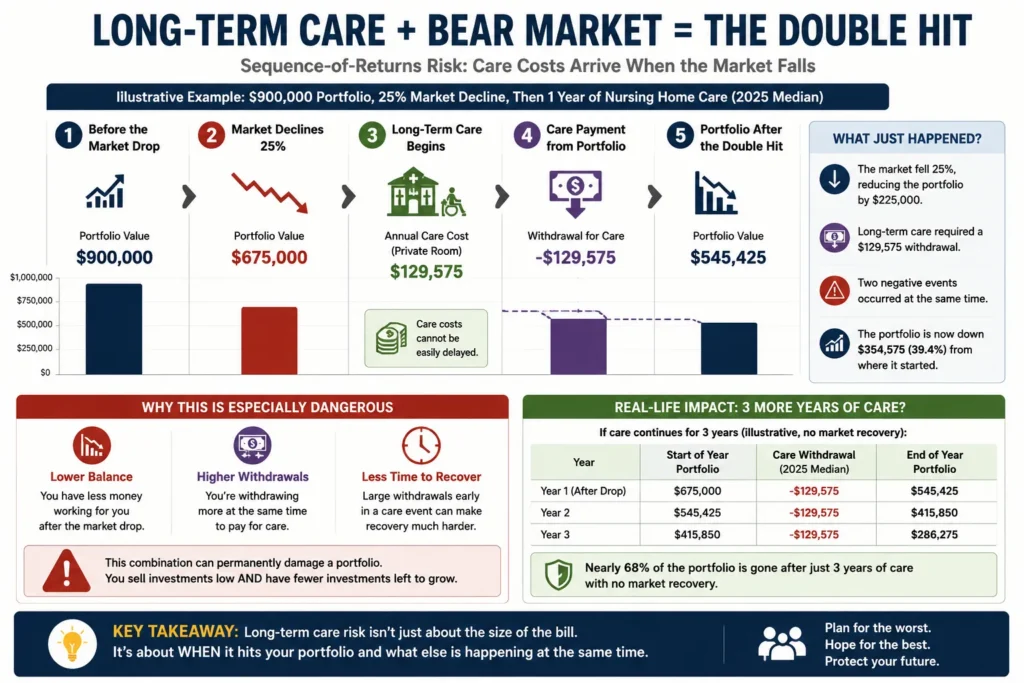
Then the stock market falls 25%.
At almost exactly the same time, the family begins withdrawing substantially more money to pay for care.
Now two things are happening simultaneously:
The portfolio is worth less.
And:
The family is withdrawing more from it.
That’s one of the worst combinations a retirement portfolio can experience.
Long-Term Care Creates Its Own Sequence-of-Returns Risk
Sequence-of-returns risk is usually discussed in the first few years of retirement.
A retiree begins withdrawing money just as markets fall, forcing them to sell more shares when prices are depressed.
Those shares are no longer available to participate in the eventual recovery.
But a similar problem can appear much later in retirement.
Suppose a portfolio worth $900,000 falls 25%.
It is now worth approximately:
$675,000
If the retiree then needs roughly $130,000 for a year of private-room nursing care, the withdrawal represents nearly 20% of the reduced portfolio.
Another difficult market year combined with another year of care can compound the damage.
The danger isn’t simply:
“Long-term care is expensive.”
It’s:
“Long-term care can force unusually large withdrawals at exactly the wrong time.”
And unlike discretionary travel or charitable giving, care expenses may not be easy to postpone until markets recover.
Why Cutting Spending May Not Save You
Normally, retirees have several ways to respond to a bear market.
Delay the expensive vacation.
Keep the car another year.
Reduce gifts.
Postpone a renovation.
Spend a little less until markets recover.
This flexibility can dramatically improve retirement resilience.
Long-term care removes much of that flexibility.
You can’t necessarily tell a caregiver:
“The S&P 500 is down this year, so we’ll try again next summer.”
Care is needed when care is needed.
That makes long-term care fundamentally different from many other retirement expenses.
It’s potentially large, unpredictable, and difficult to postpone.
Those are exactly the characteristics that make an expense dangerous to a retirement portfolio.
$500,000 vs. $1 Million vs. $2 Million
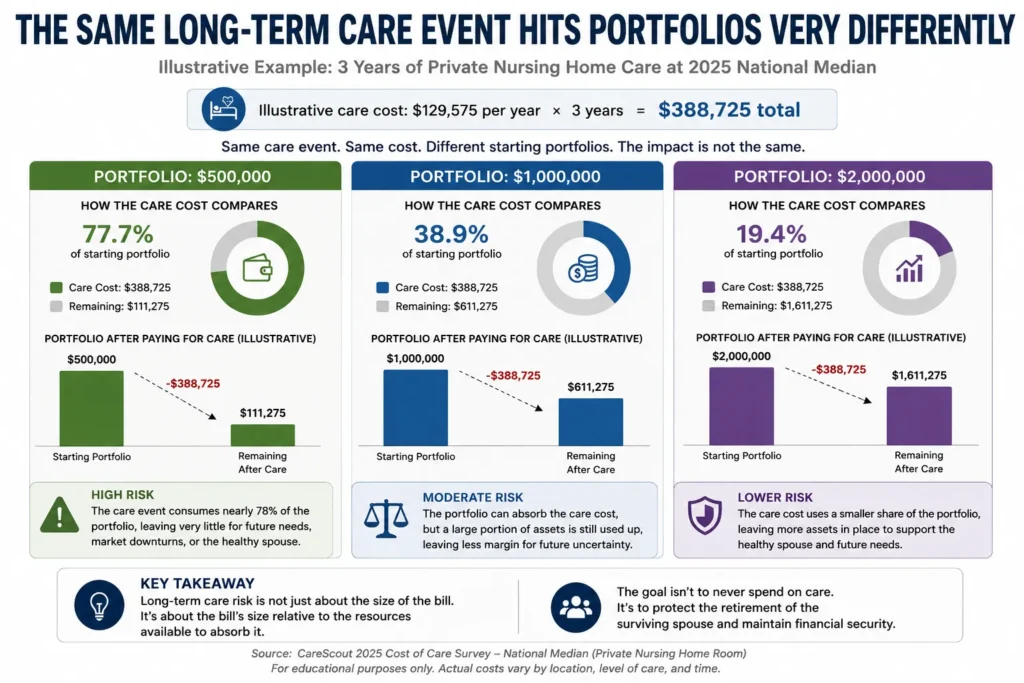
Now let’s look at the same care event across three different portfolios.
We’ll use a simplified example of three years of private-room nursing care at today’s 2025 national median of $129,575 per year.
That produces an illustrative care bill of:
$388,725
Actual costs could be substantially higher or lower depending on location, duration, inflation, insurance coverage, and the level of care required.
But holding the care expense constant allows us to see how differently the same event affects different retirees.
| Starting Portfolio | 3 Years of Illustrative Care | Care Cost as % of Starting Portfolio |
|---|---|---|
| $500,000 | $388,725 | 77.7% |
| $1,000,000 | $388,725 | 38.9% |
| $2,000,000 | $388,725 | 19.4% |
This table is deliberately simple.
It doesn’t include investment returns, taxes, Social Security, normal living expenses, or changes in household spending.
But that’s precisely why it’s useful.
The same healthcare event can be:
Potentially devastating for one household.
Highly disruptive for another.
Manageable for a third.
Long-term care risk isn’t defined only by the size of the bill.
It’s defined by the size of the bill relative to the resources available to absorb it.
Why $1 Million Is the Awkward Middle
A household with $500,000 may already recognize that a prolonged private-pay nursing home stay would be extremely difficult to self-fund.
A household with $5 million may reasonably conclude that it can reserve enough assets to absorb the risk.
But around the middle—$1 million, $1.5 million, perhaps $2 million depending on spending and income—the decision becomes more complicated.
You may have enough assets to pay for care.
But not enough to pay for care without consequences.
That’s the distinction that matters.
A retiree with $1 million might technically be able to write a $130,000 check.
But what happens after the second check?
And the third?
What happens to the surviving spouse?
What happens if that spouse eventually needs care too?
What happens if the withdrawals come from tax-deferred retirement accounts?
What happens if markets are down?
The question isn’t whether your portfolio can pay for long-term care.
The question is what remains after it does.
Your House May Be Part of the Answer
For many retirees, their investment portfolio isn’t their only major asset.
Their home may represent hundreds of thousands of dollars of additional wealth.
That creates another planning option.
If one or both spouses permanently move into residential care, selling the home may eventually release equity that can help fund care.
Other households may consider different home-equity strategies depending on their circumstances.
But home equity shouldn’t automatically be counted as a free pool of long-term care money.
The healthy spouse may still live there.
Selling may be emotionally difficult.
Transaction and moving costs exist.
And the timing may be terrible.
Still, ignoring home equity completely can make a retirement plan unnecessarily pessimistic.
A good long-term care stress test should examine both liquid investments and housing wealth.
Five Ways to Protect the Portfolio
You don’t need to predict exactly whether you’ll need long-term care.
You need to decide what will pay for it if you do.
There are several ways to make a retirement portfolio more resilient.
1. Transfer Some of the Risk With Insurance
Traditional long-term care insurance or certain hybrid policies can transfer part of the financial risk to an insurer.
The goal doesn’t necessarily have to be covering every dollar.
For some households, insuring against several years of high-cost care may be enough to prevent a catastrophic portfolio drawdown.
Insurance works best when you’re transferring a risk that would otherwise be financially painful to absorb yourself.
If you’re considering transferring some of this risk, our guide to whether long-term care insurance is worth it in retirement explains who should consider coverage—and when self-funding may make more sense.
2. Create a Dedicated Long-Term Care Reserve
Self-insuring doesn’t have to mean:
“We’ll just take money from the portfolio if something happens.”
That’s not a plan.
Instead, designate part of your retirement assets specifically for future care.
For example, a household might mentally—or physically—separate a portion of its conservative assets from the money funding normal retirement spending.
The exact amount depends on the household.
The important part is recognizing that those dollars have a job.
They’re not vacation money.
They’re not inheritance money.
They’re a buffer against future care expenses.
3. Build Spending Flexibility Into Retirement
Suppose your normal retirement lifestyle costs $90,000 per year.
How much of that spending is essential?
Perhaps $60,000 is relatively fixed.
The remaining $30,000 might include travel, entertainment, gifts, restaurants, and other discretionary spending.
If a care event occurs, some discretionary spending may naturally decline.
That doesn’t make long-term care inexpensive.
But it means the full care bill shouldn’t always simply be added on top of the existing retirement budget.
A realistic stress test should model what spending would actually change.
4. Include Home Equity in the Contingency Plan
Don’t assume you’ll sell your home.
But decide what circumstances might make selling reasonable.
For example:
- Both spouses permanently enter residential care.
- The surviving spouse no longer wants to maintain the property.
- Home modifications become impractical.
- Care needs make relocation unavoidable.
Making those decisions before a crisis can prevent families from improvising under pressure.
5. Protect the Healthy Spouse First
This may be the most important rule in the entire article.
When modeling long-term care, don’t ask only whether the sick spouse can receive care.
Ask how much money must remain afterward to support the healthy spouse.
Imagine the household decides:
“No matter what happens, we want at least $500,000 of our portfolio preserved for the surviving spouse.”
That creates a boundary.
Now the family can evaluate insurance, reserves, home equity, and care options around that objective.
Without a boundary, families may continue paying bills until they eventually discover they’ve consumed too much of the surviving spouse’s financial security.
Run the Stress Test Before You Need It
You don’t need sophisticated retirement software to perform a basic first test.
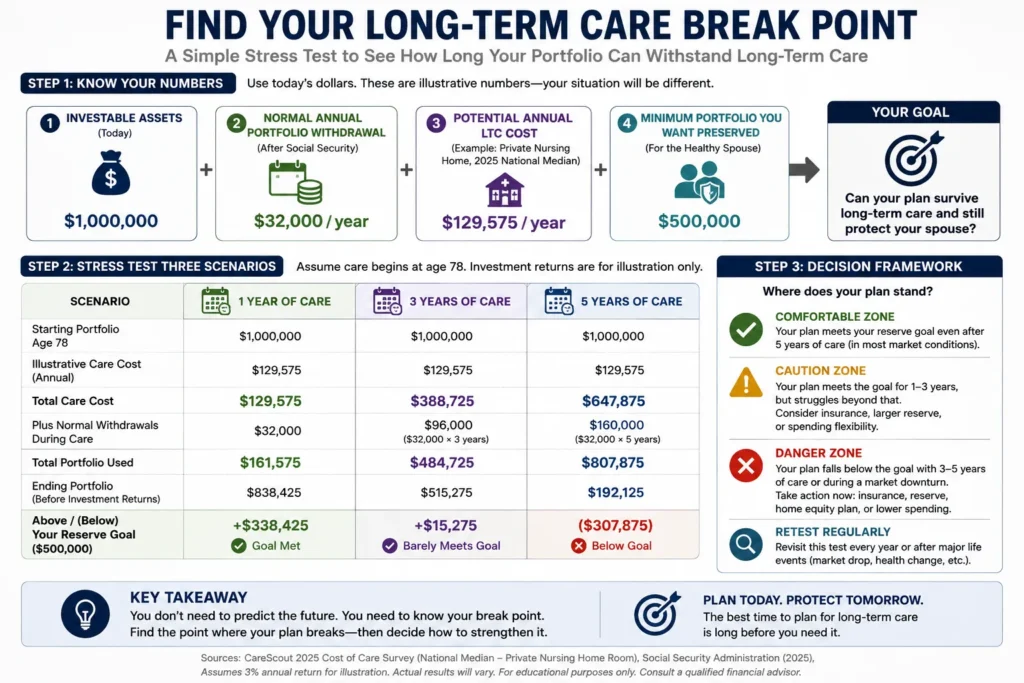
Start with four numbers.
Number 1: Your Investable Assets
Example:
$1,000,000
Number 2: Your Normal Annual Portfolio Withdrawal
Example:
$32,000
Number 3: Your Potential Annual Long-Term Care Cost
For illustration:
$129,575
Number 4: The Minimum Portfolio You Want Preserved for the Other Spouse
Example:
$500,000
Now ask:
What happens after one year of care?
Then:
Three years?
Then:
Five years?
After that, make the scenario harder.
Assume the portfolio falls 20% shortly before care begins.
You aren’t trying to forecast your future.
You’re looking for the point at which your plan breaks.
That’s what a stress test is supposed to do.
Your Long-Term Care “Break Point”
Every retirement portfolio has one.
It’s the combination of:
care cost + care duration + market conditions + normal spending
that makes the plan unacceptable.
For one household, the break point might be two years of nursing care.
For another, five years.
For a wealthy household, the portfolio may comfortably withstand almost any reasonable scenario.
Finding your break point tells you something extremely useful.
It tells you how much risk you can afford to keep.
If your portfolio survives five years of expensive care while still protecting your spouse, self-insuring becomes much easier to justify.
If the plan begins failing after two years, transferring some of the risk through insurance—or building a larger dedicated reserve—deserves much more serious consideration.
Frequently Asked Questions
Will a $1 Million Portfolio Really Be Destroyed by Long-Term Care?
Not necessarily.
The headline describes a risk, not an inevitable outcome.
A $1 million portfolio may remain resilient if the household has substantial Social Security or pension income, lower spending, home equity, insurance coverage, shorter care needs, or strong investment performance.
But several years of high-cost care can materially weaken a $1 million retirement plan.
That’s why the scenario should be modeled rather than assumed.
How Much Does Long-Term Care Cost?
CareScout’s 2025 national medians put assisted living at $6,200 per month, a semi-private nursing home room at $9,581 per month, and a private nursing home room at $10,798 per month. A non-medical caregiver had a national median rate of $35 per hour; at 44 hours per week, CareScout calculates that at $80,080 annually. Actual costs vary substantially by location and care needs.
Doesn’t Medicare Pay for Nursing Home Care?
Medicare distinguishes qualifying skilled care from ongoing long-term custodial care. Medicare’s current guidance states that it does not pay for most long-term care, including non-medical assistance with activities of daily living in a nursing home or in the community.
Should I Buy Long-Term Care Insurance If I Have $1 Million?
Portfolio size alone can’t answer that question.
Consider your spending, guaranteed income, spouse, age, health, home equity, insurance premiums, and how much of your portfolio you want to preserve.
A household with $1 million and $80,000 of guaranteed annual income is in a very different position from a household with $1 million and $30,000 of guaranteed income.
Should I Keep Several Hundred Thousand Dollars in Cash for Long-Term Care?
Usually, the more useful question is whether you need a dedicated reserve, not whether all of it needs to sit in cash.
Money that may not be needed for many years still has inflation and opportunity-cost considerations.
The appropriate investment mix depends on when the money might be needed, your overall asset allocation, and how much risk the rest of your retirement plan can tolerate.
What If Both Spouses Need Long-Term Care?
That’s one of the scenarios worth stress-testing.
Two spouses needing care simultaneously—or sequentially—can produce a much larger financial burden than modeling only one person’s care.
A robust plan should consider both possibilities even if the probability and duration are impossible to know precisely.
Final Thoughts
A million dollars is a lot of money.
Until it has too many jobs.
It may need to produce retirement income.
Survive inflation.
Absorb bear markets.
Pay taxes.
Fund healthcare.
Support two people for three decades.
And perhaps one day pay for years of long-term care.
That’s why retirement security isn’t measured by the number at the top of your brokerage statement.
It’s measured by how many bad scenarios that number can survive.
Long-term care is especially dangerous because it combines three things portfolios dislike:
Large expenses.
Uncertain timing.
Limited flexibility.
You don’t need to assume the worst.
And you don’t need to buy insurance simply because the numbers look frightening.
But you should know where your retirement plan breaks.
Because once you know that number, long-term care stops being an abstract fear.
It becomes a risk you can actually plan around.
Retirement Playbook
Before deciding that your portfolio can handle long-term care, make sure you can answer yes to these questions:
- I know approximately what long-term care costs where I expect to retire.
- I’ve modeled at least one-, three-, and five-year care scenarios.
- I’ve tested what happens if care begins during a major market decline.
- I’ve calculated how much income and assets the healthy spouse would still need.
- I’ve considered insurance, self-funding, and a dedicated LTC reserve.
- I’ve decided whether home equity could become part of our care strategy.
- I’ve considered what happens if both spouses eventually need care.
- I know the point at which long-term care would put our retirement plan under unacceptable pressure.
You don’t need enough money to make every possible retirement risk disappear.
You need a plan that keeps the risks that matter most from controlling your future.
Coming Next
How to Build a Long-Term Care Fund: How Much Should You Set Aside for Retirement?