How Healthcare Inflation Can Destroy Your Retirement Budget—and How to Plan for It
There is a simple assumption buried inside thousands of retirement plans.
It looks harmless.
You spend $80,000 today.
You assume inflation averages 2.5% or 3%.
So you increase that $80,000 every year and calculate whether your portfolio can support it for the next 25 or 30 years.
Perfectly reasonable.
Except one part of your retirement budget may refuse to cooperate.
Healthcare.
Your groceries don’t increase at exactly the same rate as your property taxes.
Your electric bill doesn’t behave exactly like airfare.
And your Medicare premiums, prescription costs, dental work, hearing care, supplemental coverage, and out-of-pocket medical expenses certainly don’t move together with everything else you buy.
That’s where a retirement plan built around one inflation number can become dangerously misleading.
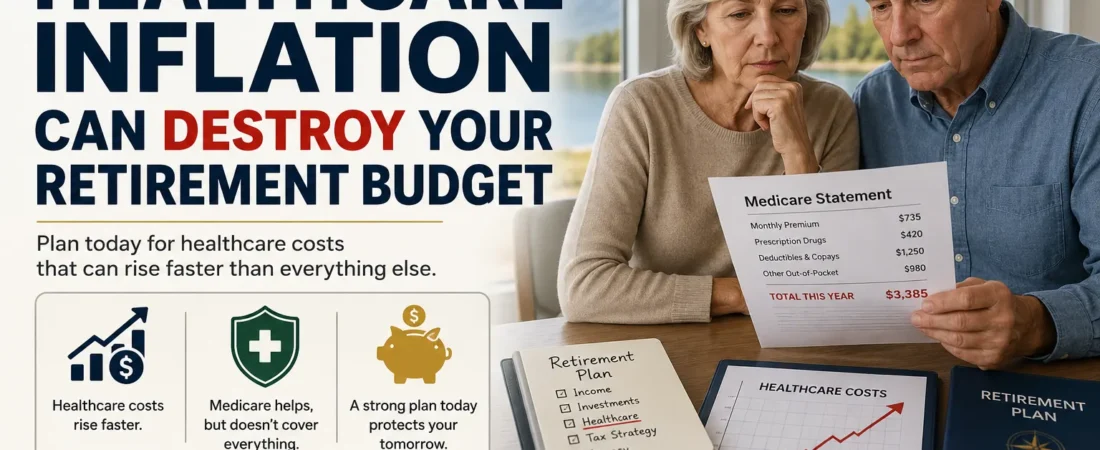
Healthcare inflation in retirement deserves separate attention because even a small difference in annual cost growth can compound dramatically over 20 or 30 years.
Not because your entire retirement suddenly becomes unaffordable.
But because one category can quietly consume a larger and larger share of the same retirement paycheck.
Consider what has already happened.
The standard Medicare Part B premium is $202.90 per month in 2026, up from $185 in 2025.
That’s $2,434.80 per year for one person before you add supplemental coverage, prescription drug costs, dental expenses, vision, hearing, copays, deductibles, or other out-of-pocket spending.
For a couple, Part B alone at the standard premium represents nearly:
$4,870 per year.
And that’s before the rest of the healthcare budget even begins.
This is why healthcare inflation deserves its own line in your retirement plan.
Not because you should be afraid of medical bills.
Because a 30-year retirement is long enough for small differences in inflation assumptions to become very large differences in dollars.
The $185,500 Number Isn’t the Number That Matters Most
Large retirement healthcare estimates make good headlines.
Fidelity’s 2026 Retiree Health Care Cost Estimate says a 65-year-old retiring in 2026 may need approximately:
$185,500
in after-tax savings for healthcare and medical expenses throughout retirement.
That’s up 7.5% from the prior year’s estimate.
And importantly, Fidelity’s estimate does not include long-term care.
That sounds intimidating.
But I don’t think $185,500 is the most important number in the study.
The more important idea is this:
Healthcare is not a one-time retirement expense. It is a spending stream that can change for decades.
You aren’t likely to retire at 65, write a $185,500 check, and declare healthcare paid for.
If you haven’t built your own starting number yet, our guide to estimating your retirement healthcare costs shows how to turn premiums, prescriptions, out-of-pocket expenses, and other medical spending into a realistic retirement budget.
Instead, the expenses arrive gradually.
Premium this month.
Prescription next month.
Dental work next year.
Higher Medicare premiums later.
Maybe hearing aids.
Maybe surgery.
Maybe very little for several years.
Then much more.
That makes healthcare less like buying a car and more like managing another form of retirement inflation.
And that requires a different kind of planning.
Why One Inflation Rate Can Mislead You
Suppose a couple retires at 65 with this simplified annual budget:
Category
Annual Spending
Housing
$24,000
Food
$12,000
Transportation
$9,000
Travel & entertainment
$15,000
Healthcare
$12,000
Other
$8,000
Total
$80,000
Their retirement software assumes:
2.5% annual inflation.
Twenty years later, $80,000 inflated at 2.5% becomes approximately:
$131,100.
So far, so good.
But suppose healthcare behaves differently.
Instead of increasing at 2.5%, their $12,000 healthcare budget grows at an illustrative:
5% per year.
After 20 years:
$12,000 → about $31,840
The remaining $68,000 of spending, growing at 2.5%, becomes approximately:
$111,500
Total spending is therefore closer to:
$143,300
rather than $131,100.
That’s a difference of roughly:
$12,200 in a single year.
And that’s not because they bought a bigger house.
Or traveled more.
Or lived extravagantly.
Their retirement lifestyle didn’t change.
One category simply grew faster than the inflation rate built into the original plan.
Illustrative example only. Actual healthcare inflation, household spending, premiums, medical needs, and investment returns will vary.
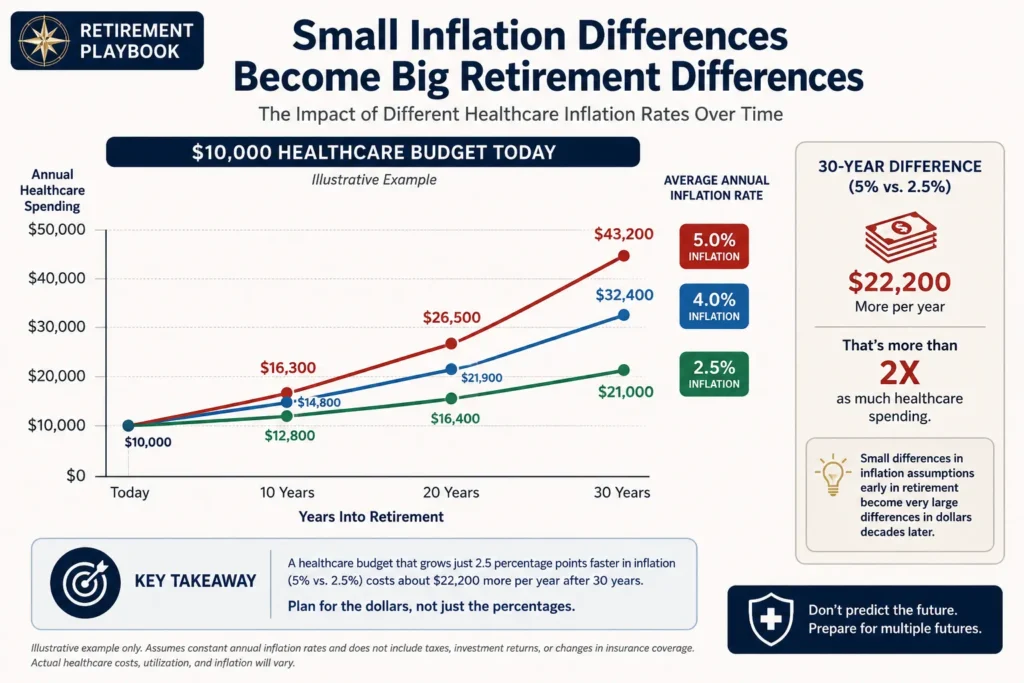
Small Inflation Differences Become Big Retirement Differences
The compounding is easy to underestimate.
Take a $10,000 annual healthcare budget.
Here’s what happens under several illustrative inflation assumptions:
Years
2.5% Inflation
4% Inflation
5% Inflation
Today
$10,000
$10,000
$10,000
10
~$12,800
~$14,800
~$16,300
20
~$16,400
~$21,900
~$26,500
30
~$21,000
~$32,400
~$43,200
The difference between 2.5% and 5% doesn’t look dramatic in year one.
After 30 years, it does.
At 2.5%, the $10,000 expense becomes roughly:
$21,000.
At 5%:
$43,200.
More than twice as much.
This is one of the central problems with retirement planning.
The assumptions that matter most often look least important when retirement begins.
But Don’t Automatically Assume Healthcare Inflation Will Be 5%
There’s another mistake on the opposite side.
You shouldn’t read the previous example and immediately change every healthcare assumption in your retirement spreadsheet to 5%, 6%, or 7%.
That creates false precision in the other direction.
Healthcare is not one product.
It includes:
Medicare premiums,
prescription drugs,
supplemental insurance,
Medicare Advantage costs,
deductibles,
copays,
dental care,
vision,
hearing,
medical equipment,
services not covered by Medicare,
and potentially long-term care.
Those costs don’t all inflate at the same rate.
Some may rise rapidly.
Some may remain relatively stable.
Some medications can become cheaper when generics enter the market.
Your insurance structure may change.
Government policy can change.
And your personal utilization of healthcare can matter as much as the underlying price inflation.
The 2026 increase in the standard Medicare Part B premium illustrates the point.
It rose from:
$185.00 per month in 2025
to:
$202.90 in 2026.
That’s an increase of about 9.7% in one year.
But it would be a mistake to extrapolate that single-year increase for the next 30 years.
CMS explains that the 2026 increase reflects projected price changes and utilization, among other program-specific factors.
One year is not a long-term inflation assumption.
The solution isn’t replacing an overly optimistic assumption with an overly pessimistic one.
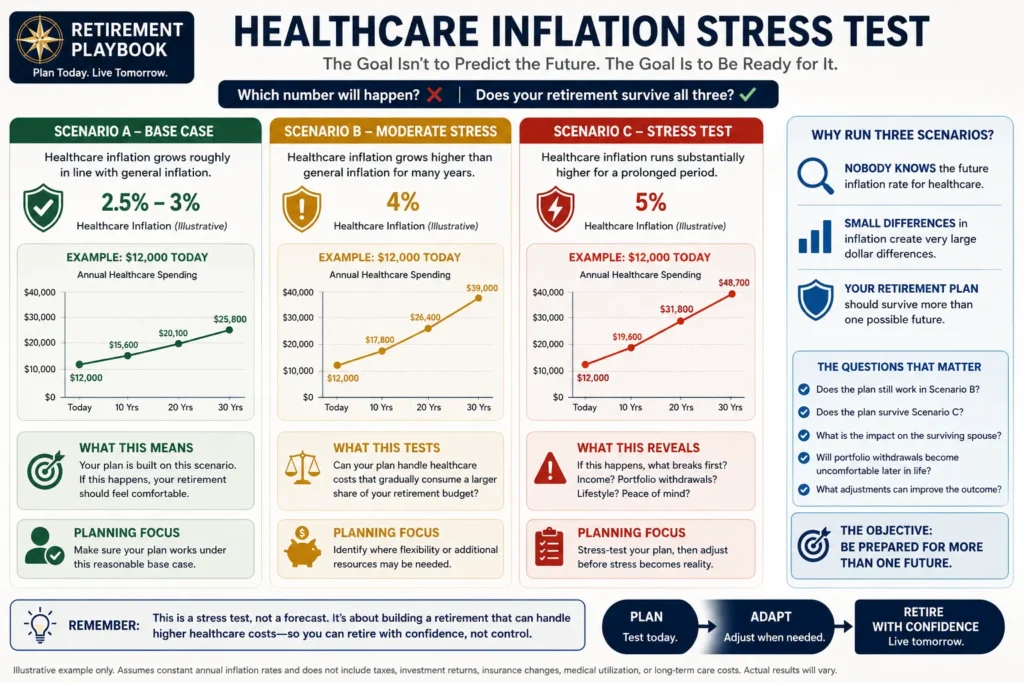
The solution is scenario planning.
Stop Asking “What Will Healthcare Inflation Be?”
Nobody knows.
Instead ask:
What happens to my retirement if healthcare inflation is higher than I expected?
That’s a question you can actually answer.
Run three scenarios.
Scenario A — Base Case
Healthcare costs grow approximately in line with your broader retirement inflation assumption.
Maybe:
2.5%–3%
depending on the assumptions in your plan.
This is the comfortable scenario.
Scenario B — Higher Healthcare Inflation
Healthcare costs grow at:
4%
while the rest of the household budget grows at 2.5%–3%.
Now you can see whether the portfolio still works when healthcare gradually consumes a larger percentage of spending.
Scenario C — Healthcare Stress Test
Run:
5% or another deliberately conservative assumption
for healthcare.
This isn’t a forecast.
It’s a stress test.
You’re asking:
“If healthcare costs grow substantially faster than the rest of our spending, what breaks first?”
Maybe nothing.
That’s useful information.
Maybe discretionary travel spending eventually needs to fall.
Maybe portfolio withdrawals become uncomfortable in your 80s.
Maybe your HSA becomes much more valuable.
Maybe retiring two years later solves the problem.
Or maybe your plan has enough margin that the higher healthcare assumption barely matters.
That’s what stress testing is supposed to tell you.
Healthcare Inflation Doesn’t Hit Every Retiree the Same Way
Imagine two couples.
Both spend:
$80,000 per year.
Both have:
$1.5 million portfolios.
Both receive:
$50,000 per year from Social Security.
On paper, their retirements look almost identical.
But Couple A spends only $8,000 per year on healthcare.
Couple B spends $20,000.
If healthcare costs rise faster than the rest of their budget, Couple B has much greater inflation exposure.
This suggests a better way to think about retirement healthcare risk.
Don’t ask only:
How much do I spend?
Ask:
How much of my spending is exposed to healthcare inflation?
Someone with expensive prescriptions, high supplemental premiums, recurring dental needs, or significant out-of-pocket costs may need a different inflation assumption from someone with relatively low healthcare utilization.
Personal inflation matters.
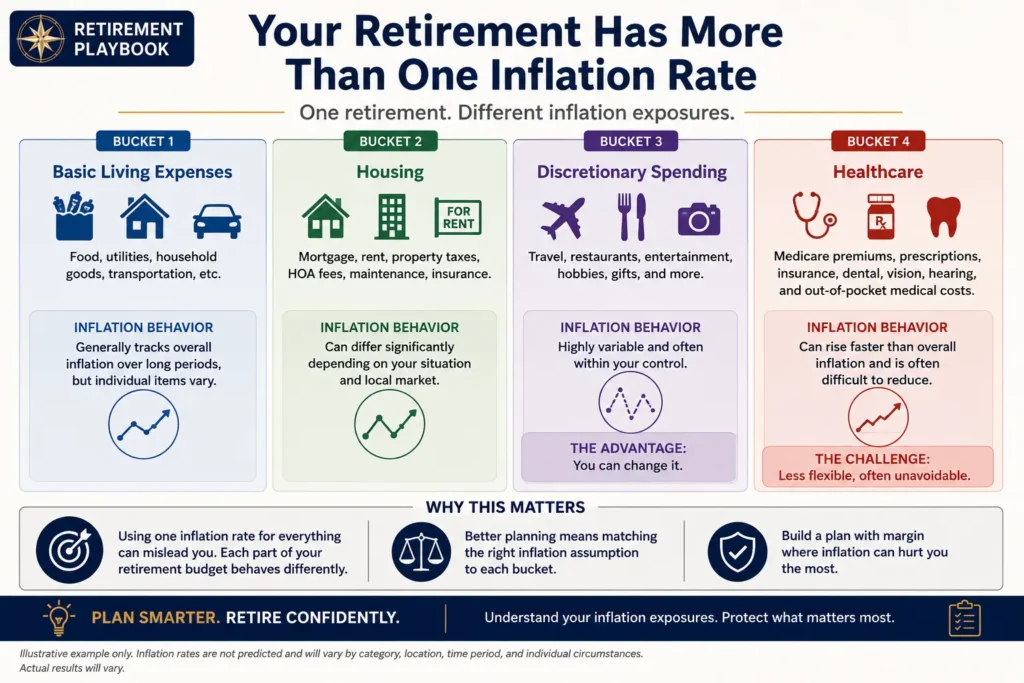
Your Retirement Has More Than One Inflation Rate
Think of your retirement budget as several different inflation buckets.
Bucket 1 — Basic Living Expenses
Food.
Utilities.
Household goods.
Transportation.
These may roughly track general inflation over long periods, although individual categories will vary.
Bucket 2 — Housing
Housing behaves differently depending on whether you:
own a mortgage-free home,
have a fixed-rate mortgage,
rent,
pay HOA fees,
or expect significant property taxes and maintenance.
A retiree with a paid-off house may have much less direct housing inflation exposure than a renter.
Bucket 3 — Discretionary Spending
Travel.
Restaurants.
Entertainment.
Hobbies.
This category has one enormous advantage:
you can change it.
If inflation is unusually high, you can take one fewer trip.
You can’t negotiate with your body in quite the same way.
Bucket 4 — Healthcare
Premiums.
Prescriptions.
Out-of-pocket costs.
Dental.
Vision.
Hearing.
Medical services.
This category can be both inflation-sensitive and relatively difficult to cut.
That’s what makes it different.
The Real Risk of Healthcare Inflation in Retirement
Suppose healthcare costs rise 5% per year.
Is your retirement doomed?
Probably not.
The bigger problem occurs when several things happen together:
Healthcare inflation is high.
You live longer than expected.
Your portfolio experiences weak returns.
Withdrawals increase.
That’s the combination that matters.
A prolonged care event can amplify that pressure even further; our $1 million portfolio long-term care analysis shows how withdrawals, market losses, and major care expenses can interact when several retirement risks arrive together.
Consider a retiree at 82.
They’ve already been retired for 17 years.
Their healthcare budget has grown substantially.
Then the stock market falls 25%.
The healthcare bill doesn’t care.
Medicare premiums still need to be paid.
Prescriptions still need to be filled.
Dental work doesn’t wait for the S&P 500 to recover.
That creates what we might call:
Healthcare Sequence Risk
Most investors understand sequence-of-returns risk near the beginning of retirement.
Poor market returns combined with withdrawals can permanently weaken a portfolio.
Healthcare creates another version of the problem later in retirement.
A large, relatively inflexible spending category may be increasing precisely when the retiree has fewer years, fewer employment options, and less flexibility to recover financially.
This is why healthcare shouldn’t simply be buried inside a generic inflation assumption.
A $1 Million Portfolio Example
Let’s make the problem more concrete.
Michael retires at 65 with:
$1 million invested
$38,000 annual Social Security income
$60,000 of total annual spending
Of that spending:
$10,000 is healthcare.
His other $50,000 grows at an illustrative 2.5%.
We’ll compare two healthcare scenarios.
Scenario 1
Healthcare also grows at 2.5%.
After 20 years:
Healthcare:
~$16,400
Other spending:
~$81,900
Total:
~$98,300
Scenario 2
Healthcare grows at 5%.
After 20 years:
Healthcare:
~$26,500
Other spending:
~$81,900
Total:
~$108,400
Difference:
~$10,100 per year
By age 85, Michael isn’t dealing with one giant healthcare bill.
He’s dealing with something potentially more difficult:
a permanently higher withdrawal requirement.
If that extra $10,000 continues for another decade, the cumulative portfolio impact can become substantial—especially if investment returns are weak.
Illustrative example only. This simplified scenario does not model taxes, changing Social Security benefits, portfolio returns, Medicare plan changes, mortality, or actual medical utilization.
Social Security Helps—But It Doesn’t Eliminate the Problem
There is good news.
Social Security benefits receive annual cost-of-living adjustments.
That gives retirees an important source of inflation-sensitive income.
If general prices rise, Social Security income can rise as well.
But there is an important mismatch.
Your Social Security COLA is not specifically designed to match your personal healthcare inflation.
If your healthcare spending grows faster than the adjustment to your income, the difference still has to come from somewhere.
Usually that means:
more portfolio withdrawals.
This is why a retirement plan with substantial guaranteed or inflation-sensitive income may handle healthcare inflation better than one that depends heavily on portfolio withdrawals.
The issue isn’t just how much money you have.
It’s how much of your future spending must be financed by assets that can fluctuate in value.
The Medicare Premium Trap
There is another complication.
For higher-income retirees, Medicare premiums can themselves become linked to retirement tax planning.
Medicare’s Income-Related Monthly Adjustment Amount—IRMAA—can increase Part B and Part D costs for beneficiaries whose modified adjusted gross income exceeds applicable thresholds.
For 2026, the standard Part B premium is:
$202.90 per month.
But higher-income beneficiaries can pay substantially more.
For example, 2026 total Part B premiums range as high as:
$689.90 per month per person
at the highest IRMAA tier.
That means a large Roth conversion, capital gain, retirement-account distribution, or other taxable-income event can potentially affect future Medicare premiums.
Now healthcare inflation is no longer just a spending issue.
It becomes connected to:
tax planning.
And that is where retirement healthcare planning starts becoming much more interesting.
Because sometimes the best way to control future healthcare costs isn’t finding a cheaper doctor.
It’s managing the financial system surrounding the healthcare bill.
Build a Healthcare Inflation Margin Into Your Retirement Budget
The easiest response to healthcare inflation is also one of the worst:
“I’ll just add another $200,000 to my retirement number.”
That sounds conservative.
But it doesn’t tell you anything about when the money will be needed, how it should be invested, or whether $200,000 is remotely appropriate for your situation.
Instead, start with your annual healthcare budget.
Suppose a newly retired couple expects to spend:
$15,000 per year
on Medicare premiums, supplemental coverage, prescriptions, dental care, and other out-of-pocket expenses.
Their broader retirement plan assumes 2.5% inflation.
Rather than immediately creating a giant healthcare reserve, they could stress-test that $15,000 at several rates.
Years Into Retirement
2.5%
4%
5%
Today
$15,000
$15,000
$15,000
10 years
~$19,200
~$22,200
~$24,400
20 years
~$24,600
~$32,900
~$39,800
30 years
~$31,500
~$48,700
~$64,800
The question isn’t:
Which column will happen?
Nobody knows.
The useful question is:
Does my retirement still work if the middle or right-hand column happens?
If yes, you probably don’t need to obsess over predicting healthcare inflation.
If no, you’ve identified a vulnerability while you still have time to do something about it.
Illustrative example only. These figures assume constant inflation rates and do not predict future healthcare costs.
Don’t Add the Entire Future Healthcare Bill to Your Retirement Number
Here’s another common mistake.
Someone calculates that healthcare might cost $40,000 per year when they’re 85.
Then they think:
“I need an extra $40,000 per year from my portfolio.”
Not necessarily.
Remember what matters in retirement:
the funding gap.
Social Security may be higher by then because of COLAs.
A pension may provide income.
Some spending categories may decline.
You may travel less.
Your mortgage may be gone.
You may own fewer cars.
Other discretionary expenses can shrink.
Healthcare can consume a larger percentage of retirement spending without increasing total spending dollar-for-dollar.
This is sometimes called the retirement spending smile or spending curve.
Many retirees spend more in their active early years, less during the middle years, and potentially more on healthcare later.
The categories change.
The total doesn’t necessarily move in a straight line.
That is why a retirement plan that assumes every category increases forever at the same rate can be misleading in both directions.
It may underestimate healthcare.
And simultaneously overestimate other spending.
Create a Healthcare Inflation Reserve
There is still value in identifying assets specifically capable of absorbing higher medical spending.
Think of this as your:
Healthcare Inflation Reserve
It does not have to be a separate bank account.
Its purpose is to answer:
If our healthcare spending eventually runs $10,000–$20,000 above our original projection, where does that money come from?
Possible sources include:
HSA assets,
taxable investments,
bonds,
Roth assets,
additional portfolio withdrawal capacity,
or lower discretionary spending.
For a financially strong household, the reserve may simply be excess portfolio capacity.
For someone closer to the edge of retirement sustainability, it may need to be much more deliberate.
The HSA Is Almost Built for This Problem
If you have accumulated a substantial Health Savings Account before enrolling in Medicare, healthcare inflation gives that account a very clear retirement job.
An HSA can potentially provide three federal tax advantages:
Tax-deductible or pre-tax contributions.
Tax-deferred investment growth.
Tax-free withdrawals for qualified medical expenses.
That combination is unusually powerful.
And unlike a generic retirement account, the purpose matches the liability.
Healthcare costs rise.
Your HSA assets can potentially grow.
Then qualified medical expenses can be paid tax-free.
For many people, that makes the HSA less like a spending account and more like a:
dedicated retirement healthcare portfolio.
Consider Letting the HSA Grow Before Retirement
Many workers use their HSA like a checking account.
Doctor visit?
Pay from the HSA.
Prescription?
Pay from the HSA.
Dental bill?
HSA again.
There’s nothing inherently wrong with that.
But someone who can comfortably pay current medical expenses from ordinary cash flow has another option.
They can leave HSA assets invested.
Imagine contributing during your 40s and 50s, investing the balance, and allowing it to compound for decades.
By retirement, the account may provide a meaningful healthcare reserve.
That reserve could eventually help pay eligible:
Medicare premiums,
deductibles,
copays,
prescriptions,
dental expenses,
vision expenses,
hearing expenses,
and certain qualified long-term care costs.
There are important rules and exceptions.
For example, HSA funds generally cannot be used tax-free for Medigap premiums.
And once you are enrolled in Medicare, you can no longer contribute to an HSA.
So this is an account where tax rules matter.
But as a retirement healthcare asset, the HSA can be extraordinarily useful.
Medicare Premiums and Roth Conversions Need to Talk to Each Other
Now return to IRMAA.
A retiree may correctly decide that Roth conversions are valuable.
They convert traditional IRA assets while tax rates are favorable.
The conversion increases taxable income.
Then, later, they discover that their higher modified adjusted gross income has pushed them into a higher Medicare IRMAA bracket.
Does that mean the Roth conversion was a mistake?
Not necessarily.
This is exactly the kind of retirement trade-off that can’t be evaluated one year at a time.
Paying an additional Medicare premium for a year may be perfectly reasonable if the conversion:
reduces future required minimum distributions,
lowers lifetime taxes,
creates more tax-free assets,
reduces future IRMAA exposure,
or improves flexibility for a surviving spouse.
The mistake isn’t triggering IRMAA.
The mistake is triggering it without realizing you were going to trigger it.
Think in Lifetime Costs, Not Annual Costs
Suppose a Roth conversion causes an extra $2,000 of Medicare premiums.
That sounds bad.
But suppose the same conversion eventually saves:
$15,000 in lifetime taxes.
Paying $2,000 to save $15,000 can still be a good trade.
Now reverse it.
Suppose you execute a conversion that saves only $1,000 in projected taxes but creates $3,000 in additional Medicare premiums.
That may be a poor trade.
This is why tax planning and healthcare planning cannot be completely separated after 65.
You have to compare:
Taxes saved versus Medicare costs created.
And because IRMAA generally uses income information from two years earlier, the consequences of today’s tax decision may not appear immediately.
That lag makes planning especially important.
Watch the Surviving-Spouse Problem
Healthcare inflation becomes even more interesting after one spouse dies.
A married couple may have:
two Social Security benefits,
possibly two pensions,
one household,
and one portfolio.
After the first death, some expenses decline.
But they rarely fall by half.
The surviving spouse may still pay:
property taxes,
utilities,
home maintenance,
insurance,
transportation,
Medicare premiums,
supplemental coverage,
prescriptions,
and other healthcare costs.
At the same time, one Social Security benefit generally disappears.
And eventually the survivor may face single-filer tax brackets and Medicare IRMAA thresholds rather than married thresholds.
This creates what retirement planners sometimes call the:
widow’s penalty.
Healthcare inflation can make that transition even more painful.
A retirement plan that looks strong for two people should therefore be tested again for:
one surviving spouse.
Your Healthcare Reserve Should Not All Be Cash
This is the same mistake retirees can make with a long-term care reserve.
Suppose you’re 60 and decide you want:
$150,000 available for future healthcare.
Putting the entire $150,000 into cash may feel safe.
But perhaps most of that money won’t be spent for 15 or 20 years.
Inflation is now the enemy.
A more useful structure might look like this.
Near-Term Healthcare Spending
Money needed over the next few years should emphasize:
liquidity and stability.
Cash, money-market funds, short-term Treasuries, or high-quality short-duration bonds may play a role.
Intermediate Healthcare Spending
Money potentially needed later can take somewhat more duration or portfolio risk depending on your overall allocation.
Long-Term Healthcare Reserve
Money intended for your 80s or 90s may remain part of a diversified long-term portfolio.
The goal isn’t to create a separate investment strategy for every dental bill.
It’s to avoid treating an expense 25 years away as though the bill arrives next Tuesday.
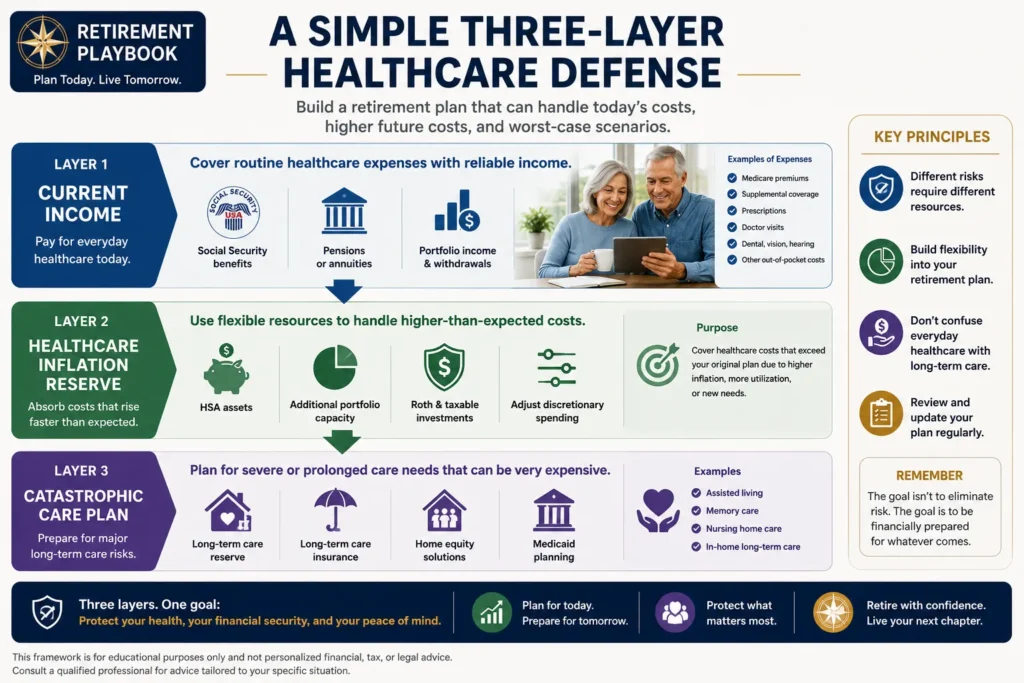
A Simple Three-Layer Healthcare Defense
You can reduce the entire strategy to three layers.
Layer 1 — Current Income
Use:
Social Security,
pensions,
portfolio income,
and normal retirement withdrawals
to cover routine healthcare expenses.
Most healthcare spending should simply be part of the retirement budget.
Layer 2 — Healthcare Inflation Reserve
Use:
HSA assets,
additional portfolio capacity,
Roth assets where appropriate,
and flexible discretionary spending
to absorb healthcare costs that rise faster than expected.
This is the buffer.
Layer 3 — Catastrophic Care Plan
Long-term care is a different financial risk.
It may require:
a dedicated LTC reserve,
long-term care insurance,
portfolio self-funding,
home equity,
or eventual Medicaid planning.
Don’t confuse ordinary healthcare inflation with long-term care.
They overlap.
They are not the same problem.
If you’re deciding whether insurance should cover part of that separate risk, our guide to whether you really need long-term care insurance explains when transferring the risk may—and may not—make financial sense.
The Best Healthcare Inflation Hedge May Be Spending Flexibility
Investment discussions often search for the perfect inflation hedge.
TIPS.
Stocks.
Real estate.
Commodities.
But retirees have another powerful hedge:
the ability to change spending.
Suppose your retirement plan includes:
$15,000 annual travel,
$8,000 restaurants and entertainment,
$5,000 hobbies,
$4,000 gifts.
That’s:
$32,000 of relatively flexible spending.
If healthcare unexpectedly costs another $8,000 one year, you don’t necessarily need to withdraw an additional $8,000 from the portfolio.
Maybe you spend $4,000 less on travel.
Maybe gifts fall temporarily.
Maybe entertainment changes.
This isn’t failure.
It’s how a resilient retirement plan works.
The retiree with $70,000 of essential spending and $30,000 of discretionary spending may actually be more financially resilient than someone spending $85,000 where almost everything is fixed.
Flexibility is an asset.
It just doesn’t appear on a brokerage statement.
How Much Healthcare Margin Should You Build?
There is no universal percentage.
But here’s a useful stress-testing framework.
Take your expected retirement healthcare budget.
Then model:
Base Budget
Your best estimate using current Medicare, insurance, prescription, and out-of-pocket costs.
Moderate Stress
Increase the healthcare inflation assumption by roughly:
1–1.5 percentage points
above your general inflation assumption.
High Stress
Model healthcare inflation approximately:
2–2.5 percentage points
above general inflation for a prolonged period.
These are not forecasts.
They are sensitivity tests.
Then measure the result.
Does the portfolio still succeed?
Does the surviving spouse remain secure?
Do discretionary expenses need modest adjustments?
Or does the plan require significantly more retirement savings?
The answer tells you whether healthcare inflation is actually a major risk for you.
Don’t Forget That Healthcare Spending Is Lumpy
Inflation models make expenses look beautifully smooth.
Real life isn’t.
You might spend:
$9,000
one year.
Then:
$16,000
the next.
Then:
$11,000.
Then a major dental procedure creates a:
$20,000 year.
That isn’t necessarily healthcare inflation.
It’s utilization.
This distinction matters because your retirement plan needs to handle both:
rising average costs
and
temporary spending spikes.
A modest cash reserve can help with the second.
Long-term portfolio growth helps with the first.
You need both.
What About Medicare Advantage?
Some retirees choose Medicare Advantage partly because plans can offer relatively low premiums and annual out-of-pocket limits for covered Medicare services.
Others prefer Original Medicare combined with Medigap and Part D for different reasons, including provider flexibility and more predictable cost-sharing depending on the coverage selected.
Neither choice eliminates healthcare inflation.
The cost simply appears in different places.
With one strategy, you may pay more predictable premiums.
With another, you may accept different networks, copays, or utilization costs.
So don’t choose Medicare coverage based solely on:
“Which premium is cheaper this year?”
The better question is:
Which structure gives me the combination of cost, access, predictability, and flexibility I want over retirement?
That’s a retirement decision—not just an insurance decision.
You cannot control whether you eventually need expensive treatment.
But you can control quite a lot.
You can:
estimate healthcare separately from ordinary spending,
build multiple inflation scenarios,
preserve discretionary spending flexibility,
accumulate HSA assets when eligible,
coordinate Roth conversions with IRMAA,
choose Medicare coverage deliberately,
maintain appropriate liquidity,
and stress-test the surviving spouse.
This is the difference between forecasting and planning.
Forecasting asks:
What will happen?
Planning asks:
What will we do if something different happens?
Retirement plans become much stronger when they answer the second question.
FAQ
How much should I budget for healthcare in retirement?
There isn’t one number that works for every household.
Your starting budget should reflect the expenses you are actually likely to face, including Medicare premiums, supplemental or Medicare Advantage coverage, prescription costs, dental and vision care, and expected out-of-pocket spending.
Then stress-test that budget at higher healthcare inflation rates rather than relying entirely on a single lifetime estimate.
Does Medicare protect me from healthcare inflation?
Medicare provides substantial healthcare coverage, but it does not make retirement healthcare free.
Beneficiaries can still face:
premiums,
deductibles,
copays,
prescription costs,
supplemental coverage costs,
dental expenses,
vision expenses,
hearing expenses,
and services Medicare does not cover.
Medicare also generally does not pay for prolonged custodial long-term care.
So Medicare reduces healthcare risk.
It does not eliminate healthcare inflation risk.
What healthcare inflation rate should I use for retirement planning?
There is no single rate that can reliably predict the next 20 or 30 years.
Instead of choosing one supposedly correct number, consider running several scenarios.
For example:
General inflation: 2.5%–3%
Moderately higher healthcare inflation: around 4%
Healthcare stress test: around 5%
Those figures should be treated as illustrative planning assumptions, not forecasts.
The objective is to see whether your retirement survives different outcomes.
Does Social Security keep up with healthcare inflation?
Social Security receives cost-of-living adjustments based on an inflation measure, but those adjustments are not specifically designed around your individual healthcare spending.
Your personal medical expenses can therefore rise faster—or slower—than your Social Security benefit.
The larger your healthcare budget, the more important that mismatch can become.
Can an HSA pay Medicare premiums?
After age 65, HSA funds can generally be used tax-free for certain Medicare premiums and other qualified medical expenses.
However, there are important exceptions.
For example, Medigap premiums generally are not qualified HSA expenses.
And once enrolled in Medicare, you generally can no longer contribute to an HSA.
Because the rules can be detailed, verify current IRS guidance before making withdrawals or contributions.
Is healthcare inflation more dangerous than general inflation?
Not necessarily.
The danger comes from the combination of:
the size of your healthcare spending,
how quickly those costs rise,
how much of the spending is unavoidable,
how long you live,
and how dependent you are on portfolio withdrawals.
For some retirees, healthcare inflation will be easily manageable.
For others, it can become one of the largest pressures on late-retirement cash flow.
Should I save a separate $185,500 for healthcare?
Not automatically.
Lifetime healthcare estimates are useful for understanding the scale of the expense, but they shouldn’t necessarily be interpreted as a required separate cash reserve.
Healthcare will generally be funded from multiple sources over decades:
Social Security,
pensions,
HSA assets,
retirement accounts,
taxable investments,
and normal retirement cash flow.
What matters is whether your retirement plan can support the future spending stream.
Final Thoughts
Healthcare inflation sounds like a problem that requires a prediction.
It doesn’t.
You don’t need to know whether healthcare costs will rise:
3.1%
or:
4.3%
or:
5.2%.
Thirty years of retirement planning built around a decimal-point forecast is an illusion of precision.
What you need is margin.
You need a retirement plan that still works when healthcare costs more than expected.
That may mean:
a larger portfolio,
an HSA,
more flexible spending,
smarter tax planning,
better Medicare decisions,
or simply recognizing that part of your portfolio has another job later in life.
There is also an important psychological benefit.
If your retirement plan works only when every assumption is correct, every premium increase feels like bad news.
If you’ve already modeled higher healthcare costs, an increase becomes something else:
a scenario you expected could happen.
That’s a much stronger way to retire.
You don’t beat healthcare inflation by predicting it.
You beat it by building a retirement plan that doesn’t require you to.
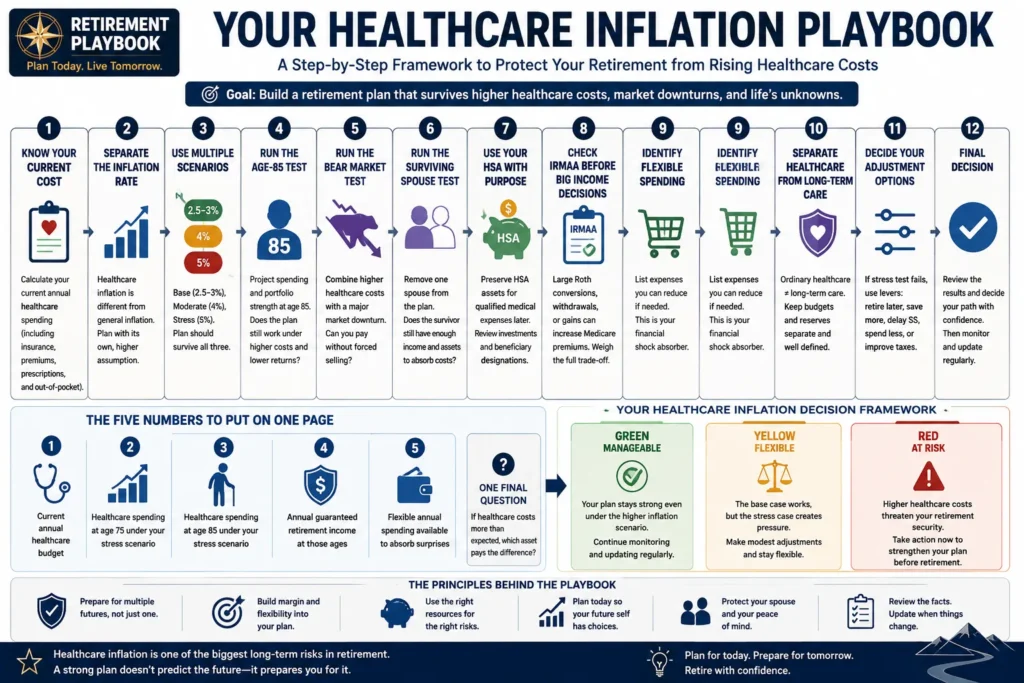
Retirement Playbook: Stress-Test Your Healthcare Budget
Here is the practical version.
Step 1 — Find Your Current Healthcare Number
Add up your expected annual:
Medicare premiums,
Medigap or Medicare Advantage costs,
Part D costs where applicable,
prescriptions,
dental care,
vision,
hearing,
and other recurring out-of-pocket expenses.
Do not start with a national average.
Start with your budget.
Step 2 — Separate Healthcare From Everything Else
Do not bury healthcare inside one generic retirement spending number.
Create at least two inflation categories:
General retirement spending
and
Healthcare spending
Now you can stress-test them independently.
Step 3 — Run Three Healthcare Inflation Scenarios
Test something like:
Scenario
Illustrative Healthcare Inflation
Base
2.5%–3%
Moderate
4%
Stress
5%
These are scenarios—not predictions.
The point is not to choose the number you think is most likely.
The point is to see what happens when you are wrong.
Step 4 — Look at the Dollar Difference, Not Just the Inflation Rate
Now convert those percentages into actual future spending.
Suppose your healthcare budget begins at:
$12,000 per year.
After 20 years, approximately:
Scenario
Annual Healthcare Spending
2.5%
$19,700
4%
$26,300
5%
$31,800
The difference between the base and stress scenarios is approximately:
$12,100 per year.
That’s the number your retirement plan needs to handle.
Percentages are abstract.
Cash flow isn’t.
Illustrative example only. Figures are rounded and assume constant annual inflation.
Step 5 — Find Your Healthcare Inflation Gap
Now ask:
If healthcare spending eventually runs $10,000–$15,000 above my original projection, where does that money come from?
Identify the actual funding source.
It might be:
additional portfolio withdrawals,
HSA assets,
Roth assets,
taxable investments,
reduced travel,
lower discretionary spending,
or some combination.
Do not stop at:
“We’ll have enough savings.”
Give the future expense a funding source.
Step 6 — Run the Age-85 Test
Take your retirement plan and jump forward.
Imagine yourself at 85.
Ask:
What might our healthcare budget look like?
How large is the portfolio under a weak-return scenario?
How much guaranteed income do we still have?
How much of our spending is discretionary?
Would higher healthcare spending require uncomfortable portfolio withdrawals?
This is particularly important because healthcare inflation doesn’t become most dangerous when you’re 65.
It can become more difficult when you’ve already spent 15 or 20 years drawing from the portfolio.
Step 7 — Run the Bear-Market Test
Now make the scenario harder.
Assume healthcare spending is elevated.
Then assume the portfolio experiences a significant market decline.
Ask:
Can we pay unavoidable healthcare expenses without being forced to sell a large amount of depressed assets?
This is where liquidity matters.
You don’t need decades of healthcare expenses sitting in cash.
But you do want enough stable assets that an expensive medical year doesn’t automatically become a bad investment year too.
Step 8 — Run the Surviving-Spouse Test
If you’re married, remove one spouse from the plan.
Then recalculate.
Assume:
one Social Security benefit disappears,
some household expenses remain,
the survivor files taxes as a single taxpayer,
Medicare coverage continues individually,
and healthcare expenses remain significant.
Now ask:
Does the surviving spouse still have enough income and portfolio capacity to absorb higher healthcare costs?
A retirement plan that works beautifully for two people but becomes fragile after the first death has an important weakness.
Find it before it matters.
Step 9 — Give Your HSA a Retirement Job
If you have an HSA, decide what role it plays.
For example:
“We will preserve our HSA primarily for qualified medical expenses later in retirement.”
That is much more useful than simply accumulating an account with no purpose.
Then review:
the investment allocation,
beneficiary designations,
qualified-expense rules,
Medicare interaction,
and whether paying current medical expenses from other cash flow still makes sense.
If you don’t have an HSA, that’s fine.
Your healthcare reserve can live elsewhere in the portfolio.
The principle matters more than the account label.
Step 10 — Check IRMAA Before Large Income Decisions
Before executing a significant:
Roth conversion,
traditional IRA withdrawal,
realized capital gain,
or other income-producing transaction,
check whether it could affect future Medicare premiums.
Then compare the entire trade-off.
Do not automatically avoid IRMAA.
Instead ask:
What do I gain in exchange for the additional Medicare cost?
Sometimes paying more Medicare premium today can contribute to lower lifetime taxes or better future flexibility.
Sometimes it isn’t worth it.
Know which situation you’re in.
Step 11 — Identify Your Flexible Spending
Write down the retirement expenses you could reduce without harming your basic standard of living.
Examples might include:
travel,
restaurants,
entertainment,
hobbies,
gifts,
vehicle upgrades,
and other discretionary purchases.
Then total them.
Suppose you discover:
$25,000 per year
of your retirement budget is reasonably flexible.
That $25,000 is not merely spending.
It is part of your financial shock absorber.
A temporary $7,000 healthcare surprise becomes much less dangerous when the budget contains $25,000 of expenses you control.
Step 12 — Separate Healthcare Inflation From Long-Term Care
Make sure your retirement model does not accidentally treat these as the same risk.
Your ordinary healthcare budget may include:
Medicare,
insurance,
prescriptions,
doctors,
dental,
hearing,
vision,
and routine out-of-pocket expenses.
Your long-term care plan addresses a different possibility:
prolonged home assistance,
assisted living,
memory care,
or custodial nursing-home care.
You need a plan for both.
But don’t double-count the same dollars.
For the long-term care side of that equation, our guide to building a long-term care fund shows how to calculate the funding gap and decide how much portfolio capacity to reserve for future care.
If part of your portfolio is already designated as a long-term care reserve, clearly define whether those assets are also included in your ordinary healthcare reserve.
Step 13 — Decide What Happens If the Stress Scenario Fails
This may be the most important step.
Suppose your retirement plan works with 3% healthcare inflation.
At 4%, it becomes uncomfortable.
At 5%, it fails.
Don’t immediately conclude:
“I need another $300,000 before I can retire.”
First ask what adjustment would actually solve the problem.
Perhaps you could:
retire one year later,
save slightly more before retirement,
reduce planned discretionary spending,
delay Social Security,
improve tax efficiency,
reduce fixed expenses,
preserve more HSA assets,
or accept modest spending reductions later in life.
A failed stress test isn’t a prediction of failure.
It’s information.
Use it.
The Five Numbers to Put on One Page
You do not need a 70-page financial plan to understand your healthcare inflation exposure.
Write down these five numbers:
1. Current annual healthcare budget
2. Healthcare spending at age 75 under your stress scenario
3. Healthcare spending at age 85 under your stress scenario
4. Annual guaranteed retirement income at those ages
5. Flexible annual spending available to absorb surprises
Then add one final question:
If healthcare costs more than expected, which asset pays the difference?
If you can answer that clearly, you’ve moved from hoping healthcare will be affordable to actually planning for it.
A Simple Example
Imagine a 65-year-old couple with:
Current healthcare budget: $15,000
Healthcare stress assumption: 5%
Approximate healthcare budget at 75: $24,400
Approximate healthcare budget at 85: $39,800
Now suppose they expect inflation-adjusted Social Security and other reliable income to cover most essential household expenses.
They also have:
$30,000 of discretionary annual spending
and a substantial investment portfolio.
Their age-85 healthcare number looks frightening in isolation:
nearly $40,000 per year.
But the retirement plan may still be strong.
Why?
Because they don’t need $40,000 of entirely new money.
Some of that healthcare spending was already in the original budget.
Their guaranteed income continues.
Their portfolio provides additional capacity.
And discretionary spending can adjust if necessary.
This is why the headline healthcare number rarely tells you whether a retirement works.
The system around the number does.
Illustrative example only.
Your Healthcare Inflation Decision Framework
At this point, your strategy should fall roughly into one of three categories.
Green — Healthcare Inflation Is Manageable
Your retirement remains strong even under the higher healthcare inflation scenario.
The surviving spouse remains secure.
The portfolio maintains substantial capacity.
You have meaningful discretionary spending.
Your job is mostly to:
monitor and update the assumptions.
Do not overfund healthcare simply because frightening lifetime estimates exist.
Red — Healthcare Inflation Threatens the Retirement
Higher healthcare costs cause:
excessive portfolio withdrawals,
a serious surviving-spouse problem,
depletion of liquid assets,
or very little room for an additional long-term care event.
Now the issue deserves attention before retirement.
The solution may involve several changes rather than simply accumulating one enormous healthcare fund.
This is where retirement timing, Social Security strategy, housing costs, insurance choices, taxes, portfolio withdrawals, and discretionary spending all need to work together.
Review the Plan—Don’t Rebuild It Every Year
Healthcare costs will change.
Medicare premiums will change.
Tax rules will change.
Your prescriptions may change.
Your health will change.
That doesn’t mean you need to redesign your retirement plan every time Medicare announces a new premium.
Instead, review the healthcare assumptions periodically.
A useful review might ask:
Has our actual healthcare spending materially changed?
Are Medicare premiums meaningfully different from our assumptions?
Have prescriptions become a major expense?
Has our income created new IRMAA exposure?
Has the HSA grown as expected?
Has our discretionary spending changed?
Has one spouse developed a condition that changes future planning?
Does our separate long-term care strategy still make sense?
Update the numbers when the facts change.
Not when the headlines change.
One Final Rule
Do not build a retirement that succeeds only if healthcare behaves.
Thirty years is too long.
Medical technology will change.
Government policy will change.
Insurance will change.
Your health will change.
Prices will change.
Trying to predict all of that precisely is impossible.
Instead, build a retirement with enough room that your forecast can be wrong.
That’s the real purpose of:
diversified assets,
HSA savings,
tax flexibility,
discretionary spending,
adequate liquidity,
Social Security,
and conservative stress testing.
Each gives you another way to respond when reality refuses to follow the spreadsheet.
A strong retirement plan doesn’t require healthcare inflation to cooperate.
It gives you choices when it doesn’t.
Coming Next
Healthcare and long-term care create one major retirement planning question:
How much money should remain available for expenses you may face decades from now?
That leads directly to another decision many retirees struggle with:
How Much Cash Should You Keep in Retirement? The 1-Year, 3-Year, and Bucket Strategy Explained
In the next Retirement Playbook, we’ll examine how much cash retirees actually need, why keeping too little can force you to sell investments during a market crash, why keeping too much creates its own inflation and opportunity-cost problem, and how to decide whether a one-year reserve, multi-year reserve, or bucket strategy fits your retirement.