
Imagine retiring with $1.5 million.
You have no paycheck anymore.
The market falls 25%.
Your portfolio statement suddenly shows hundreds of thousands of dollars less than it did a few months ago.
Then the property-tax bill arrives.
You need a new roof.
You have a $6,000 dental expense.
And next month’s groceries still need to be purchased.
This is when cash feels wonderful.
It doesn’t fall 25%.
It doesn’t care what the Federal Reserve says.
It doesn’t require you to wait for the market to recover.
It simply sits there and does its job.
So the natural conclusion is:
The more cash I keep in retirement, the safer I am.
Unfortunately, that isn’t quite true.
Cash solves one retirement risk while creating another.
Keep too little and a bear market may force you to sell investments when they’re down.
Keep too much and inflation can quietly erode purchasing power while your portfolio gives up years of potential growth.
The right question therefore isn’t:
“Is cash safe?”
It is:
How much cash does my retirement actually need to do its job?
So how much cash should you keep in retirement? The answer starts with the spending gap your portfolio—not Social Security or a pension—must actually cover.
For one retiree, the answer might be six months of spending.
For another, two or three years.
And for someone with substantial Social Security, pension income, and flexible spending, the amount may be surprisingly small.
Let’s build the number instead of guessing it.
First, Define What “Cash” Means
Retirement discussions often use the word cash loosely.
For this article, we’re talking about money designed primarily for:
liquidity and capital stability.
That can include:
- checking accounts,
- savings accounts,
- money-market deposit accounts,
- money-market funds,
- Treasury bills,
- and other very short-term, high-quality instruments.
These are not all identical.
Bank deposits may have FDIC insurance within applicable limits.
Money-market mutual funds are investments and are not FDIC-insured.
Treasury securities carry the backing of the U.S. government but fluctuate in market value if sold before maturity.
The details matter.
But they can all potentially serve versions of the same retirement job:
Provide money you can access without depending on the stock market being cooperative.
That’s the job we’re trying to size.
The “Three Years of Cash” Rule Sounds Safer Than It Is
A common retirement rule says:
Keep one to three years of expenses in cash.
It sounds sensible.
Suppose you spend:
$80,000 per year.
Three years means:
$240,000 in cash.
But that calculation may be completely wrong.
Why?
Because you probably don’t need the cash reserve to fund your entire lifestyle.
Imagine the same retiree receives:
- $40,000 from Social Security
- $10,000 from a pension
That’s:
$50,000 of reliable annual income.
Their portfolio only needs to provide:
$30,000 per year
to support an $80,000 lifestyle.
Three years of the actual portfolio spending gap is:
$90,000.
Not $240,000.
That’s a huge difference.
And it gives us the first principle of retirement cash planning:
Fund the Gap, Not the Lifestyle
Your starting formula is:
Annual Spending
− Reliable Income
= Annual Portfolio Spending Gap
Then:
Annual Portfolio Spending Gap
× Desired Cash-Reserve Years
= Starting Cash Target
Let’s see how much this changes the answer.
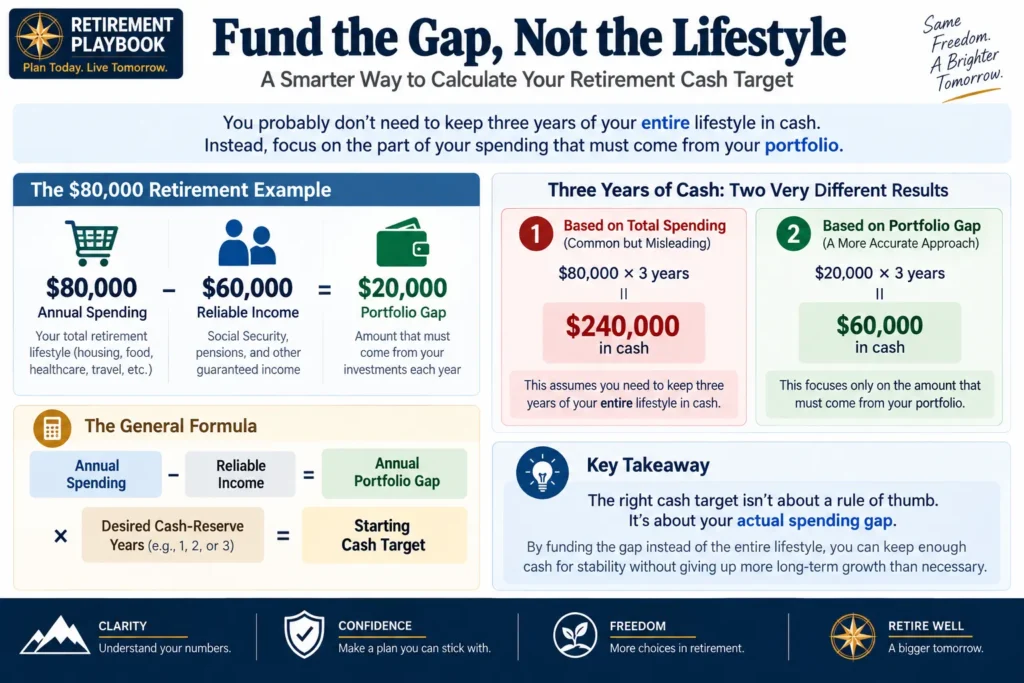
The $80,000 Retirement Example
Consider Mark and Linda.
They retire at 66 with:
- $1.4 million invested
- $48,000 combined Social Security
- $12,000 annual pension income
- $80,000 annual spending
Their reliable income is:
$60,000
Their portfolio gap is:
$20,000 per year.
Now compare several cash strategies.
| Cash Strategy | Based on Total Spending | Based on Portfolio Gap |
|---|---|---|
| 6 months | $40,000 | $10,000 |
| 1 year | $80,000 | $20,000 |
| 2 years | $160,000 | $40,000 |
| 3 years | $240,000 | $60,000 |
That’s not a minor difference.
If Mark and Linda blindly follow the “three years of spending” rule, they might hold:
$240,000
in cash.
Using the portfolio-gap approach gives them:
$60,000.
The difference is:
$180,000.
That $180,000 could potentially remain invested for longer-term retirement goals instead of sitting in a low-volatility reserve for expenses Social Security and the pension are already covering.
Illustrative example only. Actual spending, taxes, income, investment returns, interest rates, and cash needs will vary.
But the Portfolio Gap Isn’t the Whole Answer Either
Suppose Mark and Linda calculate their three-year gap:
$60,000.
Done?
Not quite.
Cash has more than one job in retirement.
It may also need to cover:
- home repairs,
- a new vehicle,
- major dental work,
- insurance deductibles,
- family emergencies,
- temporary healthcare spikes,
- taxes,
- and other irregular expenses.
Healthcare deserves particular attention because those expenses can become both recurring and unpredictable; our guide to estimating your retirement healthcare costs shows how to build them into the broader retirement budget before calculating your cash reserve.
So a better formula is:
Spending-Gap Reserve
- Known Near-Term Expenses
- Emergency Reserve
= Practical Cash Target
Suppose Mark and Linda expect:
- $60,000 three-year portfolio gap
- $20,000 roof replacement within two years
- $15,000 general emergency reserve
Their practical target becomes:
$95,000
Now the number has a reason behind it.
That’s much better than choosing $240,000 because someone on the internet said retirees should keep three years of expenses in cash.
What Is the Cash Actually Protecting You From?
The obvious answer is:
a market crash.
But let’s be more precise.
Imagine you need $40,000 from your portfolio this year.
The stock market falls 30%.
Without cash or stable assets, you may need to sell investments after the decline to finance spending.
Those shares are gone.
If the market rebounds next year, the shares you sold don’t participate.
This is one mechanism behind:
Sequence-of-Returns Risk
Average return alone doesn’t determine retirement success.
The order of returns matters when money is leaving the portfolio.
A severe decline early in retirement combined with large withdrawals can damage a portfolio much more than the same decline occurring later.
Cash can help because it gives you another source of spending money while risky assets are depressed.
But here’s the crucial point:
Cash doesn’t eliminate sequence risk.
It buys you time.
And the value of that time depends on how much you actually need to withdraw.
What One Year of Cash Really Buys You
Suppose your portfolio needs to provide:
$35,000 per year.
You hold:
$35,000 in cash.
The market crashes.
You can potentially fund approximately one year of normal portfolio withdrawals without selling stocks for spending.
That’s useful.
But what happens if the bear market lasts longer?
You have several options.
You might:
- refill cash from bonds,
- reduce discretionary spending,
- rebalance the portfolio,
- use interest and dividends,
- or resume normal withdrawals as markets recover.
This is why a cash reserve should not be evaluated in isolation.
It sits inside the rest of your retirement portfolio.
What Three Years of Cash Really Buys You
Now hold:
$105,000
for the same $35,000 annual gap.
You have much more runway.
A prolonged bear market becomes psychologically easier to tolerate.
You don’t need to look at a falling stock portfolio and wonder where next month’s spending will come from.
That behavioral benefit is real.
A retiree who panics and sells stocks after a crash can do far more damage than someone who holds a somewhat larger-than-optimal cash reserve.
But three years of cash has a cost.
The money isn’t available to your longer-term portfolio in the same way.
Over a 25- or 30-year retirement, that opportunity cost can matter.
The question becomes:
How much bear-market runway is worth paying for?
There is no universal answer.
The Hidden Cost of Too Much Cash
Imagine two retirees each have:
$1 million.
Retiree A holds:
$50,000 in cash.
Retiree B holds:
$300,000 in cash.
Retiree B certainly has more short-term stability.
But $300,000 represents:
30% of the entire portfolio.
If that retiree doesn’t actually need such a large low-volatility allocation for spending, the portfolio may struggle to generate enough long-term growth.
This matters because retirement isn’t a five-year problem.
It may be a:
30-year problem.
Cash is excellent at protecting next year’s grocery bill.
It is not designed to maximize purchasing power in 2055.
Inflation Is Cash’s Quiet Enemy
Suppose you keep:
$200,000
in cash.
If the return on that cash consistently trails inflation by just:
1 percentage point
the purchasing power erosion compounds over time.
At a 1% annual real loss, after 20 years the purchasing power is roughly equivalent to:
$164,000 in today’s dollars.
At a 2% annual real loss, it falls to roughly:
$134,000.
The account statement may still say $200,000—or more if it earns interest.
But the amount of retirement lifestyle that money can buy has changed.
This is why “I can’t lose money in cash” is incomplete.
There are at least two kinds of loss:
Nominal loss
and
purchasing-power loss.
Retirees need to care about both.
Healthcare can make that purchasing-power problem even more complicated, which is why we separately stress-tested healthcare inflation in retirement rather than assuming every expense rises at the same rate.
Illustrative example only.
Today’s Cash Yields Can Create a Dangerous Illusion
When savings accounts, money-market funds, or Treasury bills offer attractive yields, holding large amounts of cash can feel almost costless.
You get stability.
Liquidity.
And interest.
Why own anything else?
Because today’s yield is not a 30-year contract.
Short-term rates change.
A money-market fund yielding attractively today can yield much less after monetary policy changes.
This is called:
reinvestment risk.
If your retirement strategy requires today’s short-term yield to remain available indefinitely, you don’t really have a long-term strategy.
You have a current interest rate.
Cash should earn as much as reasonably possible for the job it performs.
But the reason to hold cash is not because its yield happens to be attractive this year.
The reason is that you need liquidity.
The 1-Year Cash Strategy
Now we can compare actual approaches.
A one-year reserve might be appropriate for retirees who have:
- substantial Social Security or pension income,
- relatively small portfolio withdrawals,
- flexible discretionary spending,
- meaningful bond holdings,
- no major near-term expenses,
- and a high tolerance for market volatility.
Suppose you spend:
$90,000
but receive:
$70,000
from Social Security and pensions.
Your portfolio gap is only:
$20,000.
One year of that gap is $20,000.
Add perhaps:
$20,000–$30,000
for emergencies and known expenses.
Your practical cash position might be roughly:
$40,000–$50,000.
Holding $270,000 because you spend $90,000 annually would be solving a problem your guaranteed income has already solved.
The 2-Year Cash Strategy
Two years can provide a useful middle ground.
It offers more protection against an extended downturn without committing a very large percentage of the portfolio to cash.
Consider someone with:
- $70,000 annual spending
- $40,000 reliable income
- $30,000 annual portfolio gap
Two years of portfolio withdrawals:
$60,000
Add:
$20,000 emergency/near-term reserve
and the target becomes approximately:
$80,000.
For a $1.2 million portfolio, that’s about:
6.7% of assets.
That may feel very different from saying:
“I keep two years of expenses in cash.”
Two years of total spending would have been:
$140,000.
Again, fund the job.
Not the slogan.
The 3-Year Cash Strategy
Three years provides a larger psychological and financial buffer.
It may appeal to retirees who:
- strongly dislike selling during market declines,
- rely heavily on portfolio withdrawals,
- have relatively little guaranteed income,
- expect large near-term expenses,
- or simply sleep better with more liquidity.
Suppose annual spending is:
$90,000
and reliable income is only:
$30,000.
The portfolio must provide:
$60,000 per year.
Three years means:
$180,000
before emergency or known-expense reserves.
For a $1 million portfolio, that is already:
18% of assets.
Now the trade-off becomes significant.
The larger reserve may be worth it.
But it should be a deliberate decision.
Not an automatic rule.
The Retiree Who May Need More Than Three Years
There are circumstances where even a large cash allocation can make sense.
Imagine you know you will:
- buy a retirement home in 18 months,
- pay $100,000 toward a child’s home,
- replace two vehicles,
- fund a major renovation,
- or pay several years of planned expenses before Social Security begins.
Money with a known short time horizon should not necessarily be exposed to stock-market risk simply because a generic asset-allocation rule says you are holding “too much cash.”
This isn’t really retirement cash.
It’s:
money already assigned to a near-term liability.
That’s different.
If you plan to spend $250,000 in 18 months, holding that $250,000 safely isn’t an overly conservative investment decision.
The money already has a job.
The Retiree Who May Need Less Than One Year
Now consider the opposite case.
A retired couple spends:
$75,000
but receives:
- $50,000 Social Security
- $20,000 pension
Reliable income:
$70,000.
Portfolio gap:
$5,000 per year.
They also have:
$1.8 million invested.
Do they need $75,000–$225,000 in cash because they are retired?
Probably not for routine spending alone.
Their guaranteed income already covers almost the entire lifestyle.
They may still want an emergency reserve and money for near-term purchases.
But retirement status itself does not create a magical requirement for three years of cash.
This is why the right cash allocation can differ dramatically between two households with identical portfolio sizes.
Cash and Bonds Are Not the Same Thing
This distinction matters when people discuss bucket strategies.
Cash provides:
- very high liquidity,
- minimal short-term price volatility,
- and immediate spending capacity.
Bonds can provide:
- income,
- diversification,
- potentially higher expected returns than cash over longer periods,
- and a source for rebalancing.
But bonds can fall in value.
The 2022 bond-market decline reminded retirees that “safe” and “cannot decline” are not synonyms.
That does not make bonds useless.
It means they perform a different job.
A retirement plan might reasonably hold:
one year of spending gap in cash
plus:
several additional years in high-quality bonds.
That can provide much more bear-market runway than the cash balance alone suggests.
And now we arrive at the strategy that tries to formalize exactly that idea:
The Retirement Bucket Strategy
Instead of asking how many years should sit entirely in cash, the bucket strategy divides retirement assets according to when the money may be needed.
Done well, it can make retirement spending easier to understand.
Done poorly, it can become little more than multiple accounts with fancy labels.
The difference is in how the buckets interact.
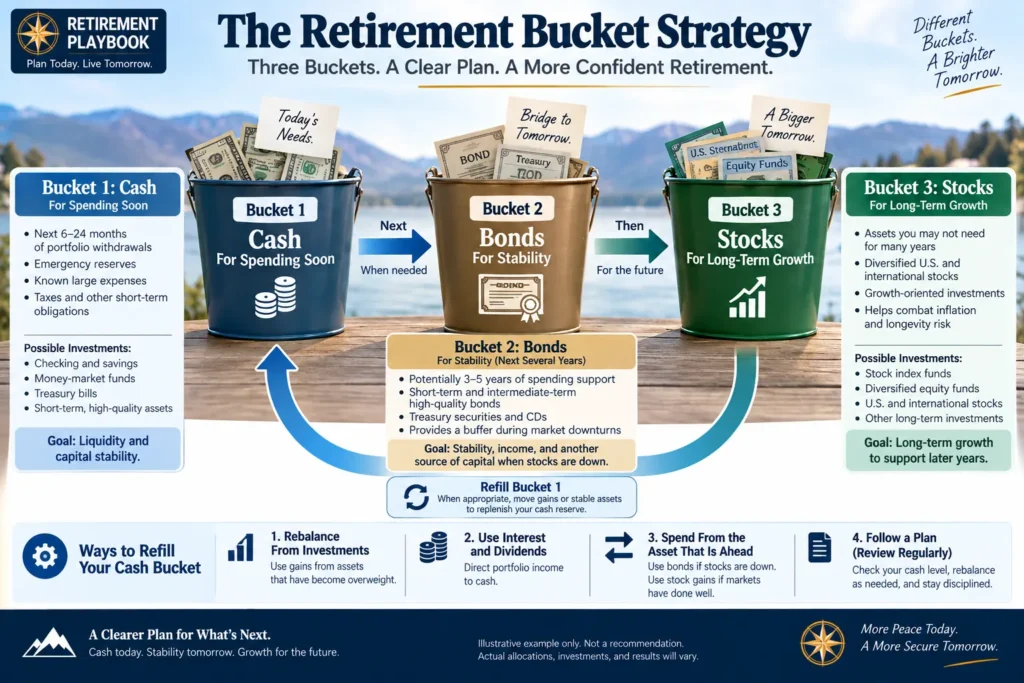
Bucket 1 — Cash for Spending Soon
The first bucket contains money you expect to spend relatively soon.
That might include:
- the next 6–24 months of portfolio withdrawals,
- emergency reserves,
- known large expenses,
- taxes,
- and other short-term obligations.
Possible holdings might include:
- checking,
- savings,
- money-market funds,
- Treasury bills,
- or other highly liquid, low-volatility assets.
The purpose isn’t return maximization.
It’s reliability.
If the stock market falls 30% tomorrow, Bucket 1 should still be able to do its job.
Bucket 2 — Stability for the Next Several Years
The second bucket is where the strategy becomes more interesting.
This money isn’t needed tomorrow.
But you may need it before you want to rely entirely on stocks recovering from a major bear market.
Depending on the broader portfolio, this bucket might contain:
- short-term bonds,
- intermediate-term high-quality bonds,
- Treasury securities,
- CDs,
- or other relatively conservative assets.
Suppose Bucket 1 covers:
one year of the portfolio spending gap.
Bucket 2 might provide another:
three to five years of potential withdrawals.
That does not mean you automatically spend Bucket 2 down every year.
Its purpose is to create another source of capital when stocks are depressed.
Bucket 3 — Long-Term Growth
The third bucket holds money you probably won’t need for many years.
This is where growth assets can live.
Depending on your investment plan, that may include:
- diversified U.S. stocks,
- international stocks,
- stock index funds,
- and other long-term investments.
Why own volatile assets at all after retirement?
Because retirement may last 30 years.
A 65-year-old isn’t investing only for age 66.
Some of today’s portfolio may ultimately fund spending at:
75
85
or even:
95.
Those dollars have a long time horizon.
Putting every retirement dollar into cash because you no longer receive a paycheck can exchange short-term market risk for long-term inflation and longevity risk.
The Buckets Are Not Three Separate Retirement Plans
This is where bucket strategies sometimes become unnecessarily complicated.
Imagine:
Bucket 1 — Cash
Bucket 2 — Bonds
Bucket 3 — Stocks
That may sound revolutionary.
But economically, you may simply be describing:
an asset allocation.
A portfolio with:
- 5% cash,
- 35% bonds,
- 60% stocks
can be described as three buckets.
Or it can simply be called:
a 60/35/5 portfolio.
The labels themselves do not create additional returns.
The value of buckets is primarily:
- behavioral,
- organizational,
- and operational.
They can help retirees understand which assets are intended for near-term spending and which are intended for long-term growth.
That’s useful.
But don’t assume that putting the same investments into three different accounts magically makes the portfolio safer.
The Most Important Bucket Rule: How Do You Refill Bucket 1?
Imagine you begin retirement with:
$50,000 in Bucket 1.
You spend $30,000 during the year.
Now Bucket 1 has:
$20,000.
What happens next?
This is where a real bucket strategy needs a rule.
Without one, you don’t have a strategy.
You have a checking account that is slowly disappearing.
There are several ways to refill it.
Refill Rule 1 — Rebalance From Investments
Suppose stocks have had a strong year and risen above your target allocation.
You sell part of the appreciated stock position and move the proceeds into cash.
Conceptually:
Sell what became overweight → refill spending reserve → restore target allocation.
This can be an elegant system.
You’re not selling stocks simply because January arrived.
You’re using portfolio rebalancing to fund spending.
Refill Rule 2 — Use Interest and Dividends
Portfolio income can flow into the cash bucket rather than automatically being reinvested.
This might include:
- bond interest,
- stock dividends,
- money-market interest,
- CD interest,
- and Treasury payments.
That income may fund part of annual spending before any assets need to be sold.
But be careful with the idea of “living only off dividends.”
A dollar of dividend is not economically magical.
Total return still matters.
Refill Rule 3 — Spend From the Asset That Is Ahead
Suppose stocks have had several excellent years.
Use some stock gains to refill cash.
Suppose stocks have crashed but bonds are relatively stable.
Use bonds instead.
This creates a flexible withdrawal system.
Rather than mechanically selling every asset proportionally every month, you have options.
What Happens During a Bear Market?
Let’s build a simplified example.
Sarah retires with:
$1.2 million.
Her annual spending is:
$75,000.
Social Security and pension income provide:
$45,000.
Portfolio gap:
$30,000 per year.
She holds:
$40,000 in Bucket 1
and a substantial high-quality bond allocation in Bucket 2.
Then stocks fall:
30%.
Instead of immediately selling stocks to fund her lifestyle, Sarah can use the $40,000 cash reserve.
If stocks remain depressed after that, she can potentially:
- use bonds,
- rebalance,
- reduce discretionary spending,
- or combine several approaches.
The important point isn’t:
“Sarah has exactly 1.33 years of cash.”
It’s:
Sarah has multiple non-stock sources available while stocks recover.
The same principle becomes even more important when a market decline collides with a major care expense, as our $1 million portfolio long-term care analysis demonstrates.
That’s a much better measure of retirement liquidity.
Calculate Your Bear-Market Runway
Instead of measuring only:
Years of cash
consider measuring:
Bear-Market Runway
Ask:
How long could I fund the portfolio portion of my spending without being forced to sell stocks?
Suppose you need:
$30,000 per year
from the portfolio.
You have:
- $40,000 cash
- $150,000 high-quality bonds
Potential non-stock resources:
$190,000
Ignoring investment changes and other complications, that represents more than:
six years of the current portfolio spending gap.
You do not have six years of cash.
But you may have roughly six years of non-stock spending capacity.
That’s a much more informative number.

Illustrative example only. Bonds can decline in value, income and spending change, taxes matter, and this simplified calculation is not a forecast.
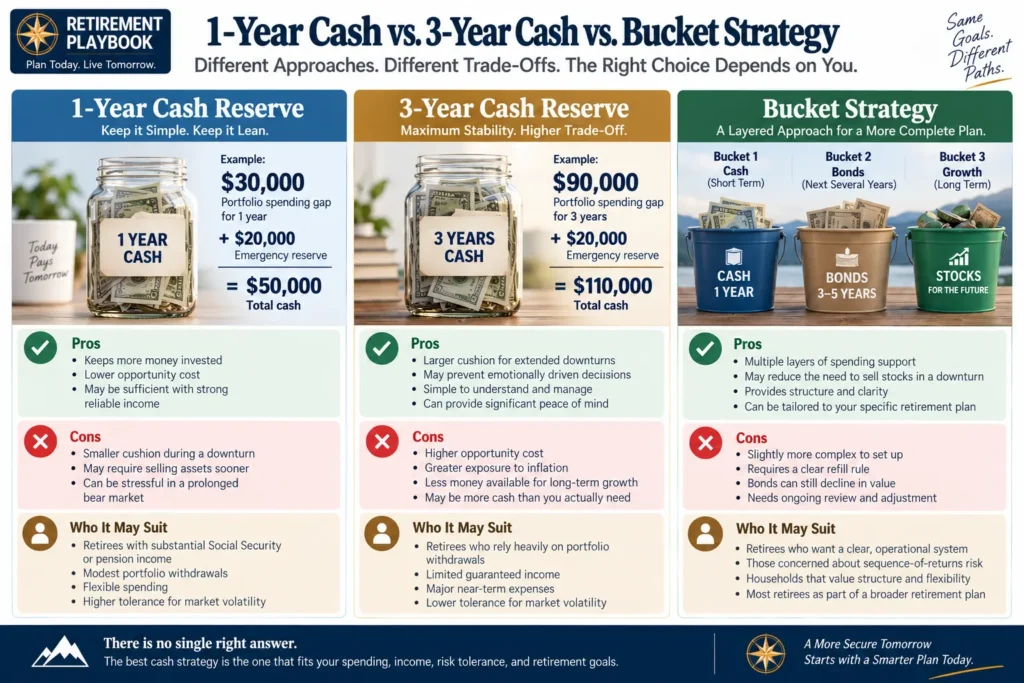
1-Year Cash vs. 3-Year Cash vs. Bucket Strategy
Now let’s compare the three approaches directly.
Assume:
- $1.2 million portfolio
- $75,000 annual spending
- $45,000 reliable income
- $30,000 annual portfolio gap
- $20,000 additional emergency reserve
Strategy A — One-Year Cash Reserve
Spending-gap reserve:
$30,000
Emergency reserve:
$20,000
Total cash:
$50,000
Strategy B — Three-Year Cash Reserve
Three years of portfolio gap:
$90,000
Emergency reserve:
$20,000
Total cash:
$110,000
Strategy C — Bucket Approach
Cash:
$50,000
High-quality bonds:
$150,000
Long-term portfolio:
$1 million
The third strategy doesn’t necessarily have more cash than Strategy A.
But it has additional stable assets that can potentially support withdrawals during a prolonged stock-market decline.
Here’s the conceptual difference:
| Strategy | Cash | Additional Stable Assets | Main Strength |
|---|---|---|---|
| 1-Year Cash | $50K | Depends on portfolio | More money remains invested |
| 3-Year Cash | $110K | Depends on portfolio | Larger immediate runway |
| Bucket | $50K | $150K bonds | Multiple spending layers |
There is no automatic winner.
The right strategy depends on what the rest of the portfolio looks like.
When the 1-Year Strategy May Be Better
A relatively small cash reserve can make sense when:
- guaranteed income covers most essential spending,
- your withdrawal rate is modest,
- you have meaningful bond exposure,
- spending is flexible,
- your portfolio is large relative to withdrawals,
- and market declines do not cause you to panic.
In that situation, keeping several hundred thousand dollars in cash may solve a risk that wasn’t particularly dangerous to begin with.
When the 3-Year Strategy May Be Better
A larger reserve can make sense when:
- portfolio withdrawals fund a large share of spending,
- guaranteed income is limited,
- you have major near-term expenses,
- you have relatively low tolerance for volatility,
- or a large cash buffer prevents emotionally driven investment decisions.
Do not underestimate the last point.
A mathematically optimized portfolio is useless if you abandon it during the first major bear market.
If three years of cash is what allows you to leave the long-term portfolio alone during a crash, the opportunity cost may be worth paying.
When the Bucket Strategy May Be Better
Buckets can be particularly useful when you want a clear operational system.
You know:
what pays for next year
what provides stability for the following years
and
what remains invested for the distant future.
That clarity can make retirement easier to manage.
It can also help a spouse who isn’t interested in investing understand the plan.
Instead of explaining factor exposures, duration, expected returns, and sequence risk, you can say:
“This account pays our bills. These assets protect the next several years. These investments are for later.”
There is real value in a retirement plan that someone besides you can understand.
The Best Strategy May Be a Hybrid
You do not have to declare yourself:
Team Cash
or:
Team Bucket.
A practical retirement portfolio might simply contain:
- 12–18 months of the spending gap in cash,
- several years of potential spending in high-quality bonds,
- long-term growth assets,
- and flexible discretionary spending.
That’s effectively a bucket strategy without requiring three separate bank accounts or complicated refill rules.
The architecture matters more than the label.
Cash Should Change When Your Income Changes
Suppose you retire at 62.
You spend:
$80,000 per year.
Social Security hasn’t started.
Maybe you need:
$60,000 per year
from the portfolio.
Your cash requirement may be relatively large.
Then at 70, Social Security begins and provides:
$45,000 per year.
Suddenly the portfolio gap falls dramatically.
Should your cash target remain exactly the same?
Probably not.
This is why cash planning should be dynamic.
Your reserve may change when:
- Social Security begins,
- a pension starts,
- a mortgage ends,
- you sell a home,
- required minimum distributions begin,
- spending falls,
- or major planned expenses are completed.
Cash isn’t a retirement number you calculate once at 65 and carve into stone.
The Social Security Bridge Is a Special Case
Some retirees intentionally delay Social Security while spending portfolio assets in the early retirement years.
Suppose you retire at 65 but plan to claim Social Security at 70.
Those five years may require substantially larger portfolio withdrawals.
Part of that spending may reasonably be positioned in safer assets before retirement.
Why?
Because it isn’t an unknown future expense.
You already know you intend to spend the money.
This is similar to the retiree planning a home purchase.
A known liability deserves different treatment from money intended for age 90.
Don’t Forget Taxes
Suppose you need:
$40,000 of spending money.
If it comes from a checking account, you may need exactly $40,000.
If it requires a traditional IRA withdrawal, you may need to withdraw more than $40,000 to cover the resulting taxes.
If it comes from taxable investments with embedded gains, the tax consequences are different again.
If it comes from Roth assets, qualified withdrawals may have another treatment.
So when calculating your spending gap, ask whether the number is:
before tax
or:
after tax.
A $40,000 after-tax spending gap is not necessarily a $40,000 portfolio withdrawal.
This becomes especially important when large withdrawals interact with:
- Medicare IRMAA,
- capital-gains taxation,
- Social Security taxation,
- and other income-based thresholds.
Cash planning and tax planning should talk to each other.
That coordination matters even more after Medicare begins, because taxable income can affect IRMAA as well as the premiums and out-of-pocket expenses already built into your retirement healthcare budget.
Our guide to how much Medicare really costs in retirement explains those expenses and where retirees commonly underestimate them.
Where Should Retirement Cash Actually Be Kept?
The answer depends on what job the money has.
Checking Account
Good for:
- monthly bills,
- automatic payments,
- near-term spending.
You generally don’t need multiple years of retirement spending sitting in checking.
High-Yield Savings Account
Potentially useful for:
- emergency reserves,
- known near-term expenses,
- accessible cash.
Check:
- yield,
- FDIC coverage,
- withdrawal rules,
- and account terms.
Money-Market Deposit Account
A bank money-market deposit account may offer competitive interest while maintaining deposit-account characteristics.
Again, check applicable FDIC insurance limits and terms.
Money-Market Mutual Fund
Common inside brokerage accounts.
Useful for:
- portfolio cash,
- settlement funds,
- short-term reserves.
But remember:
a money-market mutual fund is not an FDIC-insured bank deposit.
Treasury Bills
Treasury bills can be useful for money with a defined short horizon.
A retiree might build a short Treasury ladder with maturities timed around expected spending.
That can provide predictable access to principal without committing the money for long periods.
CDs
Certificates of deposit can also play a role when:
- the maturity matches the spending horizon,
- the yield is attractive,
- and the retiree understands early-withdrawal restrictions.
A CD ladder can create another version of a short-term spending bucket.
The best location isn’t necessarily the account advertising the highest rate this morning.
Match the instrument to the job.
How Much Cash Should You Keep in Retirement as a Percentage?
You may hear:
“Retirees should keep 5% of their portfolio in cash.”
Or:
“Keep 10%.”
Percentage rules are easy.
But retirement spending doesn’t occur as a percentage of your brokerage statement.
Consider two retirees with $2 million.
Retiree A
Portfolio withdrawal need:
$20,000/year
Retiree B
Portfolio withdrawal need:
$100,000/year
A 5% cash allocation gives both:
$100,000.
For Retiree A, that’s five years of portfolio withdrawals.
For Retiree B, it’s one year.
Same cash percentage.
Completely different liquidity.
This is why:
Cash Should Be Measured Against Spending Needs, Not Just Portfolio Size
What If the Market Crashes Right After You Retire?
This is the scenario everyone worries about.
You retire Monday.
Stocks crash Tuesday.
The first thing not to do is invent a new retirement strategy on Wednesday.
Your response should already exist.
For example:
Step 1: Spend from the planned cash reserve.
Step 2: Reduce optional spending if appropriate.
Step 3: Rebalance from assets that have held up better.
Step 4: Avoid unnecessary stock sales while equities are severely depressed.
Step 5: Refill cash according to your predetermined rules when conditions allow.
Notice what isn’t included:
“Predict when the market will bottom.”
You don’t need to know.
The purpose of liquidity planning is to reduce the number of predictions your retirement requires.
Cash Is Also a Behavioral Asset
Financial spreadsheets treat cash as:
- expected return,
- volatility,
- correlation,
- inflation exposure.
Humans experience cash differently.
Cash can create:
permission not to panic.
Imagine seeing your $1.5 million portfolio fall to $1.15 million.
If next year’s spending depends on selling stocks, that decline may feel terrifying.
If you can see:
18 months of spending in cash
and:
several more years in bonds,
the same market decline can feel very different.
That psychological difference is difficult to model.
But it matters.
A slightly inefficient portfolio you can stick with may outperform a theoretically optimal portfolio you abandon.
FAQ
How much cash should a retiree keep?
There is no universal amount.
A useful starting point is to calculate the annual gap between your spending and reliable income, then decide how many months or years of that gap you want available in cash.
Add known near-term expenses and an appropriate emergency reserve.
For many retirees, this produces a much more useful number than simply holding one to three years of total spending.
Is one year of cash enough in retirement?
It can be.
One year may be reasonable when Social Security and pensions cover much of your spending, you have a diversified bond allocation, discretionary spending is flexible, and your portfolio withdrawals are relatively modest.
A retiree who depends heavily on portfolio withdrawals may prefer more liquidity.
Is three years of cash too much?
Not necessarily.
Three years may provide valuable stability and behavioral comfort.
But the opportunity cost becomes more important as the cash reserve grows relative to the total portfolio.
Calculate three years of your portfolio spending gap, not automatically three years of total household spending.
Should I keep five years of retirement expenses in cash?
Usually that deserves careful scrutiny.
Five years of total spending can represent a very large low-growth allocation.
However, known expenses over the next several years, a Social Security bridge, unusually low risk tolerance, or other circumstances can justify substantial safe assets.
Also remember that five years of spending capacity does not necessarily require five years of literal cash.
High-quality bonds can provide additional non-stock resources.
Does my emergency fund count as retirement cash?
Yes, but give the dollars separate jobs in your calculation.
For example:
$30,000 spending reserve
plus:
$20,000 emergency reserve
equals:
$50,000 total cash.
That prevents you from accidentally counting the same $20,000 as both next year’s groceries and a new furnace.
Should retirement cash be in a savings account or money-market fund?
Either can potentially be appropriate depending on the purpose.
Savings accounts may offer FDIC insurance within applicable limits.
Money-market mutual funds can integrate conveniently with brokerage accounts but are not bank deposits and are not FDIC-insured.
Treasury bills and CDs are additional options.
Compare safety, liquidity, yield, maturity, insurance protection, and convenience.
Should I move to cash before a recession?
Trying to predict recessions and market declines is different from maintaining a planned retirement cash reserve.
The purpose of the reserve is to make market timing less necessary.
A well-designed retirement plan should already specify how much liquidity you maintain before anyone knows when the next recession will occur.
What happens when my cash bucket runs low?
Decide that before retirement.
Potential refill rules include:
- portfolio rebalancing,
- selling appreciated assets,
- directing dividends and interest to cash,
- selling bonds when stocks are depressed,
- or combining these approaches.
A bucket strategy without a refill rule is incomplete.
The purpose of the rule is to prevent every withdrawal decision from becoming a new market-timing decision.
Are Treasury bills the same as cash?
Not exactly.
Treasury bills are short-term U.S. government securities rather than bank deposits.
If held to maturity, they can provide a predictable payment at a known date, which can make them useful for planned retirement spending.
But they are still securities, and their market value can fluctuate if sold before maturity.
For retirement planning purposes, very short-term Treasury bills may perform a cash-like role without literally being cash.
Do bonds reduce how much cash I need?
Potentially, yes.
If your portfolio contains a meaningful allocation to high-quality bonds, you may already have several years of non-stock spending capacity.
That can reduce the need to hold the same number of years entirely in cash.
But bonds are not guaranteed to remain stable during every stock-market decline, so they should not automatically be treated as cash.
The better question is:
How much non-stock liquidity does my entire retirement portfolio provide?
Final Thoughts
Cash feels different after retirement.
While you’re working, a falling stock market may be unpleasant.
But another paycheck is coming.
After retirement, that paycheck disappears.
Suddenly the money sitting in checking, savings, a money-market fund, or Treasury bills represents something more than an asset allocation.
It represents:
time.
Time to let markets recover.
Time to avoid selling stocks after a severe decline.
Time to make decisions instead of reacting.
That’s why holding cash in retirement can be enormously valuable.
But more time isn’t automatically better at any price.
Keeping $300,000 in cash when your portfolio only needs to provide $20,000 per year is very different from keeping $300,000 when your portfolio must provide $100,000.
The dollar amount alone tells us almost nothing.
So forget the idea that every retiree needs:
one year
or:
three years
or:
10% of the portfolio
in cash.
Start with the financial job.
How much does your household spend?
How much reliable income arrives without selling investments?
How much must the portfolio provide?
What major expenses are already visible?
What emergency reserve do you need?
How much non-stock capacity already exists elsewhere in the portfolio?
And perhaps most importantly:
How much liquidity would allow you to leave your long-term investments alone during a bad market?
That number is your real cash target.
Not the rule of thumb.
Retirement Playbook: Calculate Your Retirement Cash Target
You can build a practical retirement cash strategy without predicting the next bear market.
Work through these steps.
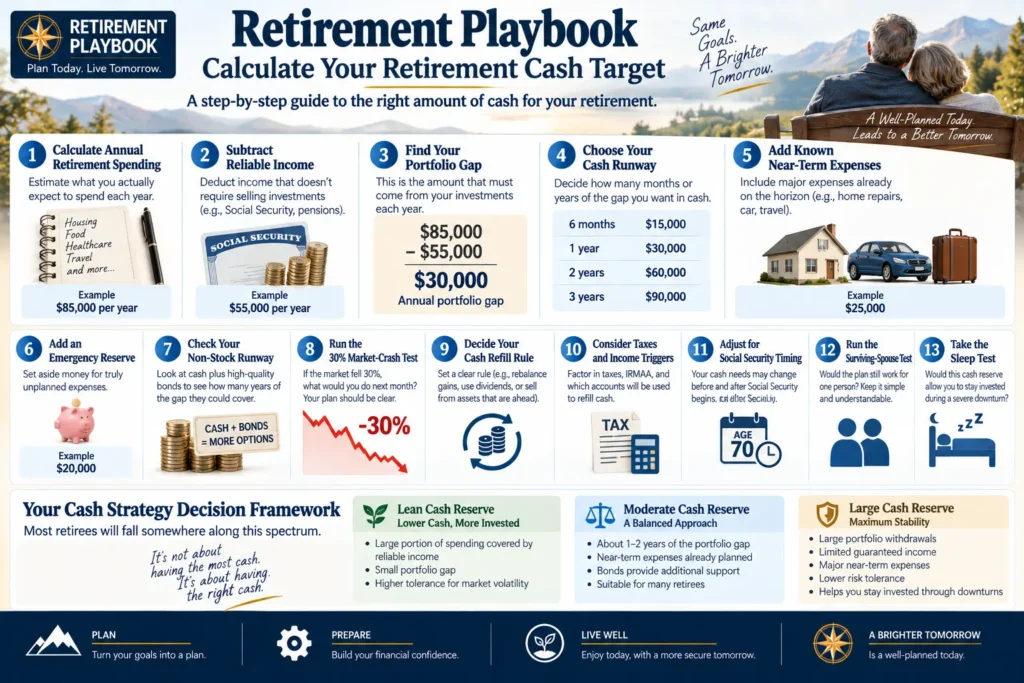
Step 1 — Calculate Annual Retirement Spending
Start with what you actually expect the household to spend.
Include:
- housing,
- food,
- transportation,
- healthcare,
- insurance,
- taxes,
- travel,
- entertainment,
- and other recurring expenses.
Suppose the result is:
$85,000 per year.
Don’t calculate your cash target yet.
Step 2 — Subtract Reliable Income
Now identify income that doesn’t require selling portfolio assets.
Examples might include:
- Social Security,
- pensions,
- annuity income,
- and other reliable recurring income.
Suppose that totals:
$55,000.
Your annual portfolio spending gap is:
$85,000 − $55,000 = $30,000
That $30,000—not automatically the entire $85,000—is the starting point for your cash reserve.
Step 3 — Choose Your Runway
Now decide how much immediate spending runway helps your retirement plan.
6 months
$15,000
1 year
$30,000
2 years
$60,000
3 years
$90,000
These numbers are not recommendations.
They show what each strategy actually costs for this household.
Step 4 — Add Known Near-Term Expenses
Look at the next two or three years.
Are you expecting:
- a roof replacement,
- a vehicle purchase,
- major dental work,
- a home renovation,
- a large tax payment,
- family assistance,
- or a major trip you’ve already committed to?
Suppose you expect:
$25,000
of additional near-term spending.
Add it separately.
Do not pretend predictable expenses are emergencies.
Step 5 — Add Your Emergency Reserve
Now determine how much truly unplanned spending you want immediately accessible.
Suppose:
$20,000.
If you selected a one-year spending-gap reserve:
**$30,000 spending reserve
- $25,000 known expenses
- $20,000 emergency reserve
= $75,000 practical cash target**
Now every dollar has a reason for being there.
Step 6 — Check for Double Counting
This step is easy to miss.
Perhaps your annual $85,000 budget already includes:
$10,000 for home repairs.
Then adding another $10,000 “home repair reserve” may count the same expense twice.
The same problem can happen with:
- healthcare reserves,
- taxes,
- travel,
- emergency savings,
- and long-term care funds.
Make sure every reserve represents a genuinely different liability.
If you’ve already designated assets for future care, our guide to building a long-term care fund can help you define which dollars belong to that reserve so they aren’t accidentally counted again as ordinary retirement cash.
Conservative assumptions are useful.
Counting the same expense twice isn’t conservative.
It’s inaccurate.
Step 7 — Calculate Your Non-Stock Runway
Now look beyond literal cash.
Suppose you have:
$75,000 cash
plus:
$180,000 high-quality bonds.
Total non-stock assets:
$255,000.
Your annual portfolio gap is:
$30,000.
That represents approximately:
8.5 years of the current spending gap
before considering investment changes, taxes, interest, or inflation.
That does not mean you have 8.5 years guaranteed.
Bonds fluctuate.
Spending changes.
Inflation matters.
But it tells you something important:
You may not need three additional years sitting entirely in cash when the rest of the portfolio already contains substantial defensive capacity.
Step 8 — Run the 30% Market-Crash Test
Imagine stocks fall:
30%.
Now ask:
What would we actually do next month?
Your answer should be specific.
For example:
Year 1: Spend from cash.
If stocks remain depressed: Use part of the bond allocation and reduce optional spending.
When stocks recover or become overweight: Rebalance and refill cash.
If your answer is:
“I guess we’d decide then,”
the retirement plan isn’t finished.
Step 9 — Decide Your Cash Refill Rule
Write it down.
A simple rule might be:
Review the cash reserve twice per year. When stocks have performed strongly or exceed their target allocation, rebalance gains into the cash reserve. During significant equity declines, fund withdrawals from cash and defensive assets rather than mechanically selling depressed stocks.
Your actual rule may differ.
The important thing is having one.
This turns cash from a pile of money into part of a withdrawal system.
Step 10 — Check the Tax Source
Identify which account refills cash.
Is it:
- taxable brokerage assets,
- a traditional IRA,
- a Roth IRA,
- bond interest,
- dividends,
- maturing Treasuries,
- or some combination?
Then consider the tax consequences.
A withdrawal strategy that minimizes market risk but accidentally creates unnecessary taxes or Medicare IRMAA can still be expensive.
Cash flow, investments, and taxes belong in the same plan.
Step 11 — Run the Social Security Timing Test
If you haven’t claimed Social Security yet, calculate your cash needs:
before Social Security
and:
after Social Security.
They may be dramatically different.
For example:
Age 65–69
Annual portfolio gap:
$60,000
Age 70+
Social Security begins.
Portfolio gap:
$20,000
Using the same cash target for both periods would make little sense.
Your cash strategy should evolve as your income changes.
Step 12 — Run the Surviving-Spouse Test
If you’re married, calculate the cash need again after the first spouse dies.
Some expenses disappear.
Others remain.
One Social Security benefit generally disappears.
Taxes may change.
Healthcare spending changes.
The surviving spouse may also prefer a simpler financial system.
Ask:
Would our current cash and bucket strategy still be understandable and workable for one person?
This isn’t just an investment question.
It’s an estate-planning and household-management question.
Step 13 — Run the Sleep Test
Now forget the spreadsheet for a moment.
Imagine the stock market falls:
35%.
Financial news is terrible.
Your portfolio statement is painful to open.
Would the amount of cash you’ve chosen allow you to leave the long-term investment strategy alone?
If yes, the reserve may be doing its job.
If no, increasing liquidity may be reasonable—even if a spreadsheet says a smaller reserve is mathematically optimal.
Behavior belongs in retirement planning.
The Retirement Cash Decision Framework
After working through the numbers, most retirees will fall somewhere along this spectrum.
Lean Cash Reserve
Potentially appropriate when:
- reliable income covers most spending,
- the portfolio withdrawal gap is small,
- bond reserves are substantial,
- discretionary spending is flexible,
- and market volatility does not create behavioral problems.
Think:
liquidity for the job—not cash for the sake of cash.
Moderate Cash Reserve
Potentially appropriate when:
- portfolio withdrawals fund a meaningful share of retirement,
- you want approximately one to two years of the spending gap readily available,
- near-term expenses exist,
- and bonds provide additional bear-market capacity.
For many retirees, this can create a useful balance between liquidity and long-term growth.
Large Cash Reserve
Potentially appropriate when:
- portfolio withdrawals are large,
- guaranteed income is limited,
- significant near-term expenses are already planned,
- risk tolerance is low,
- or a larger reserve is what allows you to remain invested through severe market declines.
The cost is greater inflation and opportunity-cost exposure.
That doesn’t automatically make the strategy wrong.
It means you’re paying for additional stability.
Know what you’re buying.
One Number to Remember
If you remember only one calculation from this article, make it:
Annual Spending − Reliable Income = Portfolio Spending Gap
Then size your cash reserve against that gap.
Not automatically against total spending.
Not automatically against portfolio size.
Not because someone said every retiree needs three years.
Suppose two households each spend:
$100,000 per year.
Household A receives:
$80,000 of reliable income.
Portfolio gap:
$20,000.
Household B receives:
$30,000.
Portfolio gap:
$70,000.
Three years of total spending would tell both households to hold:
$300,000.
Three years of their actual portfolio gaps would suggest:
$60,000
versus:
$210,000.
Now the cash strategy reflects the retirement.
That’s the point.
Cash isn’t there because you’re retired.
Cash is there because certain dollars have a short-term job.
Give those dollars enough safety to do that job.
And give the rest of your retirement money enough time to do its own.
Coming Next
Once you know how much cash to keep, the next question is unavoidable:
Where should the rest of your retirement portfolio go?
Stocks can provide long-term growth.
Bonds can provide stability and income.
Cash provides liquidity.
But the right mix changes dramatically depending on your withdrawal needs, guaranteed income, risk tolerance, and retirement horizon.
In the next Retirement Playbook:
How Should You Allocate Your Portfolio in Retirement? Stocks, Bonds, and Cash by Age
We’ll examine why age alone shouldn’t determine your asset allocation, compare several retirement portfolio structures, stress-test them against market declines and inflation, and build a practical allocation framework for different types of retirees.