
Imagine two retirees.
Both are 67.
Both have $1.5 million invested.
Both expect to live another 25 or 30 years.
Should they own the same portfolio?
At first glance, maybe.
They’re the same age.
They have the same amount of money.
A traditional age-based allocation rule might put both somewhere around the same mix of stocks and bonds.
But now let’s add one detail.
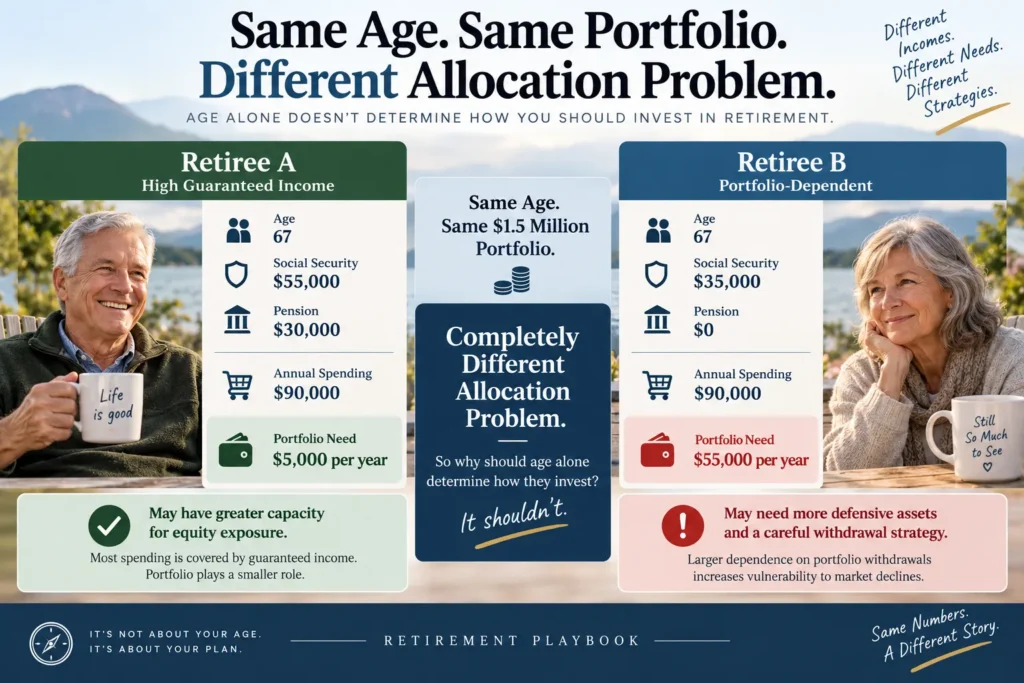
Retiree A receives:
- $55,000 from Social Security
- $30,000 from a pension
Annual spending:
$90,000
The portfolio only needs to provide:
$5,000 per year.
Retiree B receives:
- $35,000 from Social Security
- no pension
Annual spending:
$90,000
The portfolio needs to provide:
$55,000 per year.
Same age.
Same $1.5 million.
Completely different dependence on the portfolio.
So why should age alone determine how they invest?
It shouldn’t.
Age matters.
But it is only one variable.
A better retirement allocation starts with a different question:
What does this portfolio actually need to do?
Some retirement dollars need to pay next year’s bills.
Some may be needed five years from now.
And some may remain invested for 20 or 30 years—or eventually pass to heirs.
Those dollars do not all have the same time horizon.
That’s why the right mix of stocks, bonds, and cash in retirement should be built around the job of the portfolio, not simply the age of the retiree.
A Strong retirement portfolio allocation starts with thos financial jobs first and chooses the percentages second.
Why Retirement Asset Allocation Is Different
While you’re working, portfolio management can be relatively simple.
You earn a paycheck.
You contribute money.
The portfolio grows—or doesn’t.
You generally aren’t asking it to finance groceries every month.
Retirement changes that.
Money begins moving in the opposite direction.
Instead of:
Paycheck → Portfolio
you now have:
Portfolio → Paycheck
That changes the consequences of volatility.
A 30% stock-market decline at age 45 can be uncomfortable.
But if you’re still contributing, you may even buy more shares at lower prices.
At 70, a 30% decline combined with portfolio withdrawals creates a different problem.
You may be selling assets precisely when they are depressed.
This is why retirement asset allocation has to balance three competing objectives:
Growth
You need enough growth to fight inflation and support a retirement that could last decades.
Stability
You need assets that can reduce the damage from severe stock-market declines.
Liquidity
You need money available for near-term spending without depending on markets being favorable.
Stocks, bonds, and cash each solve a different part of that problem.
What Stocks Do in a Retirement Portfolio
Stocks are often described as the “risky” part of a retirement portfolio.
In the short run, that’s fair.
Stock markets can fall:
20%
30%
or occasionally much more.
That volatility becomes especially uncomfortable when you’re withdrawing money.
But removing stocks creates another risk.
Your Retirement May Last Longer Than You Think
A 65-year-old retiree isn’t investing only for next year.
Some money may not be needed until age:
75
85
or:
95.
That gives part of the portfolio a very long time horizon.
Stocks can provide:
- long-term capital growth,
- dividend income,
- participation in economic growth,
- and an important defense against long-term inflation.
A retiree who moves almost everything into cash and short-term bonds may dramatically reduce short-term volatility.
But they may also increase:
inflation risk
and:
longevity risk.
Safety has more than one definition.
What Bonds Do in a Retirement Portfolio
Bonds often serve as the bridge between cash and stocks.
They can potentially provide:
- income,
- lower volatility than stocks,
- diversification,
- capital for rebalancing,
- and assets that may be sold when equities are depressed.
But bonds are not cash.
And bonds are not risk-free.
Bond prices can fall when interest rates rise.
Credit risk matters.
Duration matters.
Inflation matters.
The 2022 bond-market decline gave retirees a painful reminder that stocks and bonds can decline at the same time.
Still, that does not make bonds useless.
It means the phrase:
“Bonds are safe.”
is too simplistic.
The more useful question is:
What job are these bonds performing?
Shorter-duration high-quality bonds may help stabilize near- and intermediate-term spending.
Longer-duration bonds may respond differently to interest-rate changes.
Treasury securities have different credit characteristics from corporate bonds.
TIPS can provide explicit inflation protection on principal.
“Bonds” is not one asset.
Just as “stocks” isn’t one company.
What Cash Does in a Retirement Portfolio
Cash has the clearest job.
It pays for things soon.
Cash can provide:
- immediate liquidity,
- emergency reserves,
- near-term portfolio withdrawals,
- known major expenses,
- and psychological comfort during market declines.
But cash also has limitations.
Over long periods, it may struggle to preserve purchasing power after inflation.
And short-term yields can fall.
So cash is excellent for:
next year.
It is much less compelling as the default home for money intended for:
20 years from now.
The objective isn’t to maximize cash.
It’s to hold enough cash that your long-term investments are not constantly being interrupted to solve short-term problems.
If you haven’t calculated that number yet, our guide to how much cash you should keep in retirement compares one-year and three-year reserves with a bucket strategy based on your actual portfolio spending gap.
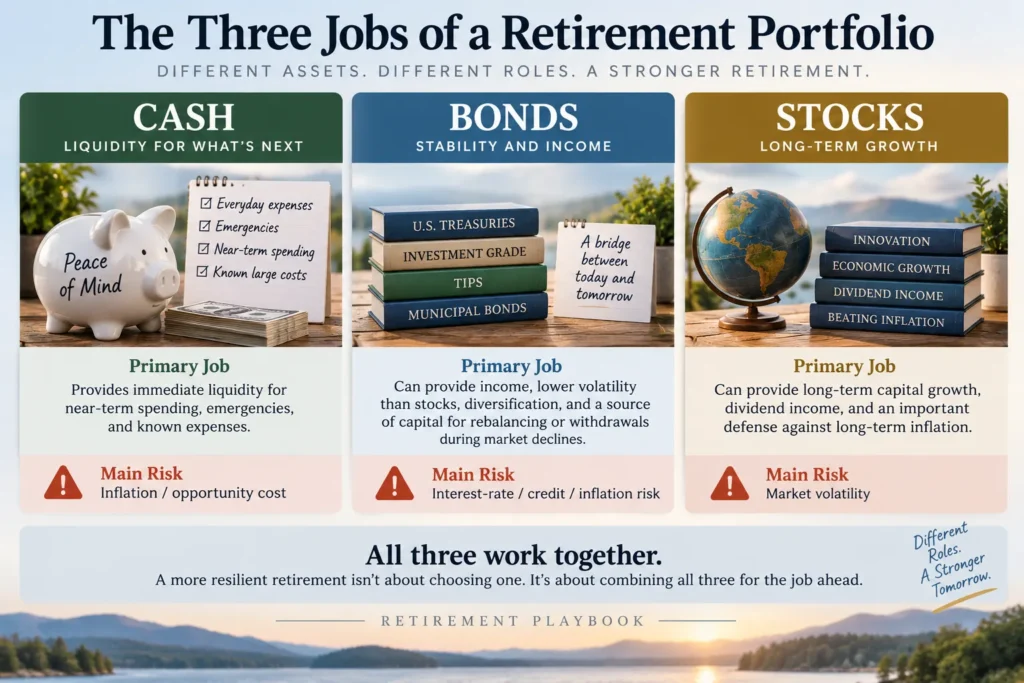
The Three Jobs of a Retirement Portfolio
You can think about retirement allocation as three jobs.
| Asset | Primary Job | Main Risk |
|---|---|---|
| Cash | Liquidity | Inflation / opportunity cost |
| Bonds | Stability & income | Interest-rate / credit / inflation risk |
| Stocks | Long-term growth | Market volatility |
This is a more useful framework than:
“I’m 70, so I should own X% stocks.”
Age still matters because it influences time horizon.
But the portfolio’s job matters more.
Why “100 Minus Your Age” Doesn’t Work Very Well
One of the oldest allocation rules says:
Stock allocation = 100 − your age
At 60:
40% stocks
At 70:
30%
At 80:
20%
Later variations changed 100 to:
110
or:
120
because people live longer.
The problem isn’t the exact number.
The problem is pretending age contains enough information.
Consider our two 67-year-olds again.
Retiree A
$1.5 million portfolio
$85,000 reliable annual income
$90,000 spending
Portfolio gap:
$5,000
Retiree B
$1.5 million portfolio
$35,000 reliable income
$90,000 spending
Portfolio gap:
$55,000
Retiree A may have enormous risk capacity.
Most essential spending is already covered.
A severe market decline may have little effect on lifestyle.
Retiree B is much more dependent on portfolio withdrawals.
Yet an age-only formula gives them exactly the same allocation.
That’s the problem.
Risk Tolerance and Risk Capacity Are Not the Same
This distinction is essential in retirement.
Risk Tolerance
How much volatility can you emotionally tolerate?
If your $1.5 million portfolio falls to:
$1.05 million
during a severe bear market, will you stay invested?
Or will you sell?
That’s risk tolerance.
Risk Capacity
How much volatility can your financial plan actually survive?
A retiree whose Social Security and pension cover nearly all essential spending may have high risk capacity.
They don’t need to sell stocks to pay the electric bill.
Another retiree may love investing and feel emotionally comfortable with stocks—but require large portfolio withdrawals every year.
Their risk tolerance may be high.
Their risk capacity may not be.
Your allocation has to respect both.
The Most Important Number May Be Your Portfolio Dependency
Here’s a simple metric.
Portfolio Dependency Ratio
Calculate:
Annual Portfolio Withdrawal Need ÷ Annual Spending
Suppose you spend:
$100,000
and Social Security plus pensions provide:
$75,000.
Portfolio withdrawal need:
$25,000
Portfolio Dependency Ratio:
25%
Now consider another retiree spending the same $100,000 but receiving only $30,000 of reliable income.
Portfolio withdrawal:
$70,000
Portfolio Dependency Ratio:
70%
The second household is much more exposed to portfolio volatility.
This doesn’t automatically mean they should own fewer stocks.
Portfolio size also matters.
But it tells us something age doesn’t.
Portfolio Size Changes the Meaning of the Same Withdrawal
Consider two households that each need:
$60,000 per year
from investments.
Household A
Portfolio:
$750,000
Withdrawal need:
8%
Household B
Portfolio:
$3 million
Withdrawal need:
2%
Same dollar withdrawal.
Completely different financial pressure.
Household A has very little room for a prolonged market decline combined with withdrawals.
Household B has much greater capacity.
So retirement allocation should consider at least:
- age,
- portfolio size,
- withdrawal rate,
- guaranteed income,
- spending flexibility,
- time horizon,
- risk tolerance,
- and legacy goals.
Now we’re getting somewhere.
Start With Spending, Not Stocks
Many retirees begin allocation planning by asking:
“What percentage should I have in stocks?”
Reverse the process.
First ask:
How much money might I need from this portfolio over the next five years?
Suppose you spend:
$90,000 per year.
Social Security and pension income provide:
$60,000.
Portfolio gap:
$30,000.
Five years of today’s gap:
$150,000.
That doesn’t mean you need $150,000 in cash.
But it gives you a picture of the near- and intermediate-term liability the portfolio may need to support.
Now compare that with a:
$1.5 million portfolio.
Only about 10% of the portfolio represents five years of the current spending gap.
That context matters enormously when deciding what the remaining 90% needs to do.
A Simple Retirement Portfolio Allocation Framework
Instead of starting with age, divide the portfolio by time horizon.
Money Needed Soon
Approximate horizon:
0–2 years
Primary objective:
liquidity and capital stability
Potential assets may include:
- cash,
- money-market funds,
- Treasury bills,
- short-term high-quality instruments.
Money Needed Later
Approximate horizon:
3–7 years
Primary objective:
stability, income, and moderate growth
Potential assets may include:
- high-quality bonds,
- Treasury securities,
- TIPS,
- diversified bond funds,
- and other defensive assets appropriate to the plan.
Money Needed Much Later
Approximate horizon:
8+ years
Primary objective:
long-term growth
This is where a diversified stock allocation becomes increasingly defensible.
The exact year boundaries are not sacred.
The principle is.
Match the investment risk to when the money may be needed.
Does This Mean Everyone Should Use a Bucket Strategy?
No.
This framework may look familiar because it resembles the retirement bucket strategy.
But you don’t need three separate accounts.
A portfolio containing:
- cash,
- bonds,
- stocks
with a disciplined rebalancing and withdrawal process can accomplish essentially the same economic objective.
The buckets are useful if they help you understand and stick with the plan.
They’re unnecessary if they create complexity.
The investment structure should serve the retiree.
Not the other way around.
So What Stock Allocation Is Reasonable?
Now we can finally discuss percentages.
Not as rules.
As starting points for analysis.
A retirement portfolio might broadly fall into one of these ranges:
Conservative
30%–40% stocks
50%–60% bonds
5%–10% cash
Potentially appropriate for someone who:
- prioritizes stability,
- has limited tolerance for volatility,
- depends meaningfully on portfolio withdrawals,
- and has enough assets that aggressive growth isn’t necessary.
Balanced
50%–60% stocks
30%–40% bonds
5%–10% cash
Potentially appropriate for someone seeking a balance between:
- long-term growth,
- bear-market resilience,
- and current retirement spending.
This general range is often where retirement allocation discussions begin.
But it should not automatically be where they end.
Growth-Oriented
70%–80% stocks
15%–25% bonds
5% cash
Potentially appropriate for retirees who:
- have substantial guaranteed income,
- have low portfolio withdrawal needs,
- possess significant excess assets,
- have long time horizons,
- want to leave a legacy,
- and can emotionally tolerate severe market declines.
The key phrase is:
can tolerate severe market declines.
An 80% stock portfolio can fall dramatically during a major bear market.
If that would cause you to abandon the strategy, the allocation is too aggressive regardless of what a spreadsheet says.
What Would a 30% Stock-Market Decline Feel Like?
This is where percentages become real.
Suppose you have:
$1.5 million.
We’ll simplify and assume the stock portion falls 30% while cash and bonds remain unchanged.
40% Stock Portfolio
Stocks:
$600,000
30% decline:
−$180,000
Approximate portfolio after decline:
$1.32 million
Portfolio decline:
12%
60% Stock Portfolio
Stocks:
$900,000
30% decline:
−$270,000
Approximate portfolio:
$1.23 million
Portfolio decline:
18%
80% Stock Portfolio
Stocks:
$1.2 million
30% decline:
−$360,000
Approximate portfolio:
$1.14 million
Portfolio decline:
24%
Now forget the percentages.
Imagine opening your account and seeing:
$360,000 disappear.
Would you stay invested?
That’s the question.
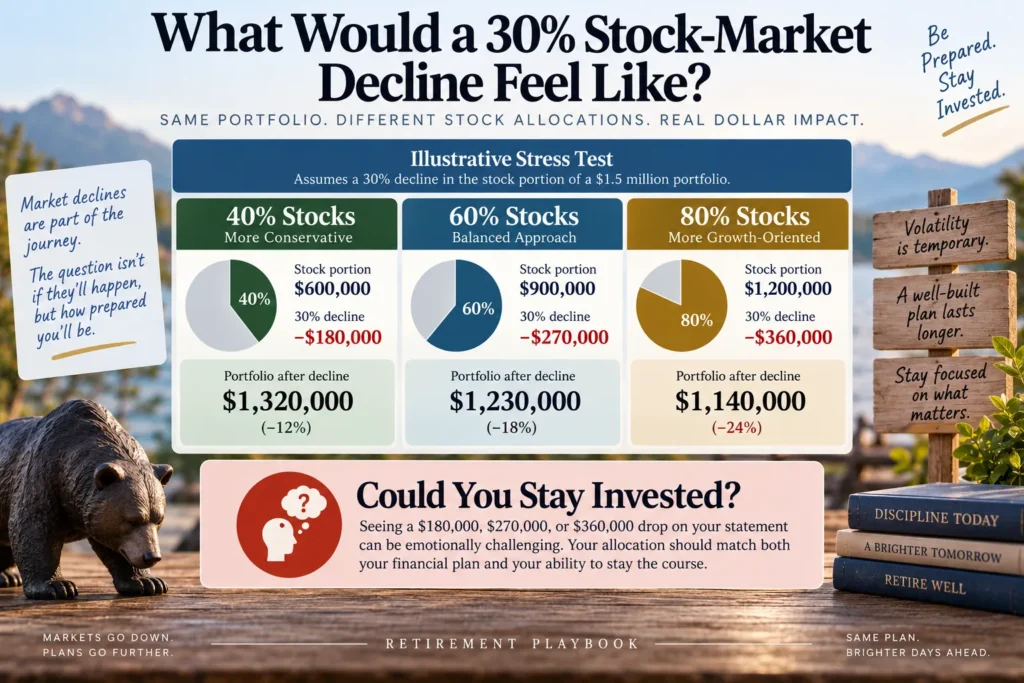
Illustrative stress test only. Real markets do not behave this simply; stocks and bonds can move simultaneously, different assets behave differently, and the example excludes withdrawals, taxes, fees, and rebalancing.
But Being Too Conservative Has a Cost Too
Now imagine the opposite.
You’re 65.
You decide retirement means you should become extremely conservative.
You move to:
10% stocks
70% bonds
20% cash
The portfolio feels wonderfully stable.
Then retirement lasts:
32 years.
Inflation compounds.
Healthcare expenses rise.
Your spending continues.
Healthcare deserves particular attention because it may not rise at the same rate as the rest of your budget; our healthcare inflation in retirement guide shows how to stress-test that risk separately.
The portfolio needs growth.
The danger isn’t a dramatic crash.
It’s something quieter:
The portfolio slowly loses the ability to support your future purchasing power.
This is why the goal isn’t minimum volatility.
The goal is:
Enough Growth With Survivable Volatility
That’s a very different objective.
Your Pension Can Act Like a Bond
Here’s a useful way to think about guaranteed retirement income.
Suppose you receive:
$40,000 per year from a pension.
That income behaves differently from stocks.
It doesn’t disappear because the S&P 500 falls.
Social Security has similar stabilizing characteristics, with the additional benefit of inflation adjustments through COLAs.
Economically, guaranteed income can function somewhat like a stabilizing asset in the household balance sheet.
That does not mean you should literally calculate a present value for Social Security and automatically increase your stock allocation.
But it does mean:
A household with substantial guaranteed income may have more capacity to tolerate portfolio volatility than the brokerage account alone suggests.
This is why looking only at investment assets can produce strange allocation decisions.
The Retiree With No Pension Has a Different Problem
Now remove the pension.
Suppose nearly all spending above Social Security must come from investments.
The portfolio isn’t simply:
wealth.
It’s also:
your paycheck.
That may increase the value of:
- bonds,
- cash,
- spending flexibility,
- and a clear withdrawal strategy.
Again, age didn’t change.
The job of the portfolio did.
What About Age?
Age still matters.
Just not in the simplistic way many rules imply.
A 60-year-old retiree may have a 35-year planning horizon.
A 90-year-old may have a shorter personal horizon—but could still be investing assets for:
- a younger spouse,
- children,
- grandchildren,
- charity,
- or future care.
So instead of saying:
“Stocks must fall every year as you age,”
ask:
“Has the time horizon or job of this money changed?”
Sometimes the answer is yes.
Sometimes it isn’t.
And this leads to one of the most interesting debates in retirement investing:
Should your stock allocation always decline as you get older—or can it eventually rise again?
The Traditional Approach: Reduce Stocks as You Age
The traditional retirement glide path is straightforward.
As you get older:
stocks decrease
and:
bonds and cash increase.
The logic makes intuitive sense.
You have fewer years to recover from a severe market decline.
You may become increasingly dependent on the portfolio.
And protecting accumulated wealth becomes more important than maximizing growth.
A simplified glide path might look something like:
| Age | Stocks | Bonds | Cash |
|---|---|---|---|
| 60 | 60% | 35% | 5% |
| 70 | 50% | 40% | 10% |
| 80 | 40% | 50% | 10% |
| 90 | 30% | 55% | 15% |
There is nothing inherently wrong with this approach.
For many retirees, gradually reducing portfolio volatility can make sense.
But there is a hidden assumption:
Your ability and willingness to take risk continuously decline with age.
That isn’t always true.
Illustrative allocations only. They are not recommendations and do not account for individual circumstances.
The Rising Equity Glide Path
Now consider a very different idea.
Instead of steadily reducing stocks throughout retirement, a retiree might:
- enter retirement with a relatively moderate stock allocation,
- maintain substantial defensive assets during the vulnerable early years,
- then gradually allow the stock allocation to increase later.
For example:
Age 65: 40% stocks
Age 75: 50% stocks
Age 85: 60% stocks
At first this sounds backwards.
Why would an 85-year-old own more stocks than a 65-year-old?
Because the largest sequence-of-returns danger often occurs near the beginning of retirement.
A severe bear market combined with withdrawals early in retirement can permanently damage the portfolio.
Later, several things may be different.
The retiree has already survived the most sequence-sensitive years.
The remaining portfolio may be larger than necessary for personal spending.
Some assets may effectively be intended for heirs.
And the remaining spending horizon may be shorter.
Research into rising equity glide paths has explored whether increasing equity exposure after the early retirement years can improve sustainability under certain conditions.
But this should not be interpreted as:
“Everyone should own more stocks when they turn 80.”
The useful idea is simpler:
Your allocation does not have to move in only one direction because your birthday changed.
The Real Glide Path Should Follow Portfolio Dependency
Imagine a retiree at 65.
They delay Social Security until 70.
From age 65 to 69, the portfolio provides:
$60,000 per year.
At 70, Social Security begins.
Portfolio withdrawals fall to:
$25,000 per year.
What happened?
The retiree got older.
But their portfolio dependency decreased.
That could actually increase their financial capacity to tolerate investment volatility.
Now imagine the opposite.
A pension ends after a spouse dies.
Healthcare spending rises.
The surviving spouse needs larger portfolio withdrawals.
Portfolio dependency increases.
The appropriate risk level may decrease.
This is why I would rather build an allocation glide path around:
changes in the financial plan
than:
changes in age alone.
Stocks, Bonds, and Cash by Age: A Better Way to Use the Table
Age-based tables can still be useful.
They just need to be treated as conversation starters, not prescriptions.
Here’s a more useful framework.

Your 60s: Protect the Transition Into Retirement
The transition from work to retirement can be financially fragile.
You may be:
- leaving a paycheck,
- delaying Social Security,
- beginning portfolio withdrawals,
- buying private health insurance before Medicare,
- executing Roth conversions,
- relocating,
- or making large one-time purchases.
This is also when sequence-of-returns risk deserves serious attention.
A reasonable planning range to investigate might be:
Stocks: 40%–70%
Bonds: 25%–50%
Cash: 5%–10%
That’s intentionally wide.
A 62-year-old whose pension covers nearly all essential spending is not the same investor as a 62-year-old withdrawing 5% of the portfolio annually.
The question for your 60s is:
Can I survive a bad first decade without abandoning my investment strategy?
Your 70s: Let the Retirement Reveal Itself
By your 70s, you know much more than you did at retirement.
You know:
- what you actually spend,
- whether Social Security covers more or less than expected,
- how you react during market declines,
- whether your portfolio has grown or shrunk,
- whether health expenses are increasing,
- and whether legacy goals are becoming more important.
This is a good time to stop following the allocation you imagined at 60 and reassess the retirement you actually have.
A broad range worth investigating might be:
Stocks: 35%–65%
Bonds: 30%–55%
Cash: 5%–10%
Again, not a prescription.
Some retirees should reduce risk.
Others may discover that Social Security, pensions, and accumulated assets now cover their needs so comfortably that they can afford to retain substantial equity exposure.
Your 80s: Simplicity Starts to Matter More
By your 80s, portfolio optimization isn’t the only objective.
Execution matters.
Who manages the investments if you cannot?
Can your spouse understand the strategy?
Are there too many accounts?
Does the portfolio require constant tactical decisions?
Do you have enough liquidity for healthcare or care-related expenses?
If you haven’t estimated that liability yet, our guide to estimating your retirement healthcare costs can help you build medical spending into the portfolio before deciding how much liquidity and defensive capacity you need.
A broad allocation range might be:
Stocks: 30%–60%
Bonds: 30%–60%
Cash: 5%–15%
But the more important objective may be:
simplicity + liquidity + survivability.
An 82-year-old with a $5 million portfolio, $100,000 of guaranteed income, and $80,000 of spending has a fundamentally different allocation problem from an 82-year-old with $600,000 who relies heavily on withdrawals.
Age tells us almost nothing about that difference.
Your 90s: Whose Money Is It Really For?
At very advanced ages, the portfolio may have multiple beneficiaries.
Some assets support your remaining lifestyle.
Some may eventually support a spouse.
Some may pay for care.
Some may already be economically destined for heirs or charity.
That means one household can have multiple time horizons simultaneously.
Money likely to be spent on care in the next two years should not necessarily be invested like money intended for a grandchild 20 years from now.
This is why an extremely conservative allocation for the entire portfolio isn’t automatically appropriate simply because the owner is 90.
Instead ask:
Who is this money for, and when will they need it?
That’s an asset-allocation question too.
Three 70-Year-Old Retirees, Three Different Portfolios
Let’s make this concrete.
All three retirees are:
70 years old.
Yet their financial situations are completely different.
Retiree A — The Pension-Heavy Household
Portfolio:
$1.5 million
Annual spending:
$85,000
Social Security + pension:
$80,000
Portfolio need:
$5,000
Possible allocation to investigate:
70% stocks / 25% bonds / 5% cash
Why could this make sense?
Because the portfolio isn’t responsible for financing most of the household’s lifestyle.
The retiree has substantial capacity to tolerate volatility.
The portfolio may increasingly serve:
- future discretionary spending,
- late-life healthcare,
- heirs,
- or charitable goals.
But if a 30% stock-market decline would cause panic, 70% stocks is still too much.
Financial capacity does not erase emotional reality.
Retiree B — The Balanced Household
Portfolio:
$1.5 million
Annual spending:
$85,000
Reliable income:
$50,000
Portfolio need:
$35,000
Possible allocation to investigate:
55% stocks / 40% bonds / 5% cash
This household needs meaningful portfolio growth.
But it also relies on investments to support current spending.
A balanced allocation creates both:
growth capacity
and:
defensive assets.
If stocks fall sharply, cash and bonds may provide alternative sources for withdrawals.
Retiree C — The Portfolio-Dependent Household
Portfolio:
$900,000
Annual spending:
$80,000
Reliable income:
$30,000
Portfolio need:
$50,000
Possible allocation to investigate:
40% stocks / 50% bonds / 10% cash
The issue isn’t that this retiree is 70.
The issue is that the portfolio must provide more than:
5.5% of its starting value annually
before considering taxes and future spending changes.
That’s a much more fragile situation.
Simply increasing bonds cannot magically fix an unsustainable withdrawal rate.
The household may also need to consider:
- spending adjustments,
- housing decisions,
- additional income,
- tax strategy,
- or other changes.
Asset allocation cannot solve every retirement problem.
All three examples are illustrative only. The allocations are examples for analysis, not personalized recommendations.
The $1 Million Portfolio Test
Suppose you retire with:
$1 million.
Your portfolio needs to provide:
$40,000 per year.
Now compare three simplified allocations.
Portfolio A — Conservative
40% stocks
50% bonds
10% cash
Dollar amounts:
- Stocks: $400,000
- Bonds: $500,000
- Cash: $100,000
Portfolio B — Balanced
60% stocks
35% bonds
5% cash
Dollar amounts:
- Stocks: $600,000
- Bonds: $350,000
- Cash: $50,000
Portfolio C — Growth-Oriented
80% stocks
15% bonds
5% cash
Dollar amounts:
- Stocks: $800,000
- Bonds: $150,000
- Cash: $50,000
Now imagine stocks decline:
35%.
For simplicity, assume bonds and cash remain unchanged.
Approximate portfolio losses:
Portfolio A
Stock loss:
$140,000
Portfolio value:
~$860,000
Portfolio B
Stock loss:
$210,000
Portfolio value:
~$790,000
Portfolio C
Stock loss:
$280,000
Portfolio value:
~$720,000
Now add the psychological reality.
You still need:
$40,000
from the portfolio this year.
Which portfolio could you actually live with?
That’s often more important than which portfolio produces the highest expected return in a simulation.
Market risk becomes even more consequential when it arrives alongside a major care expense, as our $1 million portfolio long-term care analysis demonstrates.
Now Run the Inflation Test
The conservative portfolio looks attractive during the crash.
But retirement doesn’t end after one bear market.
Suppose retirement lasts 30 years.
The portfolio must continue financing spending while prices rise.
Now the growth-oriented portfolio has an advantage:
more assets capable of long-term growth.
This creates the fundamental retirement allocation trade-off.
More stocks increase:
short-term volatility.
Fewer stocks increase:
long-term inflation and longevity risk.
There is no allocation that eliminates both.
Your job is to decide which combination of risks your retirement can survive.
Don’t Choose Your Allocation From the Last Bear Market
Human beings are excellent at investing through the rearview mirror.
After a severe stock-market decline:
“I need fewer stocks.”
After several strong stock-market years:
“Why do I own so many bonds?”
After bonds fall:
“Bonds don’t work anymore.”
After cash yields rise:
“Why invest at all?”
This is how strategic portfolios become collections of recent emotional reactions.
Your allocation should be designed around:
- spending,
- income,
- withdrawal needs,
- risk capacity,
- time horizon,
- and goals.
Not whatever asset performed best last year.
Rebalancing Is the Engine That Connects the Pieces
Suppose your target is:
60% stocks
35% bonds
5% cash
Stocks have an excellent year.
The portfolio becomes:
67% stocks
29% bonds
4% cash.
You’re now taking more equity risk than intended.
Rebalancing can mean:
selling some of what increased
and:
adding to what became underweight.
In retirement, this process can also help fund spending.
Instead of selling investments randomly, appreciated assets can help replenish the cash reserve.
This connects:
asset allocation
to:
withdrawal strategy.
What If Stocks Crash Instead?
Now stocks fall sharply.
Your 60% allocation becomes:
48%.
If you rebalance mechanically, you may sell some bonds and buy stocks.
That sounds emotionally uncomfortable.
But economically, you’re doing exactly what the allocation policy was designed to do:
buying the asset that became cheaper.
Meanwhile, near-term spending may come from:
- cash,
- bond interest,
- maturing bonds,
- or part of the bond allocation.
This can reduce the need to sell depressed stocks for living expenses.
The retirement system now has two separate processes:
Rebalancing manages portfolio risk.
Cash-flow planning manages spending.
They should work together.
How Often Should You Rebalance?
You don’t need to rebalance every Tuesday.
Common approaches include:
- annual rebalancing,
- semiannual reviews,
- or threshold-based rebalancing.
A threshold rule might say:
Rebalance when an asset class moves more than a predetermined amount away from its target.
The exact rule matters less than having a consistent process.
Constantly adjusting allocations based on headlines isn’t rebalancing.
It’s market timing.
Withdrawals Can Rebalance the Portfolio for You
Suppose stocks have performed strongly and are overweight.
You need:
$30,000
for spending.
Instead of selling bonds or withdrawing proportionally from everything, you might take the $30,000 from stocks.
You simultaneously:
- fund spending,
- reduce the overweight asset,
- and move the portfolio closer to target.
This is sometimes called:
rebalancing through withdrawals.
The same idea can work in reverse when directing income or new money.
Retirement withdrawals do not have to be separate from portfolio management.
But Taxes Can Override the Perfect Allocation Move
Imagine stocks are overweight.
The obvious rebalancing move is to sell stocks.
But those stocks sit in a taxable account with enormous unrealized capital gains.
Meanwhile, you have other assets available inside retirement accounts.
Now the mathematically clean allocation decision may create a large tax bill.
This is why retirement allocation cannot be managed independently from:
- account location,
- capital gains,
- traditional IRA withdrawals,
- Roth assets,
- required minimum distributions,
- and Medicare IRMAA.
Sometimes you tolerate a modest allocation drift because the tax cost of fixing it immediately is worse.
Retirement planning is full of trade-offs like this.
Those trade-offs can extend beyond income taxes because large taxable withdrawals and gains may also affect Medicare IRMAA, making it useful to understand how much Medicare really costs in retirement before coordinating rebalancing and withdrawals.
Asset Location Is Different From Asset Allocation
These two ideas are easy to confuse.
Asset Allocation
How much you own in:
- stocks,
- bonds,
- cash,
- and other investments.
Asset Location
Which accounts hold those investments:
- taxable brokerage,
- traditional IRA or 401(k),
- Roth IRA,
- HSA,
- and other accounts.
You could have a perfectly reasonable:
60/35/5 allocation
and still arrange those assets inefficiently across accounts.
Tax-efficient asset location can matter over a long retirement.
But taxes should not dictate an allocation you cannot tolerate.
Investment strategy comes first.
Then tax location can help improve how the strategy is implemented.
Don’t Make Every Account Look the Same
Suppose your target household allocation is:
60% stocks / 35% bonds / 5% cash.
You do not necessarily need:
60/35/5
inside every individual account.
Your Roth IRA might hold mostly long-term growth assets.
A traditional IRA might contain more bonds.
A taxable account may contain tax-efficient stock funds and near-term cash.
What matters is the:
Household Portfolio
If every account is optimized independently, the overall retirement plan can become unnecessarily complicated.
Look at everything together.
The Surviving-Spouse Test
Imagine you’re the person who manages all household investments.
You love spreadsheets.
You understand:
- asset location,
- tax-loss harvesting,
- duration,
- Roth conversions,
- rebalancing bands,
- and withdrawal sequencing.
Your spouse does not.
Then you die.
What happens?
A portfolio that requires one specific person to operate it is carrying another kind of risk:
complexity risk.
Ask:
Could my spouse understand this portfolio and continue the strategy without me?
If the answer is no, simplification may be worth more than another small improvement in expected return.
Retirement portfolio design isn’t only about surviving markets.
It also needs to survive the investor.
The Bear-Market Rule
Before retirement, write down what you will do when stocks fall substantially.
Not if.
When.
A simple framework might be:
Stocks Down 10%
Do nothing unusual.
Review the allocation according to your normal schedule.
Stocks Down 20%
Continue using planned cash flow.
Check whether allocation thresholds require rebalancing.
Avoid changing the long-term strategy because of headlines.
Stocks Down 30%+
Use cash and defensive assets for near-term spending where appropriate.
Rebalance according to your predetermined policy.
Consider reducing discretionary spending if the retirement plan requires it.
Do not suddenly decide you were “never comfortable with stocks.”
Your allocation should already have anticipated that stocks can fall severely.
If a 30% stock decline would make the plan intolerable, fix the allocation before the decline happens.
Your Allocation Should Survive the Sleep Test
Suppose your proposed portfolio is:
70% stocks
25% bonds
5% cash.
Your financial model loves it.
Then imagine your $2 million portfolio falls to approximately:
$1.55 million
during a severe market decline.
You turn on financial news.
Everyone is discussing recession.
Friends are selling.
Would you remain invested?
If the real answer is no, the allocation isn’t 70/25/5.
Your true allocation is:
70/25/5 until I’m scared.
That’s not an investment strategy.
The best portfolio isn’t the one with the highest expected return.
It’s the most growth-oriented portfolio you can realistically maintain through the bad years while still funding the retirement you want.
What Allocation Should a New Retiree Start With?
If you want a practical starting process, don’t begin with an age table.
Begin with the financial job.
Work through these questions:
- How much will I spend each year?
- How much reliable income will I receive?
- How much must the portfolio provide?
- How much spending can I reduce during a bad market?
- How many years of withdrawals are already protected by cash and defensive assets?
- How large a market decline can the plan financially survive?
- How large a decline can I emotionally survive?
- How long might some of this money remain invested?
Only then should you choose the percentage.
A 60/35/5 portfolio may emerge from that process.
So might 40/50/10.
Or 70/25/5.
The percentage should be the output of the retirement plan, not the starting assumption.
A Five-Step Allocation Stress Test
Before committing to an allocation, put it through five scenarios.
Test 1 — The 30% Stock Decline
Calculate the approximate dollar loss if the stock portion falls:
30%.
If you have:
$1.5 million
with:
60% in stocks
then approximately:
$900,000
is exposed to the stock decline.
A 30% decline in that portion represents roughly:
$270,000.
Ask:
Could I watch my portfolio fall by approximately that amount without abandoning the plan?
If not, the stock allocation may be too aggressive.
Test 2 — Five Years of Weak Returns
A crash isn’t the only risk.
Markets can also disappoint slowly.
Imagine five years in which portfolio returns are much weaker than you expected.
Meanwhile:
- inflation continues,
- withdrawals continue,
- healthcare continues,
- and life continues.
Does the plan still work?
A retirement portfolio should not require strong markets every few years to survive.
Test 3 — Higher Inflation
Now assume inflation remains elevated longer than expected.
What happens to:
- groceries,
- housing,
- healthcare,
- travel,
- and other spending?
This is where an excessively conservative portfolio can reveal its weakness.
The portfolio may experience little short-term volatility but fail to provide enough long-term growth.
Test 4 — One Spouse Dies
For couples, remove one spouse.
Then reconsider:
- Social Security,
- pension benefits,
- taxes,
- Medicare costs,
- spending,
- risk tolerance,
- and who will manage the investments.
The portfolio that works for two financially engaged spouses may not be appropriate for one surviving spouse who wants simplicity and lower volatility.
Test 5 — You Live to 95
Finally, assume retirement lasts longer than expected.
Do you still have enough growth?
A portfolio designed entirely around avoiding next year’s volatility may not be prepared for another:
25 or 30 years of spending.
Retirement allocation has to survive both:
bad markets today
and:
a very long tomorrow.
The Allocation Decision Matrix
Here’s a more useful way to think about stock exposure than age alone.
| Retirement Situation | Potential Direction |
|---|---|
| High guaranteed income + low portfolio withdrawals | More growth capacity |
| Low guaranteed income + high portfolio dependency | More defensive capacity may be valuable |
| Large portfolio + low withdrawal rate | More risk capacity |
| Small portfolio + high withdrawal rate | Less margin for severe losses |
| High spending flexibility | More ability to absorb volatility |
| Mostly essential/fixed spending | Greater need for stability |
| Long horizon / legacy assets | More growth may be appropriate |
| Severe fear of market declines | Lower volatility may improve plan adherence |
Notice what isn’t in the table:
your age by itself.
Age influences several of these variables.
It doesn’t replace them.
When Should You Change Your Allocation?
Not every year.
And certainly not every time financial television becomes exciting.
A portfolio allocation deserves review when something important changes.
Examples include:
- retirement begins,
- Social Security starts,
- a pension begins or ends,
- spending changes materially,
- a mortgage is paid off,
- a spouse dies,
- health changes,
- long-term care becomes more likely,
- a large inheritance arrives,
- a home is sold,
- the portfolio becomes much larger or smaller relative to spending,
- or your tolerance for volatility genuinely changes.
Those are changes in the retirement plan.
A market prediction isn’t.
What If Your Portfolio Has Grown Far Beyond What You Need?
This creates an interesting problem.
Suppose you retire with:
$2 million
and spend:
$80,000 per year.
Twenty years later, despite withdrawals, your portfolio has grown to:
$4 million.
Your spending is well covered by Social Security and relatively modest withdrawals.
Do you need to become more conservative because you’re older?
Maybe.
If the money exists primarily to protect your lifestyle, reducing volatility may make sense.
But suppose most of the $4 million will probably go to:
- children,
- grandchildren,
- or charity.
Now the economic time horizon of much of that money may extend beyond your lifetime.
A highly conservative portfolio could actually conflict with the eventual purpose of those assets.
Again:
Whose money is this, and when will it be spent?
The answer should influence the allocation.
What If Your Portfolio Has Shrunk?
This is harder.
Suppose the opposite happens.
You retire with:
$1.2 million.
Years later, after poor returns and withdrawals, you have:
$650,000.
Your spending hasn’t fallen enough.
Should you increase stocks to “make the money back”?
That’s dangerous reasoning.
A shrinking portfolio does not automatically create greater risk capacity.
Often it creates less.
Taking substantially more investment risk because you need higher returns can turn a difficult retirement problem into a catastrophic one.
The first questions should be:
- Is the withdrawal rate sustainable?
- Can spending change?
- Can housing costs change?
- Is additional income possible?
- Are taxes being managed efficiently?
- Are there assets elsewhere?
- Is the allocation still appropriate for the remaining liabilities?
Investment risk should not be used as a substitute for fixing a cash-flow problem.
What About a 100% Stock Retirement Portfolio?
Could it work?
For some very wealthy retirees with minimal portfolio dependency and extremely high risk tolerance, perhaps.
But “could work” is not the same as “should be the default.”
A 100% stock portfolio can experience severe declines.
Imagine:
$3 million → $1.8 million
during an extreme market event.
If your lifestyle remains fully supported by other income and you genuinely would not sell, that may be financially survivable.
But many retirees underestimate how different a 40% decline feels when:
- there is no paycheck,
- the portfolio is financing retirement,
- headlines are frightening,
- and recovery timing is unknown.
Diversification isn’t an admission that stocks are bad investments.
It is recognition that retirement spending and investment time horizons are not identical.
What About a 100% Bond Portfolio?
The opposite extreme has problems too.
Bonds can reduce equity volatility.
But an all-bond portfolio still faces:
- inflation risk,
- interest-rate risk,
- reinvestment risk,
- credit risk depending on holdings,
- and longevity risk.
A retirement lasting three decades generally needs some mechanism for maintaining purchasing power.
That doesn’t mean everyone needs a large stock allocation.
It means:
avoiding stock-market risk does not eliminate retirement risk.
It changes which risks you own.
Should Annuities Change Your Asset Allocation?
Potentially.
An income annuity can convert part of a portfolio into a stream of guaranteed income.
Economically, that may reduce dependence on investment withdrawals for essential spending.
That can change the role of the remaining portfolio.
For example, if:
Social Security + pension + annuity income
cover nearly all essential expenses, the remaining investments may have greater capacity for long-term growth.
But this does not automatically mean:
“Buy an annuity so you can own more stocks.”
Annuities involve their own trade-offs:
- liquidity,
- insurer risk,
- inflation protection,
- fees depending on product,
- survivor benefits,
- and loss of direct access to principal in some structures.
Evaluate the income decision first.
Then reconsider what job remains for the portfolio.
FAQ
What is a good stock-to-bond ratio in retirement?
There is no single ratio appropriate for every retiree.
A balanced retirement portfolio might begin around 50%–60% stocks with the remainder in bonds and cash, but the appropriate allocation depends on portfolio withdrawals, guaranteed income, risk tolerance, spending flexibility, time horizon, and goals.
Treat common allocation percentages as starting points for analysis rather than rules.
Is 60% stocks and 40% bonds still good for retirees?
A 60/40-style portfolio can still be a reasonable framework for some retirees because it combines long-term growth assets with defensive assets.
But “60/40” doesn’t tell you:
- how much cash you hold,
- what types of bonds you own,
- what types of stocks you own,
- your withdrawal rate,
- your tax situation,
- or whether the volatility is appropriate for you.
The ratio is a structure.
Not a retirement plan.
How much stock should a 65-year-old have?
Age alone isn’t enough to answer the question.
A 65-year-old with substantial pension income and a 1% portfolio withdrawal need may reasonably have more equity capacity than another 65-year-old withdrawing 5% from investments.
Instead of choosing an allocation from age alone, evaluate:
portfolio dependency + withdrawal rate + time horizon + risk capacity + risk tolerance.
How much stock should a 70-year-old have?
The same principle applies.
A broad range such as 35%–65% stocks might be worth investigating for many retirees around this age, but it should not be interpreted as a recommendation.
A retiree whose guaranteed income covers nearly all spending may reasonably choose a very different allocation from someone who depends heavily on investments.
Should I own fewer stocks when I turn 80?
Not automatically.
If your spending needs, risk tolerance, care needs, and portfolio purpose have changed, reducing equity exposure may make sense.
But if your portfolio substantially exceeds what you need and much of it is effectively invested for heirs or charity, part of the money may still have a long horizon.
The purpose of the assets matters more than the birthday.
How much cash should be included in my retirement allocation?
Start with the gap between annual spending and reliable income.
Then consider:
- near-term withdrawals,
- known large expenses,
- emergency reserves,
- bond holdings,
- and your desired bear-market runway.
A retiree does not automatically need one to three years of total spending in cash.
Are bonds still necessary in retirement?
For many retirees, bonds can provide useful diversification, income, stability, and a source of withdrawals or rebalancing during periods when stocks are depressed.
But the amount and type of bonds should reflect the job they perform.
A retiree whose guaranteed income covers almost all spending may have different bond needs from someone heavily dependent on portfolio withdrawals.
Should I become more conservative after a market crash?
A market crash by itself is usually a poor reason to redesign a long-term allocation.
If the portfolio was too aggressive before the decline, that is a planning problem.
Selling stocks and becoming more conservative only after they have fallen can lock in losses and turn a temporary decline into a permanent decision.
Review allocation when your circumstances or ability to bear risk change—not simply because markets became frightening.
Final Thoughts
Retirement asset allocation is often presented as an age problem.
At 60, own this.
At 70, own that.
At 80, reduce stocks again.
It’s wonderfully simple.
Real retirement isn’t.
Two people can be the same age with the same portfolio and need completely different investment strategies.
One may have a pension covering nearly every bill.
The other may depend heavily on portfolio withdrawals.
One may be investing primarily for themselves.
The other may already have more money than they could reasonably spend and be investing partly for the next generation.
One may sleep peacefully through a 35% market decline.
The other may sell after 15%.
Age matters.
But it does not answer the most important questions.
The better questions are:
What does my portfolio need to pay for?
When will I need the money?
How dependent am I on investment withdrawals?
How much volatility can the plan survive?
How much volatility can I survive?
Who ultimately needs these assets?
Once you know those answers, stocks, bonds, and cash become tools rather than rules.
Cash handles the near term.
Bonds can provide stability and additional spending capacity.
Stocks provide long-term growth.
And the allocation connects those jobs into one retirement system.
The goal isn’t to find the portfolio that never falls.
It doesn’t exist.
The goal is to build a portfolio that can fall—and still allow you to keep living your retirement.
Retirement Playbook: Build Your Retirement Asset Allocation
Now turn the article into your own portfolio decision.
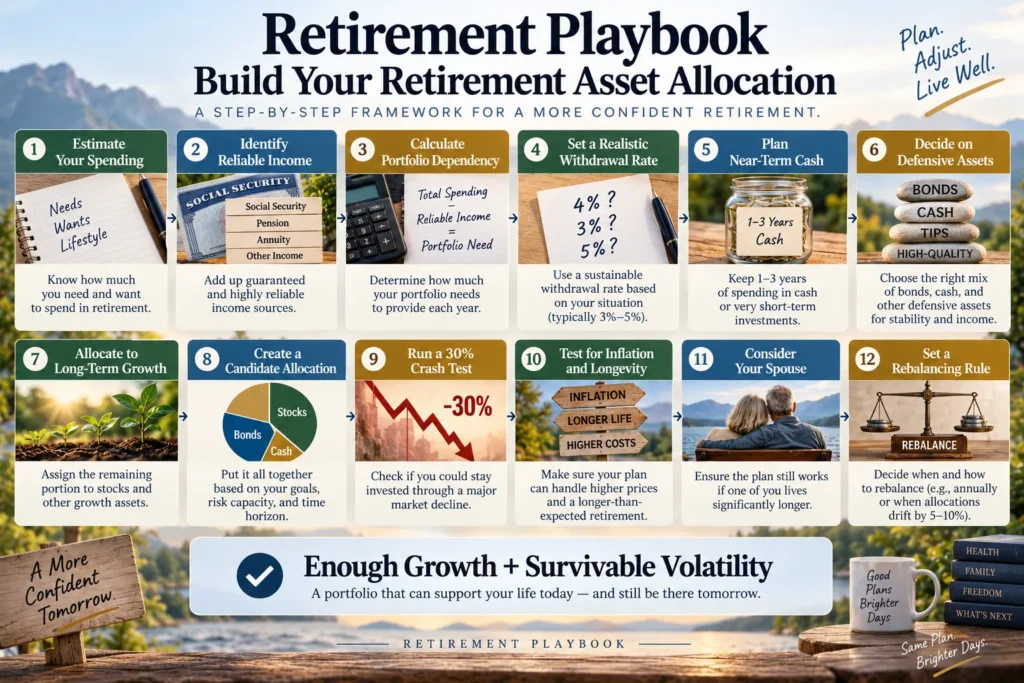
Step 1 — Calculate Annual Spending
Write down your realistic annual retirement spending.
Use:
$________
Do not begin with investment percentages.
Begin with the lifestyle the portfolio needs to support.
Step 2 — Calculate Reliable Income
Add:
- Social Security,
- pensions,
- annuity income,
- and other reliable recurring income.
Use:
$________
Then calculate:
Annual Spending − Reliable Income = Portfolio Withdrawal Need
Step 3 — Calculate Your Portfolio Dependency Ratio
Use:
Portfolio Withdrawal Need ÷ Annual Spending
Example:
$30,000 ÷ $80,000 = 37.5%
The higher this percentage, the more your lifestyle depends on portfolio performance and withdrawals.
Do not use this number by itself to select an allocation.
Use it to understand the job the portfolio performs.
Step 4 — Calculate Your Withdrawal Rate
Use:
Annual Portfolio Withdrawal ÷ Investable Portfolio
Example:
$40,000 ÷ $1,000,000 = 4%
Now you have two different pieces of information.
Portfolio dependency tells you how dependent your lifestyle is on investments.
Withdrawal rate tells you how much pressure those withdrawals place on the portfolio.
Both matter.
Step 5 — Protect Money Needed Soon
Identify approximately how much money the portfolio may need to provide over the next:
1–2 years.
Then identify:
- cash,
- Treasury bills,
- money-market assets,
- or other appropriate near-term resources
that can support those needs.
Do not expose money you know you’ll need next year to unnecessary equity risk.
Step 6 — Identify Your Defensive Capacity
Now add the assets designed to provide stability beyond immediate cash.
This may include:
- high-quality bonds,
- Treasury securities,
- TIPS,
- and other defensive holdings appropriate to your strategy.
Ask:
How long could we support portfolio withdrawals without being forced to sell stocks during a severe decline?
That’s your defensive runway.
Step 7 — Give Long-Term Money a Growth Job
Now identify assets unlikely to be needed for many years.
Ask:
How much of this portfolio genuinely has a 10-, 20-, or 30-year horizon?
Those dollars may be appropriate candidates for greater equity exposure.
This prevents short-term spending needs from dictating the investment strategy for the entire portfolio.
Step 8 — Choose a Candidate Allocation
Now—not before—choose a starting allocation.
Perhaps:
40/50/10
or:
60/35/5
or:
70/25/5.
Write down why.
For example:
“We chose 60% stocks because Social Security covers most essential spending, we have several years of defensive assets, and we can tolerate an approximately 18% portfolio decline if stocks fall 30%.”
That’s an investment policy.
“I’m 68, so 60/40 sounds right” isn’t.
Step 9 — Run the 30% Stock-Decline Test
Calculate:
Portfolio × Stock Allocation × 30%
Suppose:
$1.5M × 60% × 30% = $270,000
Now look at the dollar amount.
Could you stay invested after seeing approximately $270,000 disappear from the statement?
If not, reconsider the allocation before the bear market arrives.
Step 10 — Run the Inflation and Longevity Test
Now test the opposite risk.
What happens if:
- retirement lasts 30+ years,
- inflation remains meaningful,
- healthcare spending rises,
- and conservative assets produce modest real returns?
Does the portfolio still have enough growth?
Do not optimize only for the next crash.
You also have to survive the next three decades.
That long horizon may also include a major care event, so assets already assigned to a long-term care fund should be identified separately before you decide how much of the remaining portfolio can take investment risk.
Step 11 — Run the Surviving-Spouse Test
Ask:
Would this allocation still work if one of us died tomorrow?
Consider:
- lower household income,
- taxes,
- Medicare costs,
- risk tolerance,
- account complexity,
- and investment knowledge.
If your spouse could not operate the portfolio, simplify it.
Step 12 — Write the Rebalancing Rule
Decide in advance:
- how often you’ll review,
- what allocation drift triggers action,
- which assets fund withdrawals,
- and how cash is replenished.
Do not invent the rule during the next bear market.
Step 13 — Define What Would Actually Change the Allocation
Write down legitimate reasons.
For example:
- Social Security begins,
- spending materially changes,
- pension income changes,
- one spouse dies,
- care needs increase,
- withdrawal rate changes substantially,
- legacy goals change,
- or genuine risk tolerance changes.
Then write down what does not automatically change it:
- market headlines,
- recession predictions,
- elections,
- last year’s winning asset class,
- or fear after stocks have already fallen.
Your One-Page Retirement Allocation
At the end, you should be able to write something like:
Annual spending: $85,000
Reliable income: $55,000
Portfolio withdrawal: $30,000
Portfolio: $1.4 million
Withdrawal rate: 2.1%
Portfolio dependency: 35%
Cash: 5%
Bonds: 35%
Stocks: 60%
Defensive runway: Several years
Rebalance: Annual review + allocation bands
Bear-market response: Cash/bonds for spending; rebalance according to policy
Primary objective: Maintain purchasing power while supporting retirement spending
That single page may be more useful than an age-based allocation chart covering the next 30 years.
Because it explains not only what you own.
It explains:
why you own it.
Coming Next
Once you’ve decided how much to hold in stocks, bonds, and cash, another question becomes unavoidable:
Which investments should you withdraw from first?
You may have money spread across:
- taxable brokerage accounts,
- traditional IRAs and 401(k)s,
- Roth IRAs,
- HSAs,
- cash,
- and other retirement assets.
Simply withdrawing from whichever account is easiest can create unnecessary taxes, larger future required minimum distributions, higher Medicare premiums, and fewer tax-free assets later in retirement.
But the traditional advice to:
“Spend taxable accounts first, tax-deferred accounts second, and Roth accounts last.”
isn’t always optimal either.
Sometimes taking traditional IRA withdrawals earlier can reduce lifetime taxes.
Sometimes Roth conversions make sense before required minimum distributions begin.
Sometimes preserving taxable assets creates valuable tax benefits for heirs.
And sometimes the best withdrawal source changes from one year to the next.
In the next Retirement Playbook:
Which Retirement Account Should You Withdraw From First? Taxable vs. Traditional IRA vs. Roth
We’ll build a practical withdrawal-order framework, examine when the traditional taxable-first strategy works—and when it doesn’t—and show how taxes, Roth conversions, RMDs, Social Security, capital gains, Medicare IRMAA, and surviving-spouse planning can change the answer.
Because choosing the right investments is only half of retirement portfolio management.
The other half is deciding:
which dollars to spend first.