
Imagine two couples retiring at 65.
Both have $1.5 million.
Both receive the same Social Security benefits.
Both plan to spend $90,000 a year.
And both have accumulated their savings in the same three types of accounts:
A taxable brokerage account.
A traditional IRA.
And a Roth IRA.
Twenty years later, one couple may have paid substantially more in taxes than the other.
Not because they earned less.
Not because they invested poorly.
And not because one couple took more risk.
The difference may come down to something that rarely gets as much attention as stock selection or retirement withdrawal rates:
Your retirement withdrawal order—the sequence in which you use taxable, traditional IRA, and Roth assets—can influence how much of your savings ultimately remains available after taxes.
Which account they chose to spend from first.
For decades, the conventional advice was straightforward.
Spend taxable savings first.
Then withdraw from traditional retirement accounts.
Leave Roth accounts untouched for as long as possible.
The logic is appealing. Preserve tax-advantaged growth, postpone income taxes, and allow tax-free Roth assets to compound.
But retirement taxes don’t work quite that neatly.
A strategy that minimizes taxes at 65 can create larger required withdrawals at 75.
A Roth conversion that raises this year’s tax bill can reduce future taxes.
Selling appreciated investments can be more tax-efficient than withdrawing an equivalent amount from a traditional IRA.
And after one spouse dies, a tax strategy that worked beautifully for a married couple may become much less attractive for the survivor.
The problem is not that the traditional withdrawal order is always wrong.
It’s that a retirement withdrawal strategy should optimize lifetime after-tax outcomes—not simply minimize this year’s tax bill.
That requires looking at the entire retirement, not just the next withdrawal.
Three Retirement Accounts, Three Different Tax Systems
Before deciding which account to spend from, understand what each account actually represents.
Two accounts containing $500,000 may have very different after-tax values.
A $500,000 Roth IRA is not economically identical to a $500,000 traditional IRA.
And neither is identical to a $500,000 taxable brokerage account.
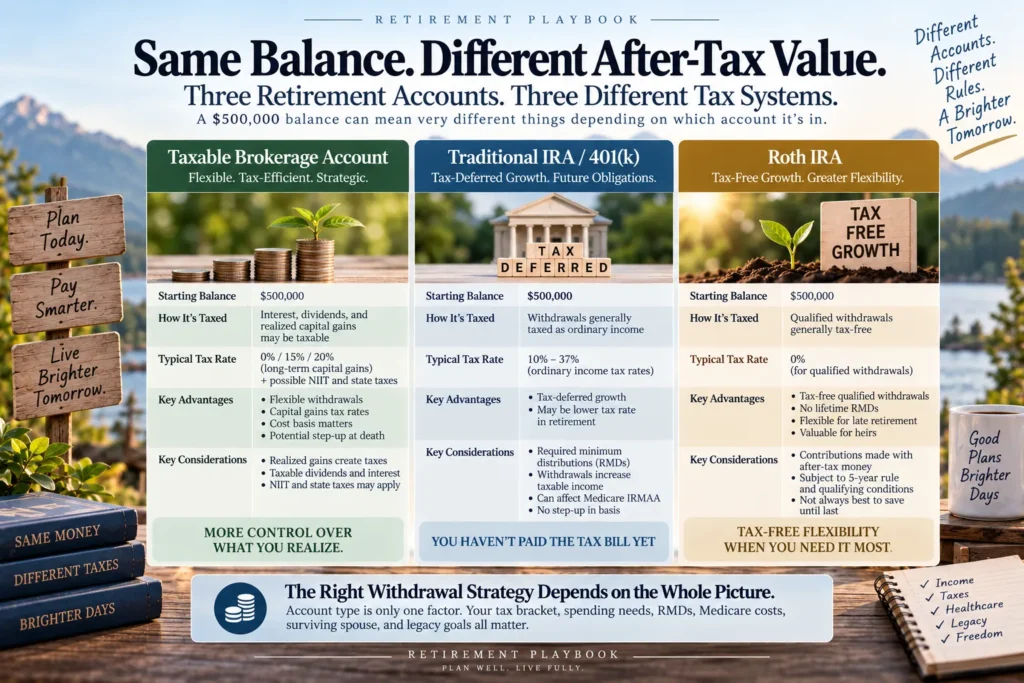
Here’s why.
| Account | Typical Federal Tax Treatment | Important Consideration |
|---|---|---|
| Taxable brokerage | Interest, dividends, and realized gains may be taxable | Capital gains and cost basis matter |
| Traditional IRA / 401(k) | Withdrawals generally taxed as ordinary income | Future RMDs and marginal tax rates |
| Roth IRA | Qualified withdrawals generally tax-free | Preserving tax-free flexibility |
These distinctions are the foundation of retirement withdrawal planning.
Taxable Brokerage: The Account With Two Values
Imagine you own $200,000 of investments in a taxable brokerage account.
You originally paid $150,000.
Your unrealized gain is:
$50,000.
If you sell the entire position for $200,000, the full $200,000 is not automatically taxable income.
Generally, the gain is the relevant amount for capital-gains taxation.
If the investment has been held longer than one year, it may qualify for preferential long-term capital-gains rates.
But the tax outcome also depends on your other income, filing status, potential net investment income tax, and state taxes.
This makes taxable brokerage accounts more flexible than many retirees realize.
A withdrawal from a taxable account is not necessarily equivalent to a taxable IRA distribution.
And that distinction can change which account should pay the next bill.
Traditional IRA: The Tax Bill You Haven’t Paid Yet
A traditional IRA often represents years of tax deferral.
You received a deduction or made pre-tax contributions.
Your investments grew without annual taxation inside the account.
Eventually, withdrawals generally become ordinary income to the extent the account contains pre-tax money.
That is the trade-off.
You avoided taxes earlier in exchange for potentially paying them later.
For many retirees, that’s a good deal.
They contributed during high-income working years and withdraw during lower-income retirement years.
But not everyone experiences lower tax rates after retirement.
A large traditional IRA can create substantial taxable distributions later in life.
And eventually, required minimum distributions may force money out whether you need it for spending or not.
Roth IRA: The Value of Having a Choice
A Roth IRA works differently.
Contributions are generally made with after-tax money, and qualified distributions can be tax-free.
Qualified Roth IRA withdrawals generally require satisfying the applicable five-year rule and a qualifying condition, such as reaching age 59½.
Roth IRA owners are not required to take lifetime RMDs.
That creates flexibility.
You can use qualified Roth distributions in years when taking additional traditional IRA income would be expensive.
You may also preserve Roth assets for late retirement or heirs.
But Roth money is not automatically sacred.
Sometimes spending Roth assets earlier can be sensible, particularly when your current marginal tax rate is unusually high or other withdrawal sources would trigger additional costs.
The Roth IRA’s greatest advantage isn’t simply tax-free growth.
It’s the ability to choose when taxable income appears elsewhere in your retirement plan.
The Traditional Retirement Withdrawal Order
The familiar sequence looks like this:
FIRST
Taxable BrokerageUse taxable assets while preserving retirement accounts
SECOND
Traditional IRA / 401(k)Withdraw tax-deferred assets later
LAST
Roth IRAPreserve qualified tax-free withdrawals for later years
Traditional taxable-first approach — a useful starting point, not a universal rule.
Why did this become standard advice?
Because it can allow tax-advantaged accounts to compound longer while taking advantage of the flexibility of taxable investments.
It can be especially attractive when a retiree expects their traditional IRA withdrawals to face relatively low future tax rates.
But there is a catch.
Tax deferral is valuable only in relation to the taxes you eventually pay.
Deferring income from a 12% tax year into a future 24% tax year may not be an improvement.
It can be the opposite.
The Hidden Problem With Taxable-First Withdrawals
Consider a hypothetical married couple retiring at 65.
They have:
| Account | Balance |
|---|---|
| Taxable brokerage | $400,000 |
| Traditional IRA | $850,000 |
| Roth IRA | $250,000 |
| Total | $1,500,000 |
They receive $45,000 annually from Social Security and plan to spend $90,000.
Their starting portfolio spending gap is approximately:
$45,000 per year.
For simplicity, we’ll ignore income taxes in that initial spending-gap calculation. Actual gross withdrawals may need to be larger.
Suppose they decide to use the taxable brokerage account first.
They withdraw what they need each year.
They leave the traditional IRA largely untouched.
And the IRA continues growing.
This feels efficient.
They are postponing ordinary income taxes.
But let’s imagine the $850,000 traditional IRA earns an illustrative 5% annual return for ten years, with no withdrawals.
Illustrative traditional IRA growth
$1.38 million
Approximate balance after 10 years at 5% annual growth, before fees and taxes, assuming no distributions
The couple is now 75.
Their traditional IRA has become substantially larger.
They may be facing RMDs, depending on their birth years and applicable starting ages.
Social Security is still arriving.
Investment income may still be arriving.
And ordinary-income withdrawals may now occupy a larger share of their tax picture.
They successfully postponed taxes.
But did they reduce them?
That’s a different question.
RMDs Can Change the Entire Calculation
Required minimum distributions are one reason retirement withdrawal planning must extend beyond the first few years.
Under current federal law, the applicable RMD starting age is generally 73 for people born from 1951 through 1959, and 75 for people born in 1960 or later.
Traditional IRA RMDs are generally calculated using the prior year-end account balance divided by an IRS life-expectancy factor.
The IRS Uniform Lifetime Table uses a divisor of 24.6 at age 75 for owners subject to that table.
Internal Revenue Service
+1
Let’s return to the illustrative $1.38 million IRA.
Illustrative RMD at age 75
Prior year-end IRA balance
$1,384,000
IRS divisor
24.6
Estimated annual required distribution
$56,260
Illustrative calculation, rounded. Assumes the standard Uniform Lifetime Table applies and the stated balance is the preceding December 31 value.
That is approximately $56,000 of traditional IRA distributions in a single year.
And it may be more than the couple actually needs for spending.
The important issue isn’t simply the amount.
It’s the potential interaction with other income.
Traditional IRA distributions can increase taxable income, potentially affect how much Social Security is taxable, and contribute to higher Medicare premiums through IRMAA.
A withdrawal strategy that looked tax-efficient at 65 may therefore create different consequences at 75.
This doesn’t mean RMDs are inherently bad.
They are simply another constraint the retirement plan must anticipate.
The 2026 Tax Brackets Create Planning Opportunities
The United States has a progressive federal income tax system.
That means not every dollar of income is taxed at the same rate.
For 2026, the federal ordinary-income brackets for married couples filing jointly include the following taxable-income ranges:
| Marginal Rate | 2026 Taxable Income |
|---|---|
| 10% | $0–$24,800 |
| 12% | $24,801–$100,800 |
| 22% | $100,801–$211,400 |
| 24% | $211,401–$403,550 |
Higher brackets apply above these amounts.
The 2026 standard deduction for married couples filing jointly is $32,200, before any applicable additional deductions.
Internal Revenue Service
+1
Notice something important.
The tax brackets apply to taxable income, not simply the amount you withdraw from an IRA.
Deductions, taxable Social Security benefits, investment income, and other tax items affect the calculation.
But the principle is straightforward.
Suppose you are retired and have substantial unused room in a relatively low tax bracket.
Should you automatically leave every traditional IRA dollar untouched?
Not necessarily.
It may be worth deliberately recognizing some ordinary income now if you expect the same money to face a higher effective tax rate later.
That could mean:
- taking a traditional IRA withdrawal earlier than required,
- converting some traditional IRA money to Roth,
- combining taxable and traditional IRA withdrawals,
- or coordinating withdrawals with years of unusually low income.
This is where retirement withdrawal planning becomes an annual tax-management decision rather than a fixed account-order rule.
A Better Question: What Is the Marginal Cost of the Next Dollar?
Imagine you need another $20,000 for spending.
You have three possible sources.
You could sell taxable investments.
You could withdraw from a traditional IRA.
Or you could use qualified Roth IRA funds.
Which one is best?
The answer depends on what the next dollar from each source costs.
Consider a simplified example.
| Source | Potential Federal Tax Consequence |
|---|---|
| Taxable brokerage | Tax on realized gains, not necessarily the entire sale proceeds |
| Traditional IRA | Generally ordinary income on pre-tax withdrawals |
| Qualified Roth IRA | Generally no federal income tax |
At first glance, Roth seems best.
Zero tax.
Why not use it every time?
Because spending Roth money today also means losing the future tax-free growth and flexibility of that money.
And using traditional IRA money today may reduce future RMDs.
The decision is not merely:
Which withdrawal creates the smallest tax bill this year?
It is:
Which withdrawal produces the best after-tax outcome over the years that matter to this household?
Sometimes the answer is taxable.
Sometimes traditional IRA.
Sometimes Roth.
And sometimes a combination.
The Three Withdrawal Strategies Worth Comparing
Rather than choosing one universal order, compare three approaches.
Strategy A — Taxable First
Use taxable investments for spending while preserving traditional and Roth accounts.
This may work well when the retiree expects low future ordinary-income tax rates, has tax-efficient taxable assets, or benefits from preserving retirement accounts.
The danger is allowing a large traditional IRA to grow into a much larger future tax obligation without testing the consequences.
Strategy B — Proportional Withdrawals
Withdraw from taxable, traditional, and Roth accounts in some planned proportion.
This can spread tax exposure across multiple years and prevent one account from being exhausted unusually early.
But proportional withdrawals aren’t automatically optimal either.
They may generate unnecessary taxable income in some years or consume valuable Roth assets when other funding sources would be preferable.
Strategy C — Tax-Bracket-Aware Withdrawals
Start with spending needs, then deliberately choose which accounts to use based on:
- current marginal tax rates,
- expected future tax rates,
- available deductions,
- capital-gains treatment,
- Roth conversion opportunities,
- RMD projections,
- Medicare premium thresholds,
- and estate-planning objectives.
This approach is more complex.
But it recognizes that the optimal withdrawal source can change from one year to the next.
The goal is not to eliminate taxes.
It’s to avoid paying more than necessary across the retirement.
Why the Lowest-Tax Year Can Be the Wrong Goal
Here’s a mistake that can sound financially sophisticated.
A retiree says:
“I paid almost no federal income tax this year. My withdrawal strategy is working.”
Maybe.
But imagine they paid almost nothing because they spent entirely from taxable cash and qualified Roth withdrawals while allowing a very large traditional IRA to keep growing.
Ten years later, RMDs may create substantial ordinary income.
A surviving spouse may face less favorable tax brackets.
Heirs may inherit a large pre-tax retirement account.
The original low-tax year was real.
But it may not have represented the best lifetime outcome.
This is why retirement tax planning needs a longer horizon.
A good withdrawal strategy may intentionally create some taxable income during low-income years.
The objective is to avoid concentrating too much taxable income in years when it becomes more expensive.
The Retirement Tax Window
For some households, the years immediately after leaving work and before RMDs begin can offer unusual flexibility.
Employment income has stopped.
Social Security may not have started yet—or may be only part of household income.
Required minimum distributions may still be years away.
And the retiree may have considerable control over how much taxable income to recognize.
This period can create opportunities for:
planned traditional IRA withdrawals and Roth conversions.
But it isn’t a universal tax-free window.
Retirees younger than 65 may need ACA Marketplace health insurance, where income can affect premium tax credits.
Retirees already on Medicare need to consider IRMAA.
And retirees with substantial capital gains, pensions, or other income may have less low-bracket room than expected.
The opportunity is not simply that retirement creates lower income.
It is that retirement can create more control over the timing and character of income.
That control can be valuable.

Why Roth Conversions Change the Withdrawal-Order Debate
A Roth conversion moves money from a traditional retirement account into a Roth account.
The taxable portion of the conversion generally becomes ordinary income in the conversion year.
You pay tax now in exchange for potentially tax-free qualified withdrawals later.
Why would anyone voluntarily accelerate taxes?
Because today’s rate may be lower than the rate the money would otherwise face in the future.
Imagine a retiree who can convert $40,000 at a relatively low marginal tax rate.
They may decide that paying tax today is worthwhile if the conversion reduces future traditional IRA balances and improves later withdrawal flexibility.
But the conversion must be evaluated carefully.
It may affect Social Security taxation, Medicare IRMAA, ACA premium tax credits, state taxes, or other income-sensitive provisions.
And paying the conversion tax from retirement assets rather than outside cash can change the economics.
A Roth conversion isn’t automatically a win because the Roth account grows tax-free.
The relevant comparison is the tax paid now versus the taxes and other costs potentially avoided later.
The Most Expensive Retirement Withdrawal May Be the One That Crosses a Threshold
Progressive income taxes usually rise gradually through marginal brackets.
But retirement has additional thresholds.
Medicare IRMAA is one example.
To understand how income-related premium adjustments fit into the broader healthcare budget, see our guide to how much Medicare really costs in retirement, including the expenses retirees often underestimate.
A relatively modest increase in modified adjusted gross income can push a Medicare beneficiary into a higher premium tier.
Because IRMAA generally relies on income from two years earlier, the effects of a withdrawal or conversion may appear later.
Other thresholds can affect capital-gains taxation, Social Security taxation, ACA subsidies, or additional taxes.
This means a $10,000 withdrawal may have an effective cost that differs from its ordinary-income tax bracket alone.
The relevant question is not merely:
“Am I in the 22% bracket?”
It is:
“What happens to my total taxes and income-sensitive costs if I recognize another $10,000?”
That’s the calculation a retirement withdrawal plan should eventually make.
A $1.5 Million Retirement: Two Withdrawal Strategies, Two Different Futures
Let’s return to our retired couple.
They’re both 65 and have accumulated $1.5 million.
Their retirement assets look like this:
| Account | Starting Balance |
|---|---|
| Taxable brokerage | $400,000 |
| Traditional IRA | $850,000 |
| Roth IRA | $250,000 |
| Total | $1,500,000 |
They receive $45,000 annually from Social Security.
Their desired retirement spending is $90,000.
That leaves an initial portfolio spending gap of approximately $45,000 before considering taxes.
They have two choices.
They can follow the traditional withdrawal order.
Or they can deliberately use some of their lower-income retirement years to reduce future traditional IRA exposure.
Let’s examine what those decisions might change.
Strategy A: Spend Taxable Assets First
Under the conventional approach, the couple uses taxable brokerage assets to fund their annual spending gap.
They leave the traditional IRA largely untouched.
They also preserve the Roth IRA.
At first, this feels efficient.
Their taxable withdrawals may create relatively little ordinary income, depending on the assets sold, cost basis, dividends, interest, and capital gains.
Meanwhile, both retirement accounts continue growing.
But the traditional IRA contains a deferred tax obligation.
Suppose the $850,000 traditional IRA earns an illustrative 5% annual return for ten years without withdrawals.
Its balance grows to approximately:
$1.38 million.
That’s impressive investment growth.
But it also means the couple now owns a substantially larger account whose future distributions are generally taxable.
And because both spouses were born in 1960 or later in this illustration, their applicable RMD starting age under current law is generally 75.
The IRA may therefore begin generating mandatory distributions just as other retirement income sources are already in place.
The couple successfully deferred taxes.
Whether they reduced lifetime taxes remains uncertain.
Strategy B: Use the Lower-Income Years Deliberately
Now imagine the couple takes a different approach.
They still use taxable assets for much of their spending.
But they also convert $40,000 annually from the traditional IRA to a Roth IRA for ten years.
They pay the conversion taxes from assets outside the traditional IRA.
For illustration, assume:
- A constant 5% annual return
- $40,000 converted at the end of each year
- Ten annual conversions
- No other traditional IRA withdrawals
- No fees or changes in tax law
Illustrative example — traditional IRA after 10 years
Strategy A
$1.38M
No conversions
Strategy B
$877K
$40K converted annually
Difference in remaining traditional IRA balance
~$503,000
The difference reflects converted principal and investment growth that would otherwise have remained in the traditional IRA. It is not a $503,000 tax saving.
The second strategy has substantially reduced the amount remaining in the traditional IRA.
But notice what it hasn’t done.
It hasn’t made $503,000 disappear.
Much of that money has moved into the Roth IRA and may continue growing there.
The household still owns the assets, subject to taxes paid on conversion and investment outcomes.
The difference is their future tax treatment.
That is the real reason to consider Roth conversions.
Not to make the traditional IRA smaller for its own sake.
But to change how future retirement income is taxed.
What Happens to Required Minimum Distributions?
Let’s compare the hypothetical RMDs.
Assume the balances above are the relevant prior December 31 values and the age-75 Uniform Lifetime Table divisor of 24.6 applies.
| No Conversions | Annual Conversions | |
|---|---|---|
| Traditional IRA balance | ~$1,384,000 | ~$877,000 |
| RMD divisor | 24.6 | 24.6 |
| Illustrative RMD | ~$56,300 | ~$35,700 |
The difference is approximately:
$20,600 in the first modeled RMD year.
That is a meaningful reduction in mandatory ordinary-income distributions.
But it is not the same as saving $20,600 in taxes.
An RMD is taxable income to the extent it comes from pre-tax money. The tax savings depend on marginal rates, deductions, other income, and additional costs triggered by the distribution.
And Strategy B paid taxes on the conversions during the preceding decade.
To determine whether the strategy is better, we must compare both sides.
Taxes paid earlier versus taxes and related costs avoided later.
A conversion strategy that lowers future RMDs but requires paying much higher taxes today may not be worthwhile.
A conversion strategy that uses lower tax brackets today and avoids higher effective tax rates later may be valuable.
The arithmetic is straightforward.
The decision is not.
Illustrative scenario only. It excludes conversion taxes, other account withdrawals, spending adjustments, actual annual market returns, and future tax-law changes. It is not a complete lifetime after-tax comparison.
The Roth Conversion Break-Even Question
Consider a simplified example.
Suppose you convert:
$100,000
from a traditional IRA to a Roth IRA.
Assume the conversion creates a 22% incremental federal tax cost.
You pay:
$22,000 in federal income taxes.
Now imagine the converted assets grow over time.
At an illustrative 5% annual return for 15 years, $100,000 becomes approximately:
$207,900.
If that money had remained in a traditional IRA and was eventually withdrawn at a 30% effective tax rate, the tax on that future withdrawal would be approximately:
$62,400.
It is tempting to compare:
$22,000 paid today
with:
$62,400 avoided later
and conclude that the conversion saved more than $40,000.
But that comparison is incomplete.
The $22,000 paid today also had an opportunity cost.
Had you kept it invested, it could have grown.
And the Roth conversion may have triggered other costs, such as Medicare IRMAA.
The correct comparison must account for:
- the tax rate at conversion,
- the tax rate when money would otherwise be withdrawn,
- investment growth,
- the source of money used to pay conversion taxes,
- the timing of withdrawals,
- and other tax consequences.
This is why Roth conversion analysis should be based on after-tax wealth under both scenarios, not simply the difference between two tax bills.
Why Tax-Bracket Filling Can Make Sense
A common approach is to identify unused room in a relatively favorable federal tax bracket.
Suppose a retired married couple expects taxable income of $75,000 before any discretionary traditional IRA withdrawal or conversion.
For 2026, the 12% federal ordinary-income bracket for married couples filing jointly extends through $100,800 of taxable income.
That suggests approximately:
$25,800 of remaining taxable-income room within the 12% bracket.
At first glance, the couple might consider converting enough traditional IRA money to fill that remaining space.
But the actual calculation requires care.
Additional IRA income can cause more Social Security benefits to become taxable.
Other deductions or income-based provisions may change.
State income taxes may apply.
And if the couple is on Medicare, a conversion may affect future IRMAA.
So $25,800 of unused bracket room does not automatically mean a $25,800 conversion will all be taxed at 12%.
The correct question is:
How much additional ordinary income can we recognize before the next dollar becomes meaningfully more expensive?
That is the foundation of tax-bracket-aware withdrawals.
The Social Security Tax Torpedo
One of the least intuitive parts of retirement taxation involves Social Security.
Many retirees assume that if they’re in the 12% federal income tax bracket, an additional $1,000 of IRA income will create approximately $120 of federal income tax.
Sometimes it does.
But sometimes additional IRA income causes more Social Security benefits to become taxable.
Under federal rules, up to 85% of Social Security benefits may be included in taxable income, depending on combined income.
This creates situations where one additional dollar of IRA income can increase taxable income by more than one dollar.
For example, if an additional $1,000 of IRA income also causes $850 of Social Security benefits to become taxable, taxable income could rise by $1,850 before considering other interactions.
At a 12% marginal rate, the incremental federal income tax would be approximately:
$222.
That’s an effective marginal rate of:
22.2% on the original $1,000 of IRA income.
This is a simplified illustration of the interaction, not a universal result.
The effect applies only within relevant Social Security taxation ranges, and other tax provisions can alter the outcome.
But the lesson is important.
Your ordinary-income tax bracket is not always the same as the effective marginal tax rate on an additional retirement withdrawal.
Medicare IRMAA: The Cost That Arrives Two Years Later
Now consider Medicare.
For many retirees, the decision to withdraw an extra $30,000 from a traditional IRA is not only an income-tax question.
It can also be a Medicare premium question.
Medicare’s Income-Related Monthly Adjustment Amount, or IRMAA, generally uses modified adjusted gross income from two years earlier.
That means a large taxable event in 2026 can potentially affect Medicare premiums in 2028.
And because IRMAA uses income tiers, crossing a threshold can create a disproportionate premium increase.
A retiree might execute a Roth conversion in a year when the income-tax cost looks acceptable.
Then discover that the conversion also increases future Part B and Part D premiums.
Does that make the conversion wrong?
Not necessarily.
Suppose the conversion creates:
$2,500 in additional Medicare premiums
but is projected to reduce future lifetime taxes by:
$20,000.
The trade-off may still be attractive.
Now imagine the conversion saves only $1,000 in projected taxes but creates $2,500 of additional premiums.
The conclusion could be very different.
The key is to include Medicare effects before executing the transaction.
Not after.
Why the Surviving Spouse Can Change Everything
This may be the most overlooked reason to reconsider a strict taxable-first withdrawal strategy.
Imagine a married couple in their early 70s.
They have:
- substantial Social Security income,
- a large traditional IRA,
- a paid-off home,
- and relatively modest spending.
Their federal tax situation looks manageable.
Then one spouse dies.
The surviving spouse may experience several financial changes simultaneously.
One Social Security benefit generally disappears, although the survivor may receive the higher applicable benefit.
Some household expenses decline.
But housing, utilities, insurance, property taxes, and many other costs remain.
The survivor may eventually file as a single taxpayer.
And the single-filer tax brackets and Medicare IRMAA thresholds are generally less generous than the married-filing-jointly thresholds.
This creates a problem.
The surviving spouse may now have a large traditional IRA and relatively high taxable income, but less favorable tax brackets.
The same IRA distribution can be taxed more heavily than it would have been during the couple’s joint retirement.
That’s why Roth conversions during married retirement years can sometimes be valuable even when the couple’s current tax bracket does not look particularly low.
They may be planning not only for themselves.
But for the tax situation of the person who lives longer.
The Widow’s Penalty in Practice
Consider a simplified household.
A married couple has:
$100,000 of annual taxable income.
Now imagine one spouse dies.
The surviving spouse’s taxable income falls to:
$80,000.
Income has declined by 20%.
But the household does not simply retain the same tax structure with a smaller income.
The survivor may now face single-filer brackets.
For 2026, the 22% federal ordinary-income bracket begins above $50,400 of taxable income for single filers, compared with $100,800 for married couples filing jointly.
The surviving spouse can therefore reach higher marginal tax brackets at substantially lower taxable-income levels.
That doesn’t mean every widow or widower will pay more total tax.
But it can mean that traditional IRA distributions face a higher marginal tax rate.
And if substantial RMDs are already in progress, the survivor may have less flexibility to manage taxable income.
This is one reason a withdrawal strategy should be tested under two household structures:
Both spouses alive.
One surviving spouse.
If you only optimize for the first scenario, you may overlook one of the most important future tax risks.
The Inheritance Problem: Traditional IRA vs. Roth
Retirement withdrawal order also affects what you leave behind.
Suppose your children eventually inherit retirement assets.
A taxable brokerage account may receive a basis adjustment at death under applicable federal tax rules, potentially reducing capital-gains tax on appreciation that occurred during the owner’s lifetime.
Traditional IRAs generally do not receive the same basis step-up treatment on pre-tax balances.
Inherited traditional IRA distributions are generally taxable as ordinary income.
And many non-spouse beneficiaries are subject to a ten-year distribution deadline, with additional annual-distribution requirements in certain situations.
Inherited Roth IRAs can also be subject to a ten-year distribution deadline, but qualified Roth distributions are generally income-tax-free.
This can make Roth assets attractive for inheritance planning.
However, it does not automatically mean every retiree should preserve Roth accounts until death.
Consider the tax rates of the beneficiaries.
A retiree paying a high marginal rate today may not benefit from accelerating traditional IRA taxes merely to leave Roth assets to an heir in a lower tax bracket.
Conversely, a retiree in a relatively low bracket may benefit from reducing traditional IRA balances before leaving assets to adult children in their peak earning years.
The relevant comparison is not simply:
Traditional IRA bad. Roth IRA good.
It is:
Who will pay the tax, at what rate, and when?
That is an estate-planning question as much as a withdrawal question.
When Spending Roth Money First Can Actually Make Sense
The traditional advice says to leave Roth accounts until last.
But there are exceptions.
Imagine a retiree who has already reached a high effective marginal tax rate for the year.
They need another $25,000 for a major expense.
Taking that money from a traditional IRA would increase ordinary income.
It might also affect Medicare premiums or other income-sensitive costs.
If the retiree has sufficient qualified Roth assets, using Roth money could avoid those additional federal income-tax consequences.
That doesn’t mean Roth should always be the first source.
It means Roth can be especially useful for:
controlling taxable income in unusually expensive years.
A large home repair.
An unexpected medical bill.
A major purchase.
A year with substantial capital gains.
Or a year in which RMDs have already pushed taxable income higher.
Roth money creates options.
And options have value in retirement.
The Taxable Brokerage Account May Be More Valuable Than It Looks
There’s another reason not to treat taxable assets merely as the first account to empty.
Taxable brokerage investments can have different cost bases.
Suppose you need $50,000.
You own two investments.
Investment A has:
$50,000 market value
and:
$48,000 cost basis.
Selling it realizes approximately:
$2,000 in capital gains.
Investment B has:
$50,000 market value
and:
$10,000 cost basis.
Selling it realizes approximately:
$40,000 in capital gains.
Same cash proceeds.
Very different tax consequences.
That means withdrawal planning inside a taxable brokerage account can matter almost as much as deciding between taxable and retirement accounts.
Specific-lot identification, capital-gains rates, loss harvesting, and asset allocation can all influence which securities should be sold.
And if appreciated taxable assets are likely to be held until death, the potential basis adjustment may become part of the decision.
This is why an account-order rule alone is insufficient.
You also need to know what is inside the account.
Don’t Let Taxes Dictate a Bad Investment Decision
Tax efficiency matters.
But there is a limit.
Imagine your portfolio has become dangerously concentrated in one stock.
Selling it would trigger capital-gains taxes.
You could avoid those taxes for now by holding the position.
But doing so leaves a large share of your retirement exposed to one company.
Is that wise?
Not necessarily.
A tax-efficient portfolio that takes excessive investment risk is not truly efficient.
Likewise, keeping an inappropriate asset allocation merely to avoid realizing gains can create risks larger than the tax bill.
The order should be:
Build a portfolio that can support retirement.
Then manage the taxes involved in maintaining and spending it.
Not the reverse.
A Practical Annual Withdrawal Process
The most effective retirement withdrawal strategy is rarely something you choose once at 65 and follow mechanically until 95.
It should be reviewed as your circumstances change.
A practical annual process begins with six questions.
1. How Much Cash Do We Actually Need This Year?
Start with expected spending.
Subtract reliable income.
Account for taxes, known large expenses, and existing cash reserves.
The result is the amount that needs to come from investments.
Do not begin by choosing an account.
Begin by calculating the liability.
2. What Income Will We Recognize Anyway?
Include expected:
- pensions,
- taxable interest,
- dividends,
- realized gains,
- taxable Social Security,
- RMDs,
- and other income.
This establishes the tax situation before discretionary withdrawals.
3. What Is Our Marginal Cost of Additional Income?
Estimate what happens if you recognize another:
$10,000
or:
$25,000
or:
$50,000.
Consider income taxes, Social Security taxation, Medicare IRMAA, capital-gains interactions, and other relevant thresholds.
4. Which Account Can Fund Spending Most Efficiently?
Now compare:
- taxable sales,
- traditional IRA distributions,
- qualified Roth withdrawals,
- and available cash.
The best withdrawal source is not necessarily the account with the lowest immediate tax bill.
Before deciding which account to withdraw from, make sure you know how much liquidity you actually need. Our guide to how much cash you should keep in retirement explains how to calculate your portfolio spending gap and compare one-year, three-year, and bucket strategies.
It is the account that best supports your current cash needs without creating unnecessary costs elsewhere in the retirement plan.
Consider three situations.
Situation A — You Have Substantial Unrealized Capital Gains
Suppose you need $40,000 and own taxable investments worth $100,000 with a $60,000 cost basis.
If you sell a proportional $40,000 portion of those holdings, approximately $16,000 represents a realized gain.
Assuming the investment qualifies for long-term capital-gains treatment, that gain may be taxed at a preferential rate.
Depending on your taxable income, some or all of it could potentially fall within the 0% federal long-term capital-gains bracket.
That may make selling taxable assets more attractive than taking a $40,000 traditional IRA distribution.
But it is not automatic.
The sale could still affect Medicare IRMAA, state income taxes, or other income-sensitive calculations.
Decision: Compare the tax on the realized gain with the full tax consequences of an IRA distribution.
Situation B — You Have Unused Low-Bracket Ordinary Income Capacity
Now imagine you have enough cash and taxable investments to cover your spending.
You could avoid traditional IRA withdrawals entirely.
But suppose your current ordinary-income tax rate is relatively low, while future RMDs may push additional income into a higher bracket.
Taking some traditional IRA income today could improve the long-term outcome.
For example, you might:
- fund part of your spending from a traditional IRA,
- use taxable assets for the remainder,
- or make a partial Roth conversion while using taxable cash for living expenses.
This can reduce future pre-tax retirement balances without creating unnecessarily high income in the current year.
Decision: Don’t leave a low-tax withdrawal opportunity unused merely because taxable assets are available.
Situation C — You Are Close to an IRMAA Threshold
Suppose additional traditional IRA income would push your Medicare modified adjusted gross income above an IRMAA threshold.
You need $15,000 for a major home repair.
A qualified Roth withdrawal might allow you to pay the bill without increasing federal adjusted gross income.
That could make the Roth account unusually valuable in this particular year.
But you should compare the potential Medicare savings with the long-term value of preserving Roth assets.
Decision: Use Roth flexibility strategically rather than automatically saving every Roth dollar until the end of retirement.
5. The Surviving-Spouse Tax Problem
One of the most overlooked retirement tax risks is the death of the first spouse.
Imagine a married couple with:
- $1.5 million in traditional retirement accounts,
- $500,000 in Roth accounts,
- $300,000 in taxable investments,
- and substantial Social Security income.
Their retirement tax plan may work reasonably well while both spouses are alive.
But when one spouse dies, several things can change.
The household generally loses the smaller Social Security benefit, while the surviving spouse may retain the larger benefit.
Some expenses disappear, but housing, insurance, utilities, transportation, and many other costs remain.
After the applicable transition period, the surviving spouse may file as a single taxpayer.
That creates a potentially difficult combination:
Less household income, but narrower tax brackets and lower IRMAA thresholds.
The surviving spouse may also inherit control of substantial traditional IRA assets.
Future RMDs could generate taxable income that is large relative to the survivor’s spending needs.
This is sometimes called the widow’s penalty.
It is one reason Roth conversions during the married years can deserve consideration.
A conversion may look only moderately attractive when evaluated against the couple’s current taxes.
But it may become more valuable when compared with the survivor’s future tax situation.
The Surviving-Spouse Test
Before deciding to preserve a large traditional IRA indefinitely, ask:
- What happens to Social Security income after the first death?
- What happens to pension income and survivor benefits?
- How much traditional IRA income might the survivor face?
- Would single-filer tax brackets materially increase the tax burden?
- Could the survivor face higher Medicare IRMAA costs?
- Would a larger Roth balance provide meaningful flexibility?
The goal is not necessarily to eliminate traditional IRA assets.
It is to avoid creating an unnecessarily concentrated future tax liability for the person who remains.
6. The Inheritance Problem: Not All Retirement Dollars Are Equal
Retirement withdrawal planning also affects what you leave behind.
Suppose you expect to leave $500,000 to your adult children.
Does it matter whether that inheritance comes from a traditional IRA, Roth IRA, or taxable brokerage account?
Absolutely.
Traditional IRA Inheritance
For many non-spouse beneficiaries, inherited traditional IRA distributions are generally taxable as ordinary income to the extent they represent pre-tax funds.
Many designated beneficiaries who are not eligible designated beneficiaries must empty inherited retirement accounts within 10 years.
Additional annual RMD requirements can apply depending on the original owner’s circumstances.
That can force substantial taxable income into a relatively short period.
If your children are in their peak earning years, the tax consequences may be significant.
Roth IRA Inheritance
Inherited Roth IRAs can also be subject to distribution deadlines.
However, distributions that satisfy the applicable Roth qualification rules are generally income-tax-free.
This can make Roth assets attractive for heirs.
But the value depends on the beneficiaries’ circumstances, applicable distribution rules, and the tax cost of creating the Roth balance in the first place.
Taxable Brokerage Inheritance
Taxable investments may receive a basis adjustment at death under applicable federal tax rules.
For appreciated assets, that can substantially reduce capital-gains tax on appreciation occurring before death.
This creates an important trade-off.
Selling highly appreciated taxable investments during retirement may trigger capital-gains taxes that could potentially have been avoided if the investments were held until death.
But preserving taxable assets isn’t always the best strategy either.
The retiree may need the money.
Future tax law may change.
And portfolio concentration or risk may make holding an appreciated investment undesirable.
The inheritance question is therefore not simply how much money you leave. It is how much after-tax value your beneficiaries ultimately receive.
7. Why the Best Withdrawal Strategy Can Change Every Year
Consider a retiree who uses the same account-order rule for 25 years.
That is simple.
But retirement rarely stays the same for 25 years.
At 62, the retiree may have no Social Security income and be eligible for ACA premium tax credits.
At 67, Medicare begins and IRMAA becomes relevant.
At 70, Social Security may begin if it was delayed.
At 75, RMDs may begin for someone born in 1960 or later.
At 82, a spouse may die.
At 87, major healthcare or long-term care expenses may arise.
Those later-life spending pressures are another reason withdrawal plans need flexibility; our analysis of healthcare inflation in retirement shows how medical expenses can change future cash needs and portfolio withdrawals.
Each event can change the tax consequences of withdrawing another dollar.
This suggests a better framework:
Keep a consistent long-term withdrawal strategy, but recalculate the best funding sources annually.
That doesn’t mean redesigning the retirement plan every January.
It means reviewing the variables that actually matter.
An Illustrative Withdrawal Strategy Comparison
Let’s compare two simplified approaches for the same household.
A married couple retires at 65 with:
| Account | Starting Balance |
|---|---|
| Taxable brokerage | $400,000 |
| Traditional IRA | $850,000 |
| Roth IRA | $250,000 |
| Total | $1,500,000 |
Their annual spending is $90,000.
Social Security provides $45,000.
Their initial portfolio spending gap is $45,000 before taxes.
For illustration, assume they are evaluating a $40,000 traditional IRA withdrawal or conversion in the first retirement year.
Strategy A — Taxable First
The couple pays living expenses primarily from taxable assets.
They leave the traditional IRA untouched.
If the traditional IRA earns an illustrative 5% annually for ten years, its $850,000 starting balance could grow to approximately $1.38 million.
That may create larger future RMDs.
However, the couple has also preserved tax deferral and may have benefited from preferential capital-gains treatment.
The strategy could still be attractive depending on future tax rates and the composition of the taxable account.
Strategy B — Deliberate Traditional IRA Income
The couple recognizes $40,000 of traditional IRA income during the first retirement year.
That could occur through a withdrawal used for spending or a Roth conversion, but the two transactions have different cash-flow consequences.
Assume for a simplified comparison that $40,000 leaves the traditional IRA at the beginning of the period.
The remaining traditional IRA balance is:
$810,000.
At an illustrative 5% annual return for ten years:
$810,000 × 1.05¹⁰ ≈ $1.32 million.
Compared with Strategy A, the traditional IRA balance is approximately $65,000 smaller after ten years.
That may reduce future RMDs.
But the couple paid income tax earlier.
And if the $40,000 was converted to Roth rather than spent, it may have continued growing in the Roth account.
If it was spent, the household preserved other assets that might otherwise have funded the expense.
Those distinctions matter.

What This Comparison Actually Proves
It does not prove that Strategy B produces more retirement wealth.
It proves that recognizing traditional IRA income earlier changes the timing and location of future taxable assets.
To determine which strategy is better, we would need to model:
- taxes paid in the initial year,
- future federal and state taxes,
- taxable brokerage cost basis,
- Roth growth and withdrawals,
- investment returns across all accounts,
- future RMDs,
- Medicare IRMAA,
- Social Security taxation,
- and any inheritance objectives.
A lower future traditional IRA balance is not automatically a better financial outcome.
The objective is higher lifetime after-tax value, not merely smaller RMDs.
Illustrative example only. Assumed investment returns are not forecasts, and the comparison does not establish that either strategy is optimal.
The Withdrawal Strategy That Often Makes More Sense
For many retirees, the most useful approach is neither strictly taxable-first nor automatically proportional.
It is a coordinated annual strategy.
The process begins by determining how much cash the household needs.
Then it considers which account can provide that cash most efficiently.
But it also looks beyond spending.
If a retiree has unused capacity in a relatively favorable ordinary-income tax bracket, the plan may deliberately include a traditional IRA withdrawal or Roth conversion even when taxable assets could cover current expenses.
If the retiree is near an expensive income threshold, qualified Roth distributions or taxable sales with limited realized gains may become more attractive.
If the retiree has substantial appreciated taxable assets and strong legacy goals, preserving some of those holdings may deserve consideration.
And if future RMDs are likely to be large, postponing all traditional IRA distributions may be unnecessarily expensive.
The principle is straightforward:
Spend from the account that makes sense today while keeping tomorrow’s tax consequences in view.
That is more work than following one fixed rule.
But it is also much closer to how retirement actually functions.
Build a Withdrawal Order Around Tax Brackets, Not Account Labels
Account labels tell you how money is taxed.
They don’t tell you the best time to recognize that tax.

Imagine a retiree with significant assets in all three account types.
Their annual withdrawal process might look like this:
First: Calculate the cash needed for spending, taxes, and planned expenses.
Second: Estimate income that will occur regardless of withdrawal choices, including pensions, taxable investment income, Social Security benefits, and required distributions.
Third: Identify the remaining room in relevant tax brackets and any important income thresholds.
Fourth: Compare taxable sales, traditional IRA distributions, qualified Roth withdrawals, and Roth conversions.
Fifth: Select a combination that balances current taxes, future RMD exposure, Medicare costs, and portfolio sustainability.
Sixth: Revisit the decision when income, spending, tax law, or family circumstances change.
This process doesn’t require every retiree to become a tax expert.
But it does require recognizing that the most tax-efficient retirement withdrawal is often a combination of accounts, not a rigid sequence.
When the Traditional Withdrawal Order Still Works
After all this discussion, it would be easy to conclude that taxable-first withdrawals are outdated.
They aren’t.
They can still make sense.
For example, consider a retiree who expects substantially lower ordinary-income tax rates later.
Perhaps a pension ends.
Perhaps large deductible expenses are expected.
Perhaps future income will be lower for other reasons.
Preserving traditional IRA assets for those lower-tax years may be valuable.
Taxable-first withdrawals can also work well when taxable investments have high cost basis and can be sold with relatively little realized gain.
And for someone who prioritizes simplicity, a traditional withdrawal order may be preferable to a complex strategy whose projected tax savings are modest and uncertain.
The point is not to abandon the traditional sequence.
It is to test it rather than assume it is optimal.
When Tax-Bracket-Aware Withdrawals Deserve Priority
A more coordinated strategy becomes especially worth examining when:
- traditional IRA balances are large relative to retirement spending,
- future RMDs may be substantial,
- there are several low-income years before RMDs,
- one spouse may face materially higher future tax rates,
- the household has meaningful Roth conversion opportunities,
- Medicare IRMAA could affect withdrawal decisions,
- or heirs may inherit substantial pre-tax retirement assets.
These situations increase the value of planning across multiple tax years.
But complexity should earn its place.
If two strategies produce nearly identical projected after-tax outcomes, the simpler one may be preferable.
The Biggest Mistake: Confusing Tax Efficiency With Retirement Success
Taxes matter.
But they are not the only objective.
A retiree can become so focused on minimizing taxes that they overlook the larger retirement plan.
They might avoid selling appreciated investments even when the portfolio is dangerously concentrated.
Tax-efficient withdrawals should work alongside a sound investment strategy, which is why our guide to retirement portfolio allocation explains how stocks, bonds, and cash should be balanced around withdrawal needs, risk capacity, and time horizon.
They might preserve Roth assets while taking excessive risk elsewhere.
They might execute Roth conversions that create cash-flow pressure.
Or they might refuse to spend money on meaningful experiences because the withdrawal would create a taxable event.
That’s not successful retirement planning.
That’s allowing the tax code to dictate the retirement.
A good withdrawal strategy should support:
spending sustainability, appropriate investment risk, tax efficiency, family security, and the life the retiree actually wants.
Taxes are a cost to manage.
They are not the purpose of retirement.
FAQ
Should I withdraw from my taxable brokerage account first in retirement?
Often, but not automatically.
Taxable-first withdrawals can preserve tax-advantaged accounts and may be efficient when investments have a high cost basis or gains qualify for favorable tax treatment.
However, using taxable assets exclusively can allow traditional retirement accounts to grow into larger future RMD obligations.
Compare current taxes with projected lifetime taxes before choosing a fixed sequence.
Should I withdraw from my traditional IRA before RMDs begin?
It can make sense.
If your current ordinary-income tax rate is relatively low and you expect higher effective rates later, planned withdrawals before RMDs may reduce future tax pressure.
But additional income can affect Medicare IRMAA, Social Security taxation, ACA premium tax credits, and other provisions.
The decision should be evaluated using your full tax situation.
Should Roth IRA money always be withdrawn last?
No.
Preserving Roth assets can be valuable because qualified withdrawals are generally tax-free and Roth IRA owners are not subject to lifetime RMDs.
But using Roth funds in a high-tax year can sometimes be preferable to creating additional traditional IRA income.
The best decision depends on both current and future tax consequences.
Is it better to withdraw proportionally from every retirement account?
Not necessarily.
Proportional withdrawals can spread tax exposure and prevent one account from being depleted unusually early.
However, a fixed proportional strategy may miss opportunities to use lower tax brackets, manage capital gains, or avoid expensive income thresholds.
A tax-bracket-aware combination may provide more flexibility.
Do Roth conversions reduce required minimum distributions?
Yes, converting traditional IRA assets to Roth can reduce the amount remaining in the traditional IRA and therefore potentially reduce future RMDs.
But the taxable portion of the conversion generally creates income in the conversion year.
The conversion is worthwhile only if its expected long-term benefits justify the current tax and other consequences.
Can retirement withdrawals increase Medicare premiums?
Yes.
Traditional IRA withdrawals, Roth conversions, and realized capital gains can increase the modified adjusted gross income used for Medicare IRMAA calculations.
Qualified Roth withdrawals generally do not increase that income.
IRMAA typically uses tax information from two years earlier, although exceptions and adjustment procedures exist.
What happens to withdrawal planning after one spouse dies?
The surviving spouse may face different income, spending, tax brackets, and Medicare IRMAA thresholds.
A large traditional IRA can create substantial taxable distributions for the survivor.
This is why a retirement withdrawal strategy should include a surviving-spouse tax projection rather than focusing only on the couple’s current filing status.
Final Thoughts
There is something comforting about a simple rule.
Taxable first.
Traditional IRA second.
Roth last.
You can remember it.
You can follow it.
You don’t need to reconsider it every year.
And sometimes it works perfectly well.
But retirement rarely follows a simple script.
Income changes.
Tax laws change.
Social Security begins.
RMDs arrive.
Healthcare expenses rise.
A spouse may die.
And the tax consequences of withdrawing the next dollar can change along the way.
The most important insight is not that one account should always come first.
It is that you have more control over the timing of retirement income than you may realize.
That control is valuable.
You can decide when to recognize some ordinary income.
You can choose when to realize capital gains.
You can preserve Roth flexibility for years when taxable withdrawals become expensive.
You can consider Roth conversions before RMDs.
And you can plan for the financial consequences facing a surviving spouse.
The goal is not to pay zero taxes this year.
The goal is to make sure taxes consume no more of your retirement than reasonably necessary over the years that matter.
A successful retirement withdrawal strategy doesn’t simply answer:
“Which account should I spend first?”
It answers:
“Which dollars should I spend this year—and what does that decision mean for the rest of my retirement?”
Retirement Playbook: Build Your Annual Withdrawal Strategy
You don’t need to forecast every future tax law.
You need a repeatable process for making better withdrawal decisions.
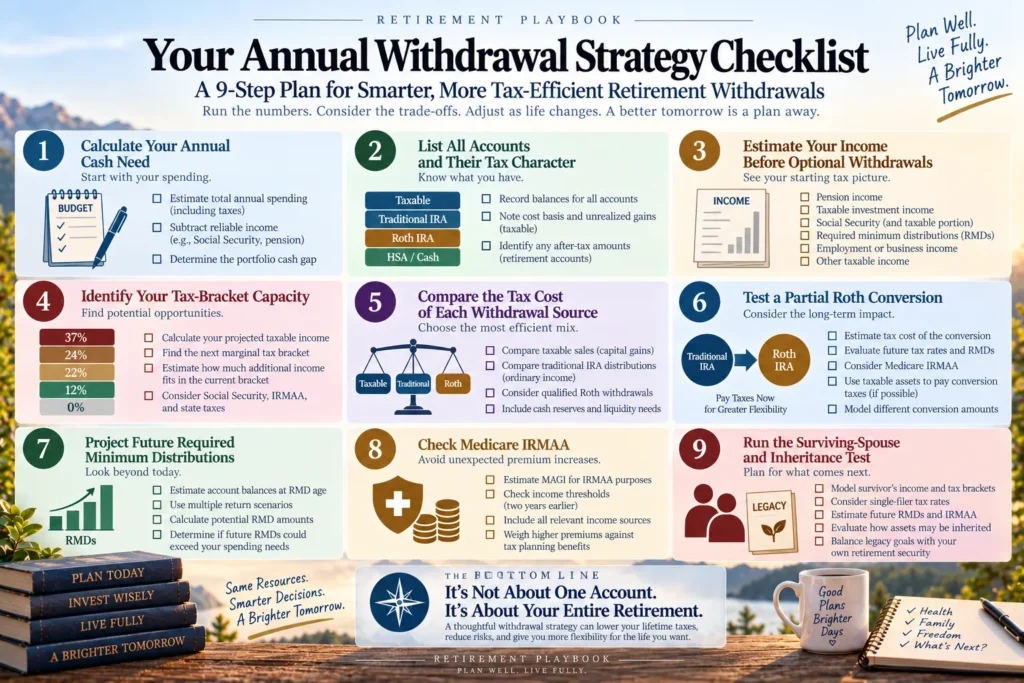
Step 1 — Calculate Your Annual Cash Need
Estimate total household spending, including taxes and known major expenses.
For the medical portion of that spending estimate, our guide to estimating your retirement healthcare costs provides a framework for incorporating premiums, prescriptions, and out-of-pocket expenses before you calculate the amount your investments must provide.
Subtract reliable income that will arrive without discretionary portfolio withdrawals.
The remaining amount is your starting portfolio cash requirement.
If your retirement plan also includes a dedicated reserve for future care, our guide to building a long-term care fund can help you separate those assets from ordinary spending reserves and avoid counting the same money twice.
Step 2 — List Every Account and Its Tax Character
Record balances for:
- taxable brokerage accounts,
- traditional IRAs and 401(k)s,
- Roth IRAs and Roth 401(k)s,
- HSAs,
- cash reserves,
- and other relevant assets.
For taxable investments, record cost basis and unrealized gains.
For traditional retirement accounts, identify any after-tax basis.
Do not assume every account dollar has the same after-tax value.
Step 3 — Estimate Your Income Before Optional Withdrawals
Include expected:
- pension income,
- taxable investment income,
- Social Security benefits and their taxable portion,
- required minimum distributions,
- employment or business income,
- and other taxable income.
This establishes your starting tax picture before you decide which accounts should provide additional cash.
Without this step, you cannot reliably determine whether a traditional IRA withdrawal will fall into a relatively low tax bracket or create an expensive additional tax consequence.
Step 4 — Identify Your Available Tax-Bracket Capacity
Estimate your taxable income after applicable deductions.
Then identify how much additional ordinary income you could recognize before reaching the next relevant marginal tax bracket.
For example, suppose your projected taxable income is $70,000 and the next federal bracket begins at $100,800.
You have approximately:
$30,800 of remaining taxable-income capacity within that bracket.
That does not automatically mean you should withdraw or convert $30,800.
It means you have identified a potential planning opportunity.
Before acting, consider how additional income may affect Social Security taxation, Medicare IRMAA, capital-gains rates, state taxes, and other income-sensitive provisions.
Illustrative example using the 2026 married-filing-jointly 12% bracket ceiling. Actual tax calculations depend on the household’s complete circumstances.
Step 5 — Compare the Tax Cost of Each Withdrawal Source
Now compare your available accounts.
| Withdrawal Source | What to Evaluate |
|---|---|
| Taxable brokerage | Realized gains, cost basis, capital-gains rates, state taxes |
| Traditional IRA / 401(k) | Ordinary-income taxes, future RMDs, IRMAA |
| Qualified Roth IRA | Tax-free flexibility, future growth, legacy value |
| Cash reserves | Liquidity needs, interest income, opportunity cost |
Ask:
Which source can provide the required spending money at the lowest reasonable lifetime cost?
The answer may involve multiple accounts.
For example, you might use taxable investments for most spending while taking a smaller traditional IRA distribution to use available low-bracket capacity.
Or you might use qualified Roth funds in a year when additional ordinary income would be unusually expensive.
The objective is coordination, not rigid sequencing.
Step 6 — Test a Partial Roth Conversion
If you have substantial traditional retirement assets, estimate whether converting part of those assets to Roth could improve your long-term tax position.
Compare:
Tax paid on the conversion today
against:
Potential future taxes and other costs avoided.
Consider:
- your current marginal tax rate,
- expected future ordinary-income rates,
- projected RMDs,
- Medicare IRMAA,
- surviving-spouse taxes,
- beneficiary tax circumstances,
- and the source of cash used to pay conversion taxes.
Do not assume that filling an entire tax bracket with Roth conversions is always optimal.
A conversion can be valuable without being maximized.
Also remember that a Roth conversion is not the same as withdrawing money for spending. The converted assets remain invested in a Roth account unless subsequently distributed.
Step 7 — Project Future Required Minimum Distributions
Estimate traditional retirement account balances at the age when RMDs begin.
Use several investment-return scenarios rather than one optimistic forecast.
For example:
Lower-return scenario
Base-return scenario
Higher-return scenario
Then estimate potential RMDs using the applicable IRS distribution factors.
Ask:
Could future required distributions create substantially more taxable income than we actually need for spending?
If yes, planned earlier distributions or Roth conversions may deserve closer examination.
If no, preserving traditional retirement assets may remain attractive.
Remember that a lower RMD is not automatically evidence of a better strategy. The taxes paid to achieve it must also be considered.
Step 8 — Check Medicare IRMAA Before Finalizing Withdrawals
If you are approaching or already enrolled in Medicare, estimate how your planned taxable income could affect future premiums.
Include:
- traditional IRA distributions,
- Roth conversions,
- realized capital gains,
- pension income,
- taxable investment income,
- and other relevant income.
Because Medicare generally uses tax information from two years earlier, today’s income decisions may affect premiums later.
Do not automatically avoid crossing an IRMAA threshold.
Instead compare the additional Medicare cost with the potential lifetime benefits of the transaction.
Sometimes paying more in Medicare premiums is a reasonable trade-off.
Sometimes it is unnecessary.
The important thing is making the decision deliberately.
Step 9 — Run the Surviving-Spouse Tax Test
If you are married, calculate what your retirement tax situation could look like after the first spouse dies.
Estimate:
- surviving Social Security income,
- continuing pension benefits,
- remaining household spending,
- traditional retirement account balances,
- future RMDs,
- single-filer tax brackets,
- and Medicare IRMAA exposure.
Then ask:
Would recognizing more traditional IRA income during our married years improve the survivor’s future financial position?
This can materially change the value of Roth conversions and early traditional IRA withdrawals.
A strategy that minimizes taxes for the couple today may not minimize taxes for the surviving spouse later.
Step 10 — Consider the After-Tax Inheritance
If leaving assets to heirs is an important goal, evaluate the types of accounts they may inherit.
A traditional IRA can create taxable income for beneficiaries.
A Roth IRA may provide more favorable income-tax treatment for qualified distributions.
Appreciated taxable investments may receive a basis adjustment at death under applicable law.
But inheritance planning should not override your own retirement security.
First ensure the household can comfortably fund retirement spending and potential care needs.
Then consider how remaining assets can be transferred efficiently.
Step 11 — Coordinate Withdrawals With Rebalancing
Your withdrawal strategy should also support your investment allocation.
Suppose stocks have performed strongly and become overweight.
Selling appreciated taxable investments may help fund spending and restore your target allocation.
But significant realized gains could create tax costs.
Alternatively, you may be able to rebalance within a tax-advantaged account and use another source for spending.
Consider both questions:
Which assets should be sold?
Which account should provide the withdrawal?
They are related but not identical.
A good retirement withdrawal plan manages portfolio risk and taxes together.
Step 12 — Compare at Least Three Strategies
Before committing to a withdrawal plan, compare these alternatives:
Strategy A — Traditional Taxable-First
Use taxable assets first, traditional retirement accounts later, and Roth assets last.
Strategy B — Proportional Withdrawals
Use a planned combination of taxable, traditional, and Roth assets.
Strategy C — Tax-Bracket-Aware Withdrawals
Coordinate account withdrawals and potential Roth conversions based on current and projected lifetime taxes.
Compare the strategies using the same assumptions for:
- investment returns,
- spending,
- inflation,
- Social Security,
- tax law,
- healthcare expenses,
- longevity,
- and beneficiary goals.
Measure more than the tax bill in the first year.
Evaluate:
Lifetime taxes
Medicare-related costs
Portfolio sustainability
After-tax assets remaining
Surviving-spouse outcomes
Potential after-tax inheritance
A strategy that saves $2,000 in taxes this year but creates much larger future costs may not be an improvement.
Step 13 — Write Your Withdrawal Policy
Turn the analysis into a short, practical policy.
For example:
Each year, we will calculate our spending needs and projected taxable income before making discretionary retirement withdrawals. We will compare taxable sales, traditional IRA distributions, and qualified Roth withdrawals, consider Roth conversions when appropriate, and review the effects on RMDs, Medicare IRMAA, and the surviving spouse. We will coordinate withdrawals with portfolio rebalancing and revisit the strategy annually.
This is more useful than a rule that simply says:
“Always spend taxable accounts first.”
Your policy should guide decisions without pretending every future year will look the same.
Your One-Page Retirement Withdrawal Plan
A practical annual review might look like this.
| Planning Item | Illustrative Household |
|---|---|
| Annual retirement spending | $90,000 |
| Social Security income | $45,000 |
| Initial portfolio spending gap | $45,000 |
| Taxable brokerage balance | $400,000 |
| Traditional IRA balance | $850,000 |
| Roth IRA balance | $250,000 |
| Total investment assets | $1,500,000 |
| Planned Roth conversion | To be determined |
| Medicare IRMAA review | Required |
| RMD projection | Required |
| Surviving-spouse tax test | Required |
| Withdrawal strategy | Tax-bracket-aware combination |
Illustrative planning worksheet, not a personalized recommendation. The spending gap is before taxes and may differ from the gross withdrawal required.
The next step is to fill in the actual tax calculations.
How much income can be recognized at a favorable rate?
How much capital gain would a taxable sale create?
Would a Roth conversion improve future flexibility?
Could additional income increase Medicare premiums?
What happens after the first spouse dies?
And which withdrawal combination best supports the household’s long-term financial goals?
You don’t need perfect predictions.
You need a repeatable decision process.
One Number to Remember
If there is one number worth calculating each year, it is not simply your required portfolio withdrawal.
It is your:
Marginal All-In Cost of Additional Retirement Income
That includes the federal and state taxes, Medicare premium effects, and other income-sensitive consequences of recognizing additional income.
But even that number is only the beginning.
The lowest immediate marginal cost is not always the lowest lifetime cost.
A Roth conversion may increase taxes today while reducing future obligations.
A taxable sale may create a modest capital gain while preserving valuable tax-deferred assets.
A qualified Roth withdrawal may avoid an expensive income threshold.
And a traditional IRA withdrawal may reduce future RMD pressure.
The best decision depends on how those consequences fit together over time.
The retirement withdrawal question isn’t:
“Which account should I empty first?”
It is:
“Which combination of withdrawals gives my household the most flexibility and financial security over the rest of retirement?”
That’s the decision worth optimizing.
Coming Next
Once you understand which retirement accounts to withdraw from, another question becomes increasingly important:
How do you prevent required minimum distributions from creating an unnecessarily large tax bill later in retirement?
For retirees with substantial traditional IRAs and 401(k)s, RMDs can change the tax picture dramatically.
A retirement plan that looks efficient in your 60s may create higher taxable income in your 70s and 80s.
And the consequences can extend beyond ordinary income taxes.
They may affect Medicare premiums, Social Security taxation, surviving-spouse finances, and the assets ultimately passed to heirs.
In the next Retirement Playbook:
Required Minimum Distributions (RMDs): How to Reduce Taxes Before and After Age 73
We’ll examine how RMDs work, why the applicable starting age matters, how Roth conversions and planned early withdrawals can affect future RMDs, when qualified charitable distributions may help, and how to build an RMD strategy that fits your entire retirement tax plan.
Because the best time to prepare for a required withdrawal may be years before the IRS requires you to take it.